East Village in Des Moines in Polk County, Iowa — The American Midwest (Upper Plains)
Cambodia
| — | Robert D. Ray Asian Garden | — |
Photographed by McGhiever, November 6, 2022
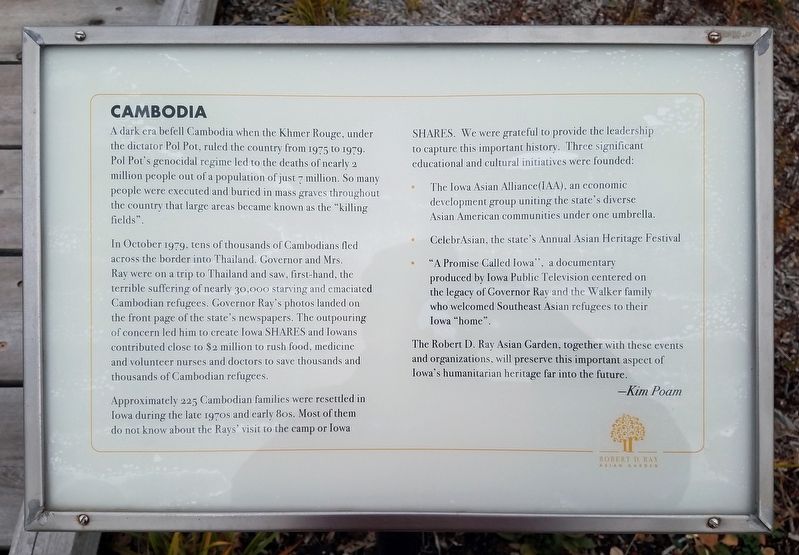
1. Cambodia Marker
A dark era befell Cambodia when the Khmer Rouge, under the dictator Pol Pot, ruled the country from 1975 to 1979. Pol Pot's genocidal regime led to the deaths of nearly 2 million people out of a population of just 7 million. So many people were executed and buried in mass graves throughout the country that large areas became known as the "killing fields".
In October 1979, tens of thousands of Cambodians fled across the border into Thailand. Governor and Mrs. Ray were on a trip to Thailand and saw, first-hand, the terrible suffering of nearly 30,000 starving and emaciated Cambodian refugees. Governor Ray's photos landed on the front page of the state's newspapers. The outpouring of concern led him to create Iowa SHARES and Iowans contributed close to $2 million to rush food, medicine and volunteer nurses and doctors to save thousands and thousands of Cambodian refugees.
Approximately 225 Cambodian families were resettled in Iowa during the late 1970s and early 80s. Most of them do not know about the Rays' visit to the camp or Iowa SHARES. We were grateful to provide the leadership to capture this important history.
this page online
• The Iowa Asian Alliance (IAA), an economic development group uniting the state's diverse Asian American communities under one umbrella.
• CelebrAsian, the state's Annual Asian Heritage Festival
• "A Promise Called Iowa", a documentary produced by Iowa Public Television centered on the legacy of Governor Ray and the Walker family who welcomed Southeast Asian refugees to their Iowa "home".
The Robert D. Ray Asian Garden, together with these events and organizations, will preserve this important aspect of Iowa's humanitarian heritage far into the future.
–Kim Poam
Topics. This historical marker is listed in these topic lists: Asian Americans • Charity & Public Work • Disasters • Immigration. A significant historical month for this entry is October 1979.
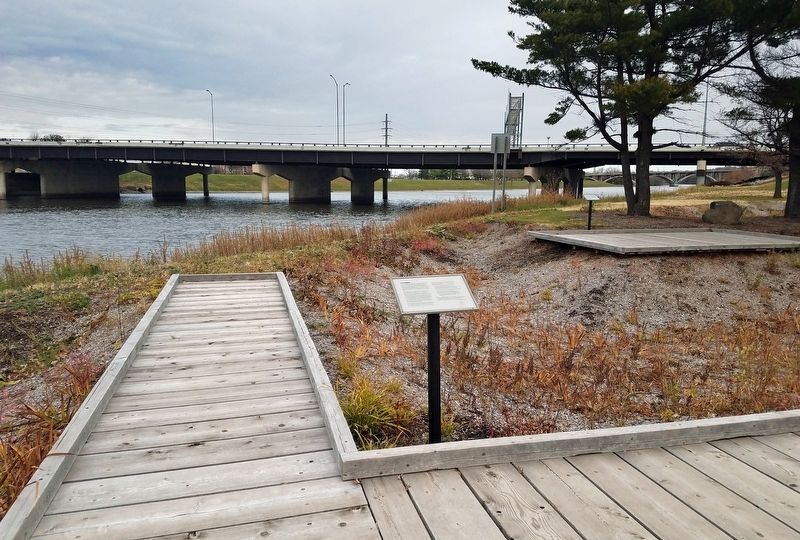
Location. 41° 35.666′ N, 93° 37.002′ W. Marker is in Des Moines, Iowa, in Polk County. It is in East Village. It can be reached from the intersection of Robert D. Ray Drive and Maple Street, on the right when traveling south. The marker is at the north end of the Robert D. Ray Asian Garden. Touch for map.
Photographed by McGhiever, November 6, 2022
2. Cambodia Marker at the north end of the Robert D. Ray Asian Garden

Regionally, this marker is in the American Midwest and in the Corn Belt. Globally, it is in North America, the Western Hemisphere, the Western World, and the Anglosphere. Historically, it finds itself in what was once the territory of the Mississippian Culture and also the Louisiana Purchase.
Other nearby markers. At least 8 other markers are within walking distance of this marker: Laos (a few steps from this marker); Hmong (a few steps from this marker); Governor Robert D. Ray, 1928-2018 (within shouting distance of this marker); Tai Dam (about 300 feet away, measured in a direct line); Vietnam (about 300 feet away); Robert D. Ray Asian Garden (about 500 feet away); a different marker also named Robert D. Ray Asian Garden (about 600 feet away); The First Licensed Ferry (approx. 0.3 miles away). Touch for a list and map of all markers in Des Moines.
Additional keywords. genocide
Credits. This page was last revised on September 26, 2024. It was originally submitted on December 18, 2023, by McGhiever of Minneapolis, Minnesota. This page has been viewed 214 times since then and 20 times this year. Photos: 1, 2. submitted on December 18, 2023, by McGhiever of Minneapolis, Minnesota. • Andrew Ruppenstein was the editor who published this page.
