Loop District in Chicago in Cook County, Illinois — The American Midwest (Great Lakes)
Fine Arts Building
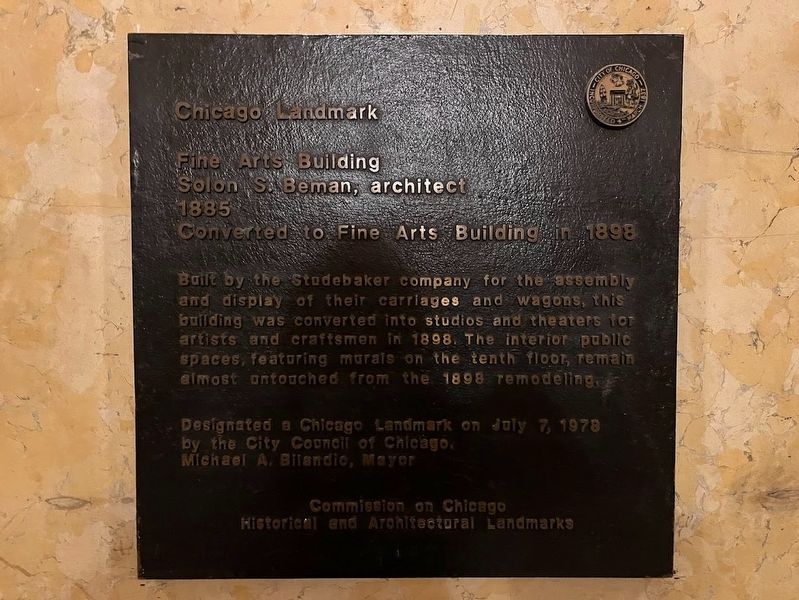
Solon S. Beman, architect; 1885; converted to Fine Arts Building in 1898
| — | Chicago Landmark | — |
Photographed by Sean Flynn
1. Fine Arts Building Marker
Built by the Studebaker company for the assembly and display of their carriages and wagons, this building was converted into studios and theaters for artists and craftsmen in 1898. The interior public spaces, featuring murals on the tenth floor, remain almost untouched from the 1898 remodeling.
Designated a Chicago Landmark on July 7, 1978
by the City Council of Chicago.
Michael A. Bilandio, Mayor
Erected 1978 by Commission on Chicago Historical and Architectural Landmarks; City of Chicago.
Topics and series. This historical marker is listed in these topic lists: Architecture • Arts, Letters, Music • Industry & Commerce • Roads & Vehicles. In addition, it is included in the Illinois, Chicago Landmarks Commission series list. A significant historical year for this entry is 1885.
Location. 41° 52.585′ N, 87° 37.47′ W. Marker is in Chicago, Illinois, in Cook County. It is in the Loop District. It can be reached from South Michigan Avenue north of East Ida B. Wells Drive, on the right when traveling south. The marker is inside the lobby of the Fine Arts Building, in the middle of the elevator bank,
this page online

Regionally, this marker is in Chicago’s Loop. It is also in the American Midwest. Globally, it is in North America, on the Great Lakes, in the Western Hemisphere, in the Western World, and in the Anglosphere. Historically, it finds itself in what was once the Viceroyalty of New France, the territory of the Mississippian Culture, and the Northwest Territory.
Other nearby markers. At least 8 other markers are within walking distance of this marker: Bertha Van Hoosen, M.D. (here, next to this marker); Auditorium Building (within shouting distance of this marker); Historic Michigan Boulevard (within shouting distance of this marker); a different marker also named Auditorium Building (about 400 feet away, measured in a direct line); a different marker also named Historic Michigan Boulevard (about 400 feet away); Diosa (Jasmina Cazucu) (about 700 feet away); Leiter II Building (approx. 0.2 miles away); Steger Building
Photographed by Sean Flynn, December 5, 2023
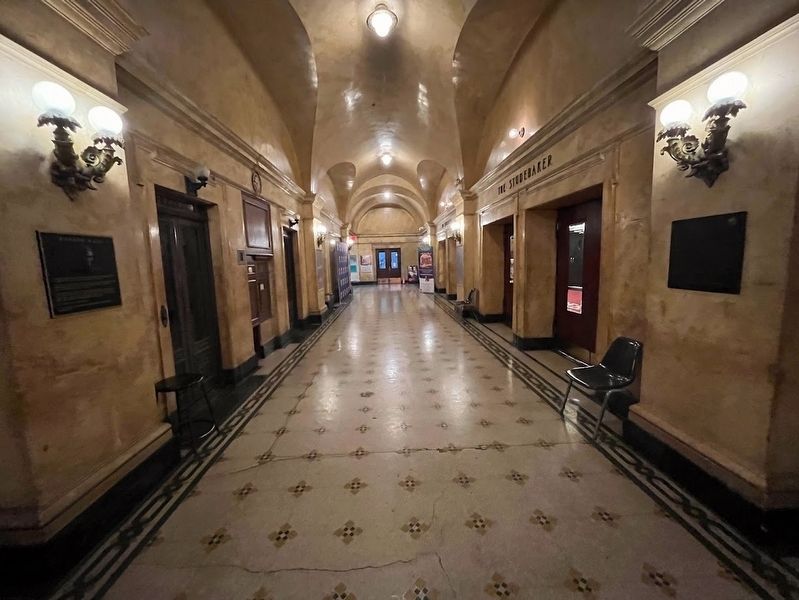
2. Fine Arts Building marker and lobby
The marker is on the right side of this photo; to the left is a marker in honor of Tommy Durkin, an elevator operator at the Fine Arts Building for 60 years.
Regarding Fine Arts Building. Studebaker Brothers Carriages and Wagons, founded in South Bend, Indiana, opened this building as a Chicago outpost of its business, but it outgrew space within a decade. In 1895 it opened a new factory and showroom about three blocks southwest of here, at at 623 S. Wabash. That building, also designed by Solon Beman, would later become the headquarters of the Brunswick Corporation and is used today by Columbia College.
Upon moving out, Studebaker invested $500,000 to remodel the building as an artists' hub with studios, offices and theaters. The building, 125 years later, remains a prime location for artists and art organizations. A renovation of the Studebaker Theater, which opened in 1898, was completed in 2022 and the theater has become the home of NPR's "Wait Wait... Don't Tell Me!"
Also see . . .
1. Fine Arts Building History. (Submitted on December 7, 2023, by Sean P. Flynn of Oak Park, Illinois.)
2. Bygone-era Fine Arts Building elevators will soon be gone. Chicago Sun-Times article about the eventual
Photographed by Sean Flynn, December 5, 2023
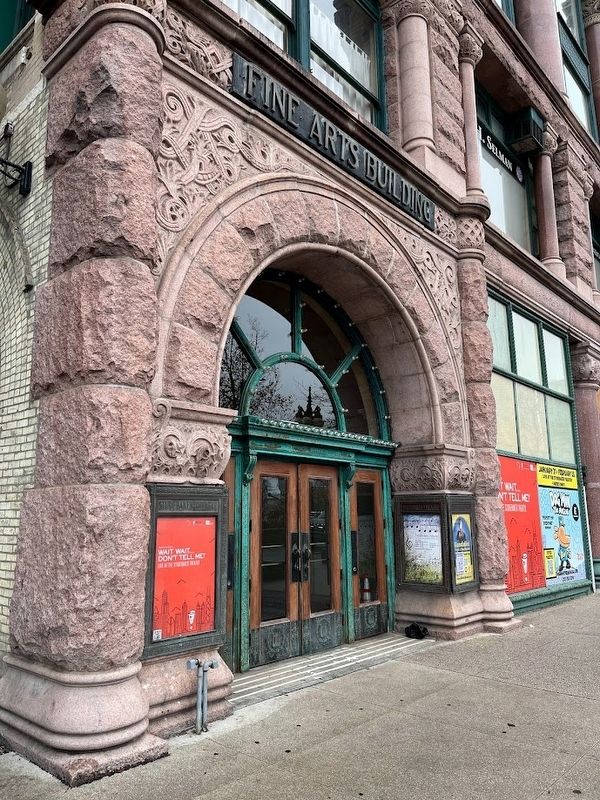
3. Fine Arts Building
The building's south entrance
Photographed by Sean Flynn, December 5, 2023
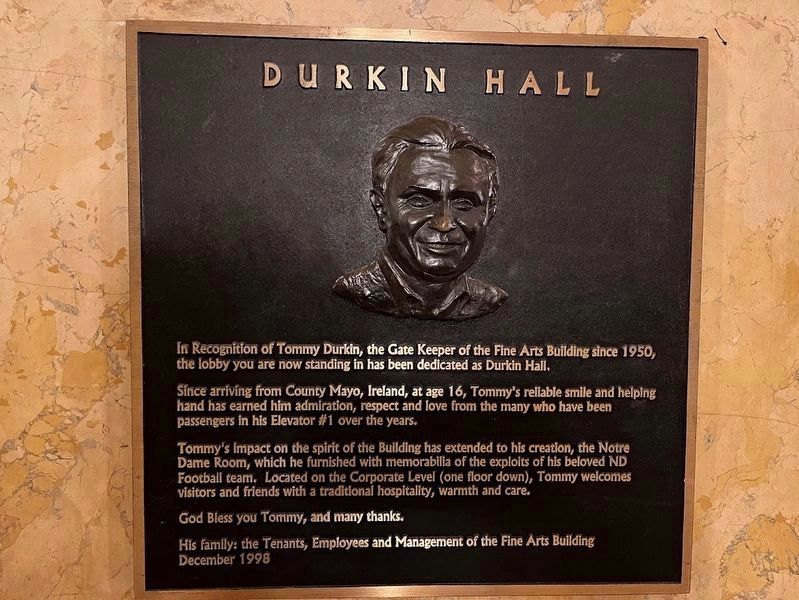
4. Tommy Durkin marker
A marker dedicated in 1998 to Tommy Durkin, a long-time elevator operator at the Fine Arts Building. Durkin worked in the building from 1950 until 2010; he died in 2013. In 2023, the building announced that it would finally replace its human-operated elevators, which date back to the 1890s.
The text of the marker:
Durkin Hall
In Recognition of Tommy Durkin, the Gate Keeper of the Fine Arts Building since 1950, the lobby you are now standing in has been dedicated as Durkin Hall.
Since arriving from County Mayo, Ireland, at age 16, Tommy's reliable smile and helping hand has earned him admiration, respect and love from the many who have been passengers in his Elevator #1 over the years.
Tommy's impact on the spirit of the Building has extended to his creation, the Notre Dame Room, which he furnished with memorabilia of the exploits of his beloved ND Football team. Located on the Corporate Level (one floor down), Tommy welcomes visitors and friends with a traditional hospitality, warmth and care.
God Bless you Tommy, and many thanks.
His family: the Tenants, Employees and Management of the Fine Arts Building
December 1998
The text of the marker:
In Recognition of Tommy Durkin, the Gate Keeper of the Fine Arts Building since 1950, the lobby you are now standing in has been dedicated as Durkin Hall.
Since arriving from County Mayo, Ireland, at age 16, Tommy's reliable smile and helping hand has earned him admiration, respect and love from the many who have been passengers in his Elevator #1 over the years.
Tommy's impact on the spirit of the Building has extended to his creation, the Notre Dame Room, which he furnished with memorabilia of the exploits of his beloved ND Football team. Located on the Corporate Level (one floor down), Tommy welcomes visitors and friends with a traditional hospitality, warmth and care.
God Bless you Tommy, and many thanks.
His family: the Tenants, Employees and Management of the Fine Arts Building
December 1998
Photographed by Sean Flynn, December 5, 2023
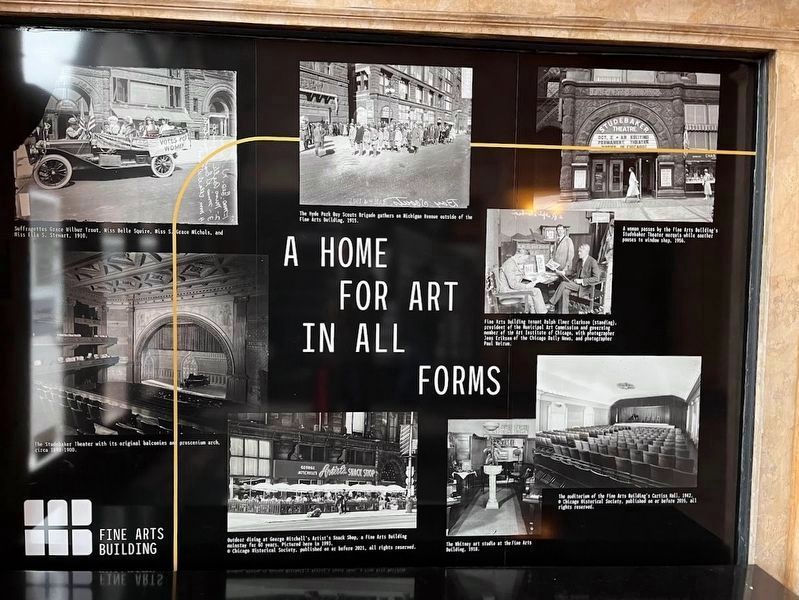
5. "A home for art in all forms"
This sign, in the building's north lobby, shows historical photos of the building, both inside of it and outside. Two photos on the top row highlight the building's role in the women's suffrage movement; the Illinois Equal Suffrage Association, led by Grace Wilbour Trout, was headquartered in this building from 1910 until 1919 — the year that Illinois became the first state to ratify the 19th Amendment granting women the right to vote.
Photographed by Sean Flynn, December 5, 2023
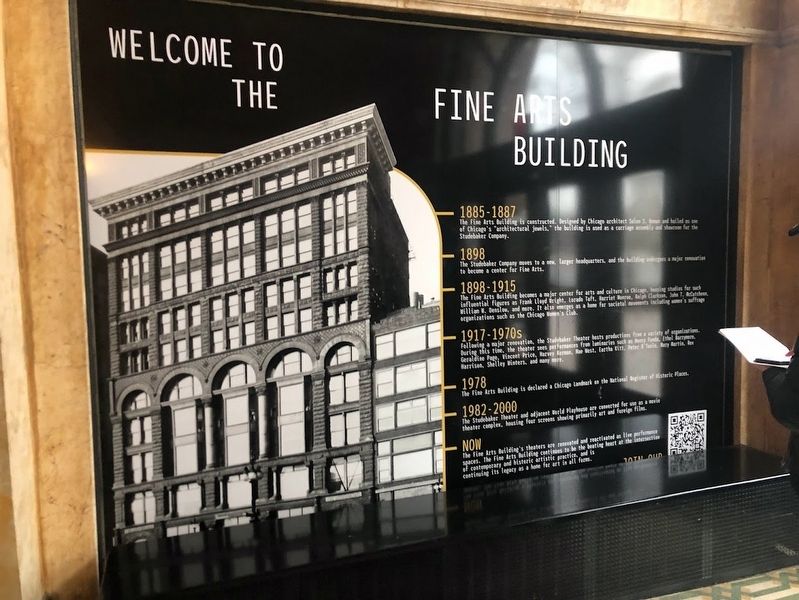
6. "Welcome to the Fine Arts Building"
This sign in the building's north lobby includes a timeline of the building's history.
Barnes-Crosby Company, courtesy of Chicago History Museum, circa 1903
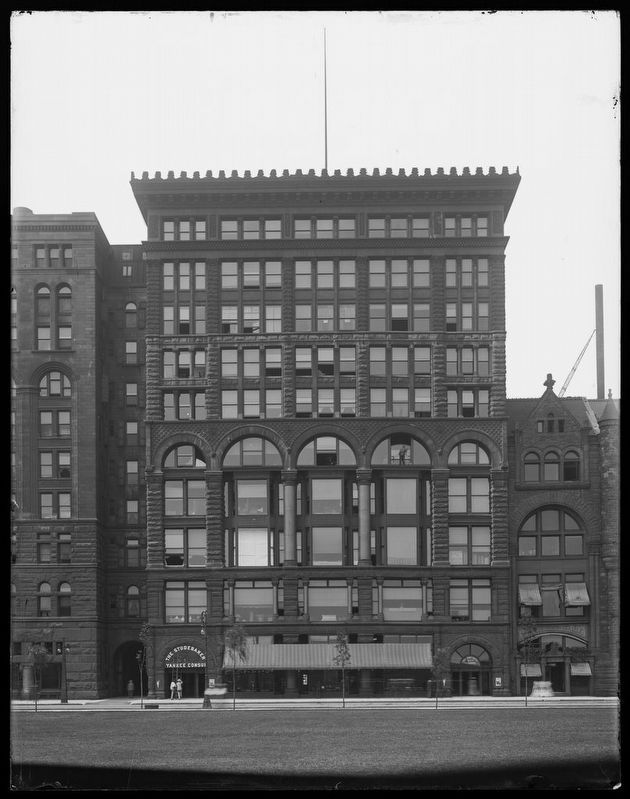
7. Fine Arts Building
In this early 20th century photo, the name of the building’s original owner, Studebaker, can be seen at the entrance to what is now known as the Fine Arts Building.
Credits. This page was last revised on August 26, 2024. It was originally submitted on December 7, 2023, by Sean P. Flynn of Oak Park, Illinois. This page has been viewed 516 times since then and 43 times this year. Last updated on December 19, 2023, by Sean P. Flynn of Oak Park, Illinois. Photos: 1, 2, 3, 4, 5, 6. submitted on December 7, 2023, by Sean P. Flynn of Oak Park, Illinois. 7. submitted on March 6, 2024, by Sean P. Flynn of Oak Park, Illinois. • Devry Becker Jones was the editor who published this page.
