Dickinson in Stark County, North Dakota — The American Midwest (Upper Plains)
The Place
Photographed by Cosmos Mariner, August 23, 2023
1. The Place Marker
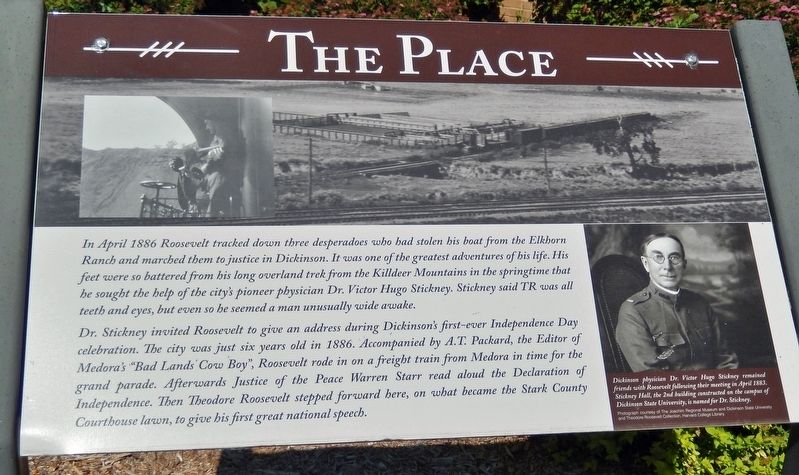
In April 1886 Roosevelt tracked down three desperadoes who had stolen his boat from the Elkhorn Ranch and marched them to justice in Dickinson. It was one of the greatest adventures of his life. His feet were so battered from his long overland trek from the Killdeer Mountains in the springtime that he sought the help of the city’s pioneer physician Dr. Victor Hugo Stickney. Stickney said TR was all teeth and eyes, but even so he seemed a man unusually wide awake.
Dr. Stickney invited Roosevelt to give an address during Dickinson's first-ever Independence Day celebration. The city was just six years old in 1886. Accompanied by A.T. Packard, the Editor of Medora’s “Bad Lands Cow Boy”, Roosevelt rode in on a freight train from Medora in time for the grand parade. Afterwards Justice of the Peace Warren Starr read aloud the Declaration of Independence. Then Theodore Roosevelt stepped forward here, on what became the Stark County Courthouse lawn, to give his first great national speech.
Topics and series. This historical marker is listed in these topic lists: Communications • Law Enforcement • Settlements & Settlers.
this page online
Location. 46° 52.919′ N, 102° 47.075′ W. Marker is in Dickinson, North Dakota, in Stark County. It is on 3rd Street East just east of Sims Street, on the left when traveling east. The marker is located on the Stark County Courthouse grounds, directly in front of the courthouse. Touch for map. Marker is at or near this postal address: 51 3rd Street East, Dickinson ND 58601, United States of America. Touch for directions.

Regionally, this marker is on the Missouri Plateau. It is also in the American Lewis & Clark Corridor, on the prairies, and on the Northern Plains. Globally, it is in North America, the Western Hemisphere, the Western World, and the Anglosphere. Historically, it finds itself in what was once Rupert’s Land and also the Louisiana Purchase.
Other nearby markers. At least 7 other markers are within walking distance of this marker: The Man (here, next to this marker); The Speech (here, next to this marker); Stark County Veterans Memorial (a few steps from this marker); SPC Jon Paul Fettig
Theodore Roosevelt Collection, Harvard College Library
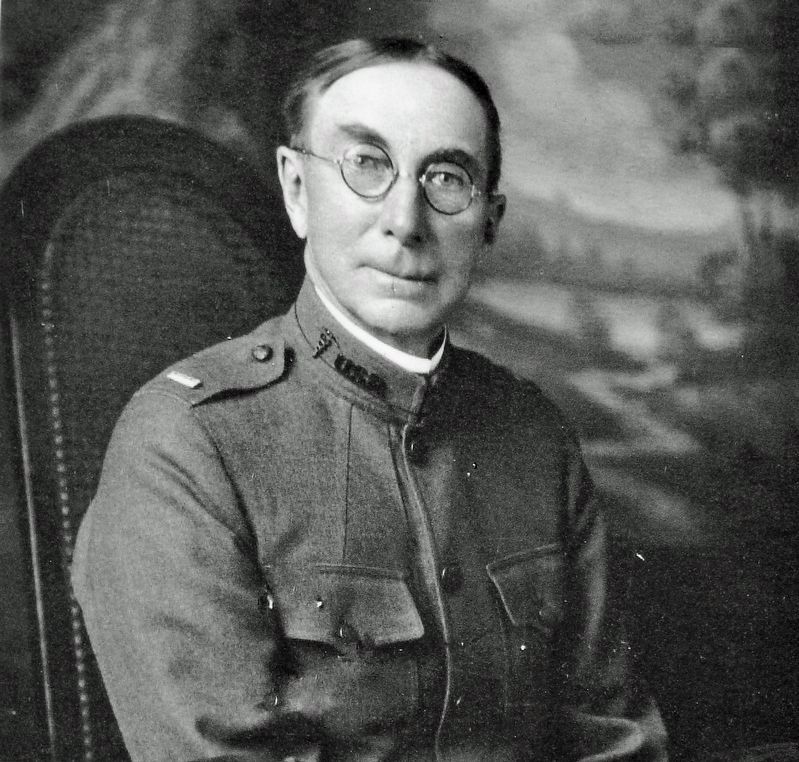
2. Marker detail: Dr. Victor Hugo Stickney
Dickinson physician Dr. Victor Hugo Stickney remained friends with Roosevelt following their meeting in April 1883. Stickney Hall, the 2nd building constructed on the campus of Dickinson State University, is named for Dr. Stickney.
Photograph courtesy of The Joachim Regional Museum and Dickinson State University and Theodore Roosevelt Collection, Harvard College Library.
Related markers. Click here for a list of markers that are related to this marker.
Also see . . .
1. Roosevelt Pursues the Boat Thieves (National Park Service). Excerpt:
Theodore Roosevelt was particularly fond of retelling the story of his pursuit and capture of the boat thieves in the badlands. He put the story on paper in his 1888 book Ranch Life and the Hunting Trail. In early spring of 1886, just as the ice was beginning to break up on the Little Missouri River, three thieves cut Roosevelt’s boat from its mooring at the Elkhorn Ranch and took it downriver. Roosevelt, out of personal pride and duty as a Billings County Deputy Sheriff, chased after them with his ranch hands Bill Sewall and Wilmot Dow.(Submitted on December 21, 2023, by Cosmos Mariner of Cape Canaveral, Florida.)
2. Victor Hugo Stickney. Excerpt:
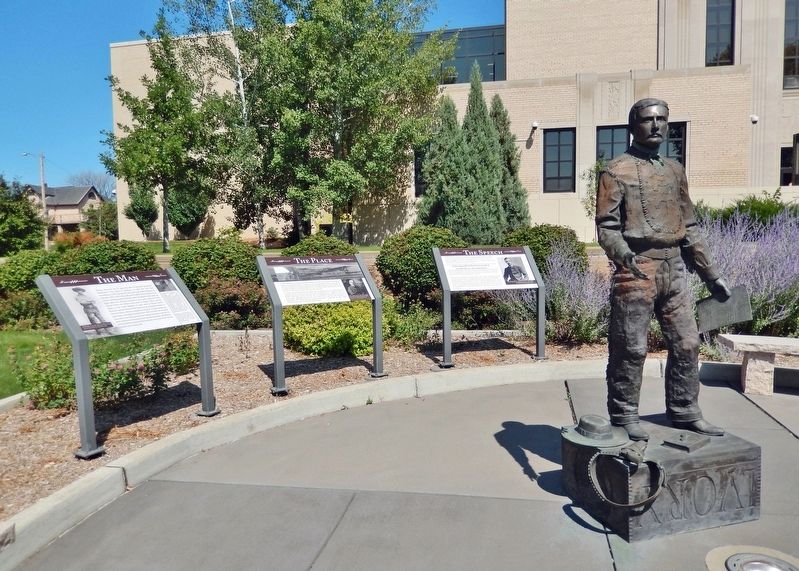
Dr. Victor Hugo Stickney was the only doctor in western Dakota Territory during Roosevelt’s years in the badlands. Born in Plymouth, Vermont, on(Submitted on December 21, 2023, by Cosmos Mariner of Cape Canaveral, Florida.)April 13, 1855, Stickney came to Dakota Territory in 1883, after finishing his medical training at Dartmouth Medical School. Stickney had a reputation for being willing to travel long distances on horseback or in a buckboard, and sometimes on a freight train or hand-car, to get to his far-flung patients. He was one of the first ten individuals to be inducted into the National Cowboy Hall of Fame. He is memorialized on the campus of Dickinson State University in the naming of one of its first buildings, constructed in 1921, Stickney Hall.Photographed by Cosmos Mariner, August 23, 20233. The Place MarkerLooking north. Marker is the center of three related markers beside the Theodore Roosevelt sculpture. Stark County Courthouse is in the background.
Credits. This page was last revised on July 17, 2025. It was originally submitted on December 21, 2023, by Cosmos Mariner of Cape Canaveral, Florida. This page has been viewed 318 times since then and 37 times this year. Photos: 1, 2, 3. submitted on December 21, 2023, by Cosmos Mariner of Cape Canaveral, Florida.
