Ban Tai in Amphoe Mueang Kanchanaburi, Kanchanaburi, Thailand — ประเทศไทย (Southeast Asia, Indochinese Peninsula)
Takashi Nagase (Fujiwara)
永瀬 隆
Photographed by Jj Karwacki
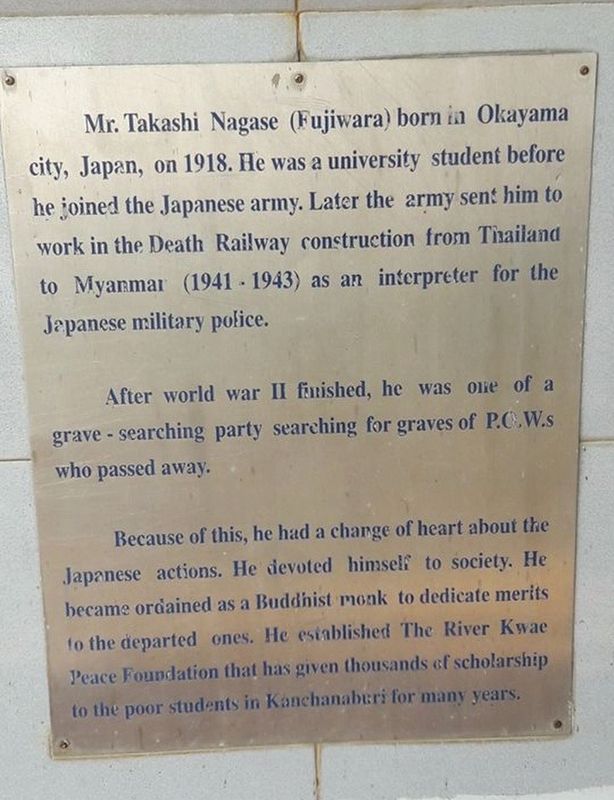
1. Takashi Nagase (Fujiwara) Marker
After world war II finished, he was one of a grave-searching party searching for graves of P.O.W.s who passed away.
Because of this, he had a change of heart about the Japanese actions. He devoted himself to society. He became ordained as a Buddhist monk to dedicate merits to the departed ones. He established The River Kwae Peace Foundation that has given thousands of scholarship to the poor students in Kanchanaburi for many years.
Topics and series. This historical marker is listed in these topic lists: Charity & Public Work • Peace. In addition, it is included in the The Thailand-Burma Railway series list. A significant historical year for this entry is 1918.
Location. 14° 0.978′ N, 99° 31.84′ E. Marker is in Ban Tai, Kanchanaburi, in Amphoe Mueang Kanchanaburi. It can be reached from the intersection of Pakprak Road
this page online

Regionally, it is in Asia, specifically in Southeast Asia, in IndoChina, on the Bay of Bengal, and on the Pacific Rim.
Other nearby markers. At least 8 other markers are within 3 kilometers of this marker, measured as the crow flies: The JEATH War Museum (a few steps from this marker); The Tomb of 10,000 Souls (approx. 1.6 kilometers away); Memorial to Dutch Prisoners of War (approx. 1.7 kilometers away); Tribute to Royal Dutch East Indies Army and the Royal Netherlands Navy Personnel Who Perished (approx. 1.8 kilometers away); That Valiant Company Who Perished While Building the Railway (approx. 1.8 kilometers away); Kanchanaburi War Cemetery (approx. 1.8 kilometers away); The Kanchanaburi Memorial (approx. 1.8 kilometers away); Chungkai War Cemetery (approx. 2 kilometers away). Touch for a list and map of all markers in Ban Tai.
Also see . . . Wikipedia entry for Takashi Nagase. Excerpt:
Nagase(Submitted on December 28, 2023.)was born in 1918 in Kurashiki, Okayama, Japan and learned English at an American Methodist college in Tokyo. He joined the Imperial Japanese Army during World War II, and became an interpreter for the Kempeitai at the construction of the Burma Railway, known for its brutal conditions leading to the deaths of over 12,000 Allied prisoners of war and 90,000 Asian labourers or romusha. Nagase was involved in the interrogation and torture of many Allied POWs. Following Japan's surrender, Nagase spent seven weeks working for the Allied War Graves Commission as a volunteer, helping recover bodies for proper burial. After returning to Japan, he founded an English-language school in Kurashiki. ...Photographed by Jj Karwacki2. Mr. Takashi Nagase (1918–2011)
Nagase was also noted for his reconciliation with former British Army officer Eric Lomax, whom he interrogated and tortured at a Japanese prisoner-of-war camp in 1942. Lomax then went on to discuss his reconciliation and eventual friendship with Nagase in his autobiography, The Railway Man. ... Nagase also wrote a book on his own experiences during and after the war entitled Crosses and Tigers, and financed a Buddhist temple at the bridge to atone for his actions during the war. The reconciliation between the two men was filmed as a documentary Enemy, My Friend? (1995), directed by Mike Finlason.
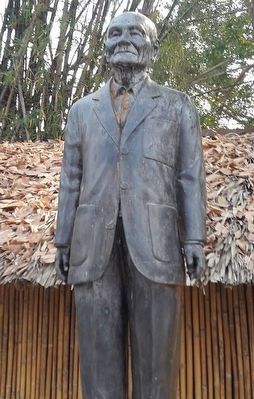
After the end of the Second World War, Takashi Nagase became a devout Buddhist priest and tried to atone for the Japanese army's treatment of prisoners of war. He made more than 100 missions of atonement to the River Kwai in Thailand. He died in 2011 in Kurashiki, Japan.
Photographed by Jj Karwacki
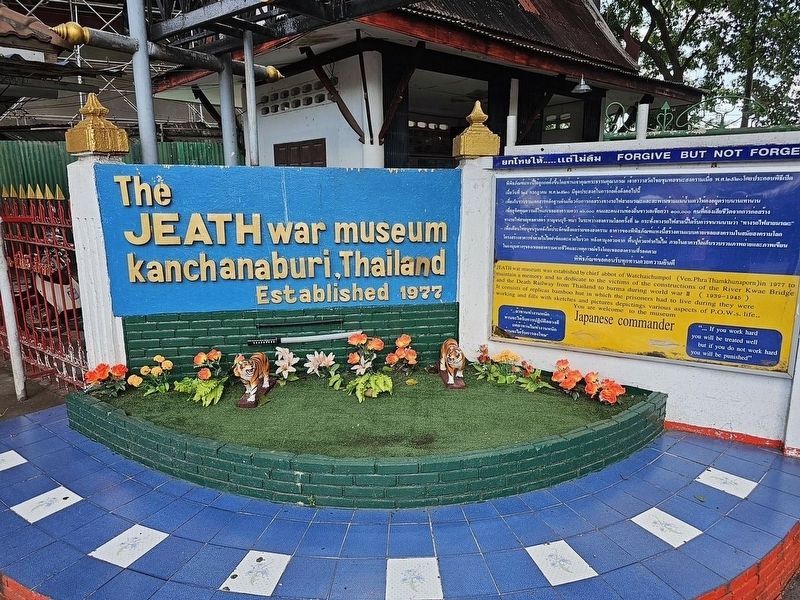
3. The JEATH War Museum Entrance
Credits. This page was last revised on July 7, 2024. It was originally submitted on December 28, 2023, by Jj Karwacki of Tha Maka, Kanchanaburi. This page has been viewed 665 times since then and 62 times this year. Photos: 1, 2, 3. submitted on December 28, 2023, by Jj Karwacki of Tha Maka, Kanchanaburi. • J. J. Prats was the editor who published this page.
Editor’s want-list for this marker. A wide shot of this marker showing it in its surroundings • Can you help?
