Ban Tai in Amphoe Mueang Kanchanaburi, Kanchanaburi, Thailand — ประเทศไทย (Southeast Asia, Indochinese Peninsula)
The JEATH War Museum
Forgive But Not Forget

Photographed by Jj Karwacki
1. The JEATH War Museum Marker
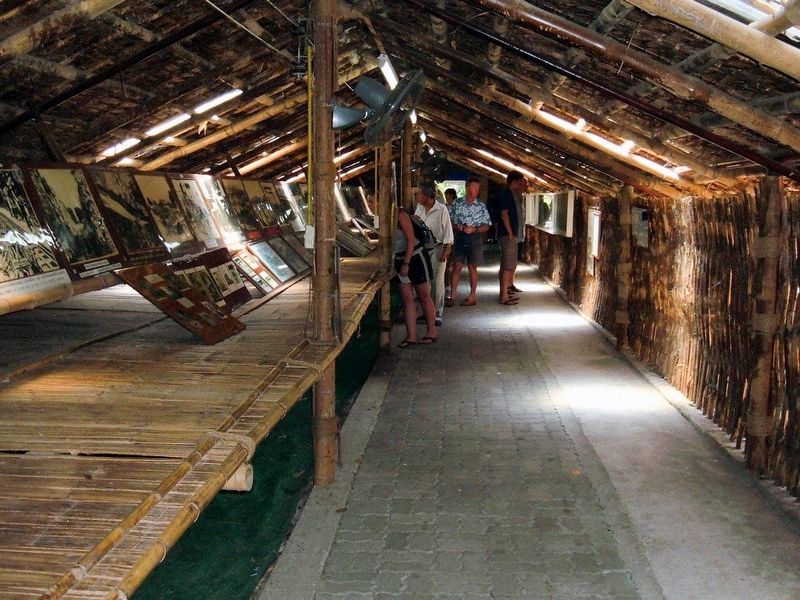
It consists of replica bamboo huts in which the prisoners had to live during they were working and are filled with sketches and pictures depicting various aspects of P.O.W.s. life...
You are welcome to the museum.
Japanese commander: “If you work hard you will be treated well but if you do not work hard you will be punished.”
(inscription in Thai could not be transcribed)
Topics and series. This historical marker is listed in this topic list: War, World II. In addition, it is included in the The Thailand-Burma Railway series list. A significant historical date for this entry is December 25, 1943.
Location. 14° 0.974′ N, 99° 31.843′ E. Marker is in Ban Tai, Kanchanaburi, in Amphoe Mueang Kanchanaburi. It is at the intersection of Pakprak Rd and Wisutarangsri Road on Pakprak Rd. Touch for map. Marker is at or near this postal address: 189 Pakprak
this page online

Regionally, it is in Asia, specifically in Southeast Asia, in IndoChina, on the Bay of Bengal, and on the Pacific Rim.
Other nearby markers. At least 8 other markers are within 3 kilometers of this marker, measured as the crow flies: Takashi Nagase (Fujiwara) (a few steps from this marker); The Tomb of 10,000 Souls (approx. 1.6 kilometers away); Memorial to Dutch Prisoners of War (approx. 1.7 kilometers away); Tribute to Royal Dutch East Indies Army and the Royal Netherlands Navy Personnel Who Perished (approx. 1.8 kilometers away); That Valiant Company Who Perished While Building the Railway (approx. 1.8 kilometers away); Kanchanaburi War Cemetery (approx. 1.8 kilometers away); The Kanchanaburi Memorial (approx. 1.8 kilometers away); Chungkai War Cemetery (approx. 2 kilometers away). Touch for a list and map of all markers in Ban Tai.
Regarding The JEATH War Museum. The museum is located on the site of one of the many POW cemeteries in Kanchanaburi. It details the history of the Thailand to Burma railway link known as the Death Railway.
Excerpts from an English

Photographed by Jj Karwacki
2. The JEATH War Museum Marker at Entrance
We call it the JEATH museum for the abbreviation of the names of the six countries involved: Japan, England, America and Australia, Thailand, and Holland. The Japanese were the controllers of the railway project, Thailand was involved as the conquered country and the other four countries were involved as PoWs on the actual construction of the 415 kilometre long Death Railway and the bridge over the River Kwae.
The word JEATH also replaces the word Death because it sounds too horrific. ...
Construction began on September 16, 1942 at Nong Pladuk, Thailand, by approximately 30,000 prisoners of war from the aforementioned countries and more than 200,000 impressed labourers from India, China, Indonesia, Malaysia, Singapore, Burma, and Thailand. Of these, more than 16,000 PoWs and 100,000 impressed labourers died of many diseases, due to starvation and lack of medical equipment.
It is said that the first survey by the Japanese engineers predicted that it would take at least five years to finish the railway line, but the Japanese army forced the prisoners to complete it in only sixteen months. Thusit was completed on 25 December 1945.Photographed by Jj Karwacki3. Inside one of the Huts in the Museum
Additional commentary.
1. built over a former cemetery
During the time when the Thai-Burma Railway workers were consolidated to the area of Kanchanaburi City, there were at least 8 different cemeteries. This museum is built on the site of one of these. It was one of the smaller ones, likely established in 1945. The remains there would have been moved to the main war graves cemetery at Don Rak.
— Submitted December 28, 2023, by Jj Karwacki of Tha Maka, Kanchanaburi.
2. the original museum
This is indeed the original JEATH museum; the one that invented the unique name. In the early 2000s, a second museum was opened near the famous Bridge. It plagiarized the name and in many tourist posts these are treated as one and the same. They are not! This original museum is a testimony to the hardships and fortitude of the POWs. The other is a for-profit tourist trap.
— Submitted December 28, 2023, by Jj Karwacki of Tha Maka, Kanchanaburi.

Photographed by Jj Karwacki
4. The JEATH War Museum Sign
A sign inside the open-air the museum. The English text reads,
Constructed in 1977 in ‘U’ architectural plan imitating a prisoner’s camp, the museum exhibits the paintings and the illustrations of the Death Railway construction events; the process of the construction and the prisoner’s lives.
In the Japanese Army camp during the World War II (1943 A.D.) it also displays their belongings. For example, clothes, knives, walkie talkie, as well as various types of bombs.

Photographed by Jj Karwacki
5. The JEATH War Museum Sign
A sign inside the open-air the museum. The English text reads,
Situated about 500 m. from TAT office in the area of chai Chumphon Temple, the bamboo hut has been constructed in the form of a prisoner of war camp, and contains photographic, pictorial and physical memorabilia dating from WW II.
Tourism Authority of Thailand

Photographed by Jj Karwacki
6. Peace Monument in the JEATH War Museum

Photographed by Jj Karwacki
7. The JEATH War Museum Watergate and Dock
Credits. This page was last revised on December 29, 2023. It was originally submitted on December 28, 2023, by Jj Karwacki of Tha Maka, Kanchanaburi. This page has been viewed 456 times since then and 81 times this year. Photos: 1, 2, 3, 4, 5, 6, 7. submitted on December 28, 2023, by Jj Karwacki of Tha Maka, Kanchanaburi. • J. J. Prats was the editor who published this page.
