South Orange in Essex County, New Jersey — The American Northeast (Mid-Atlantic)
SOPAC Sundial
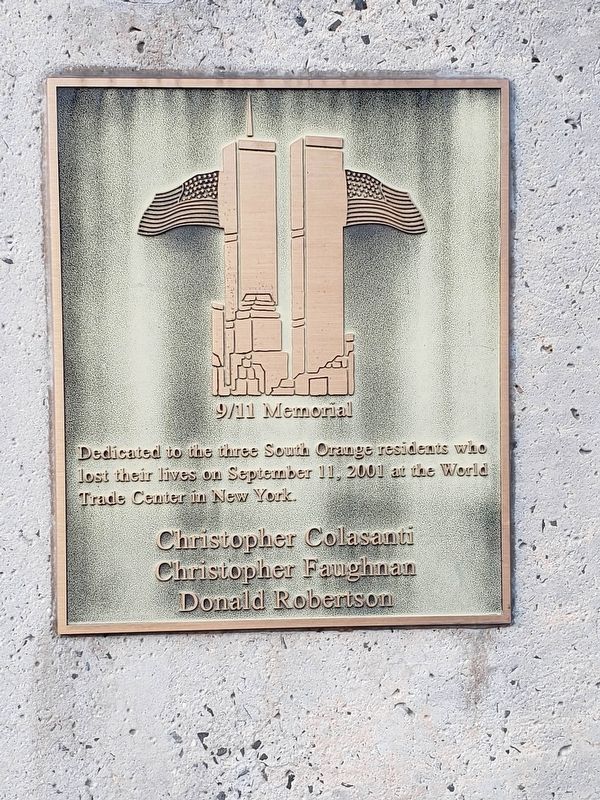
9/11 Memorial
Photographed by Bryn Douds, March 8, 2021
1. 9/11 Memorial
Dedicated to the three South Orange residents who lost their lives on September 11, 2001 at the World Trade Center in New York.
Christopher Colasanti · Christopher Faughnan · Donald Robertson
Topics. This historical marker is listed in this topic list: 9/11 Attacks. A significant historical date for this entry is September 11, 2001.
Location. 40° 44.757′ N, 74° 15.674′ W. Marker is in South Orange, New Jersey, in Essex County. It can be reached from SOPAC Way (County Route 510) south of S Orange Avenue, on the left when traveling west. Marker is in front of SOPAC (South Orange Performing Arts Center); one block south of South Orange Avenue, just west of the train tracks. Touch for map. Marker is at or near this postal address: One SOPAC Way, South Orange NJ 07079, United States of America. Touch for directions.

Regionally, this marker is in New Jersey’s North Jersey, in Greater Newark, and in the New York City Metropolitan Area. It is also in the American Northeast, in the Mid-Atlantic, and on the Eastern Seaboard. Globally, it is in the North Atlantic Region, North America, the Western Hemisphere, the Western World,
this page online
Other nearby markers. At least 8 other markers are within walking distance of this marker: South Orange War Memorial (approx. 0.2 miles away); South Orange Memorial Rock - WWII (approx. ¼ mile away); South Orange Memorial Rock - Viet Nam War (approx. ¼ mile away); South Orange Memorial Rock - Operation Iraqi Freedom (approx. ¼ mile away); South Orange Memorial Rock - Korean Conflict (approx. ¼ mile away); Cameron Field (approx. ¼ mile away); Tau / Tony Smith (approx. 0.3 miles away); Meadowland Park Lake (approx. 0.3 miles away). Touch for a list and map of all markers in South Orange.
More about this marker.
( plaque at the base )
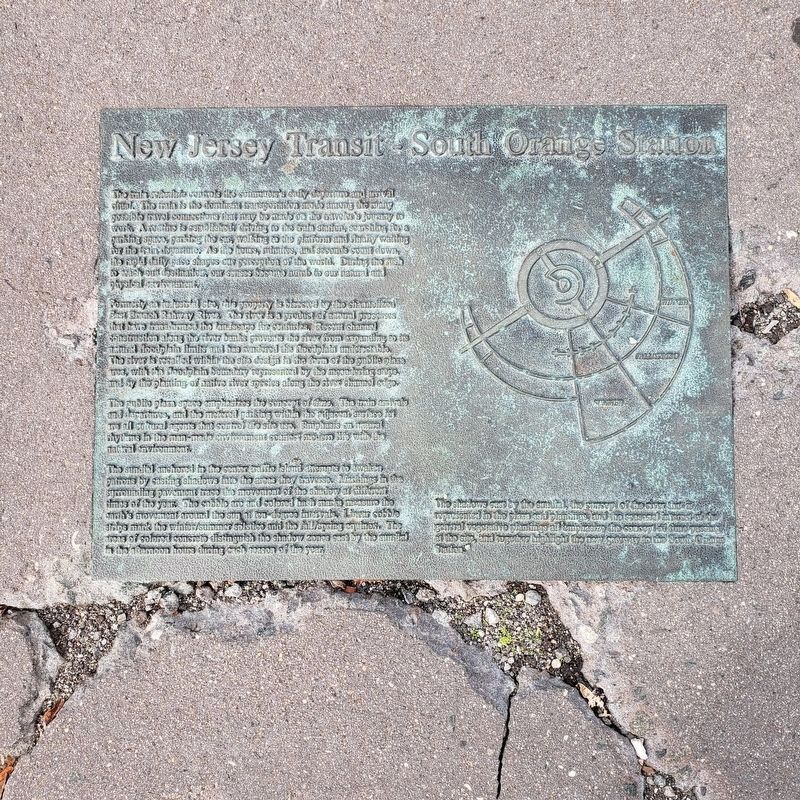
New Jersey Transit - South Orange Station
The train schedule controls the commuter's daily departure and arrival ritual. The train is the dominant transportation mode among the many possible travel connectors that may be made on the traveler's journey to work. A routine is established; driving to the train station, searching for a parking space, parking the car; walking

Photographed by Bryn Douds
2. SOPAC Sundial Marker
Formerly an industrial site, this property is bisected by the channelized East Branch Rahway River. The river is a product of natural processes that have transformed the landscape in centuries. Recent channel construction along the river banks prevents the river from expanding to its natural floodplain limits and has rendered the floodplain undetectable. The river is recalled within the site design in the form of the public plaza area, with the floodplain boundary represented by the meandering steps and by the planting of native river species along the river channel edge.
The public plaza space emphasizes the concept of time. The train arrivals and departures, and the metered parking within the adjacent surface lot are all cultural agents that control the site use. Emphasis on natural rhythms in the mad-made environment connect modern life with the natural environment.
Photographed by Bryn Douds, October 31, 2023
3. Artist's Statement for Sundial
The sundial anchored in the center traffic island attempts to awaken patrons by casting shadows into the areas they traverse. Markings in the surrounding pavement trace the movement of the shadow at different times of the year. The cobble arc and colored hash marks measure the earth's movement around the sun at ten degree intervals. Linear cobble strips mark the winter/summer solstice and the fall/spring equinox. The areas of colored concrete distinguish the shadowy zones cast by the sundial in the afternoon hours during each season of the year.
The shadows cast by the sundial, the concept of the river that is represented in the plaza and plantings, and the seasonal interest of the general vegetative plantings all emphasize the concept of time passing at the site, and together highlight the new gateway to the South Orange Station.
Credits. This page was last revised on January 13, 2024. It was originally submitted on January 1, 2024, by Bryn Douds of South Orange, New Jersey. This page has been viewed 193 times since then and 20 times this year. Photos: 1, 2, 3. submitted on January 1, 2024, by Bryn Douds of South Orange, New Jersey. • Michael Herrick was the editor who published this page.
