
Salisbury in Rowan County, North Carolina — The American South (South Atlantic)
Salisbury Arsenal
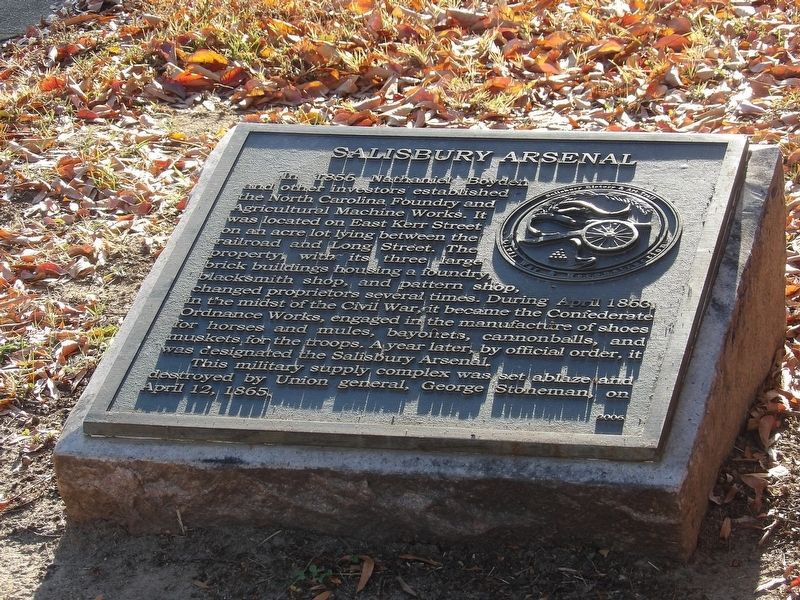
Photographed by Duane and Tracy Marsteller, November 13, 2023
1. Salisbury Arsenal Marker
This military supply complex was set ablaze and destroyed by Union general, George Stoneman, on April 12, 1865.
Topics. This historical marker is listed in these topic lists: Industry & Commerce • War, US Civil. A significant historical month for this entry is April 1863.
Location. 35° 40.108′ N, 80° 27.895′ W. Marker is in Salisbury, North Carolina, in Rowan County. It is at the intersection of East Kerr Street and Depot Street, on the right when traveling south on East Kerr Street. Touch for map. Marker is
this page online

Regionally, this marker is in the Piedmont and in Greater Charlotte. It is also in the American South and specifically in the Upper South. Globally, it is in North America, the Western Hemisphere, the Western World, and the Anglosphere. Historically, it finds itself in what was once the territory of the Mississippian Culture, one of the original Thirteen Colonies, one of the Confederate States of America, and the Antebellum South.
Other nearby markers. At least 8 other markers are within walking distance of this marker: Salisbury Confederate Memorial (about 600 feet away, measured in a direct line); Old Lutheran Cemetery (about 700 feet away); Stoneman’s Raid (about 800 feet away); Harry Cowan (approx. 0.2 miles away); The Town that Loved the Circus (approx. 0.2 miles away); Rowan County World War I Memorial (approx. 0.2 miles away); Elizabeth Maxwell Steele (approx. 0.2 miles away); Washington's Southern Tour (approx. 0.2 miles away). Touch for a list and map of all markers in Salisbury.
Also see . . .
1. Salisbury Arsenal.
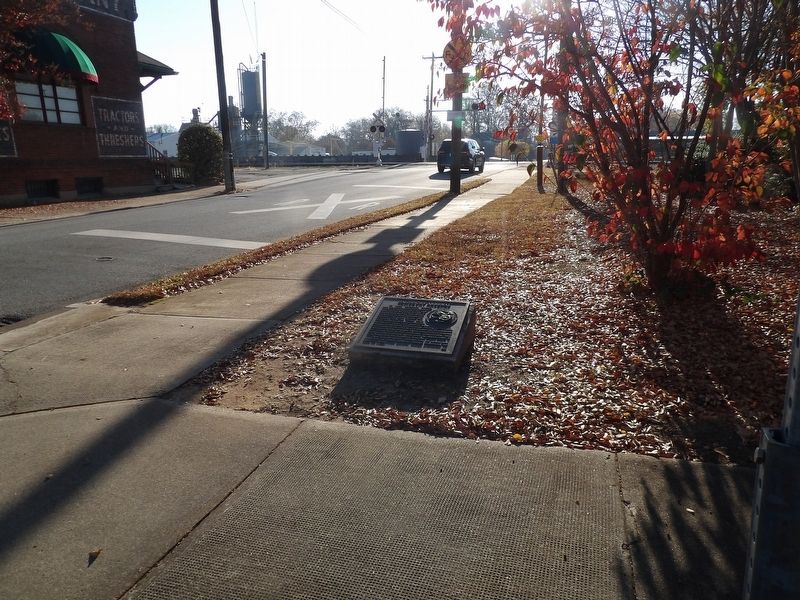
Photographed by Duane and Tracy Marsteller, November 13, 2023
2. Salisbury Arsenal Marker
2. Nathaniel Boyden. In 1822, Boyden came south to seek his fortune. He decided to settle first in Guilford County, which he believed to be very promising. He was destined to make the Old North State his home but would move several times before settling permanently in Rowan County. (Max R. Williams, Dictionary of North Carolina Biography, 1979; via NCpedia) (Submitted on January 2, 2024, by Duane and Tracy Marsteller of Murfreesboro, Tennessee.)
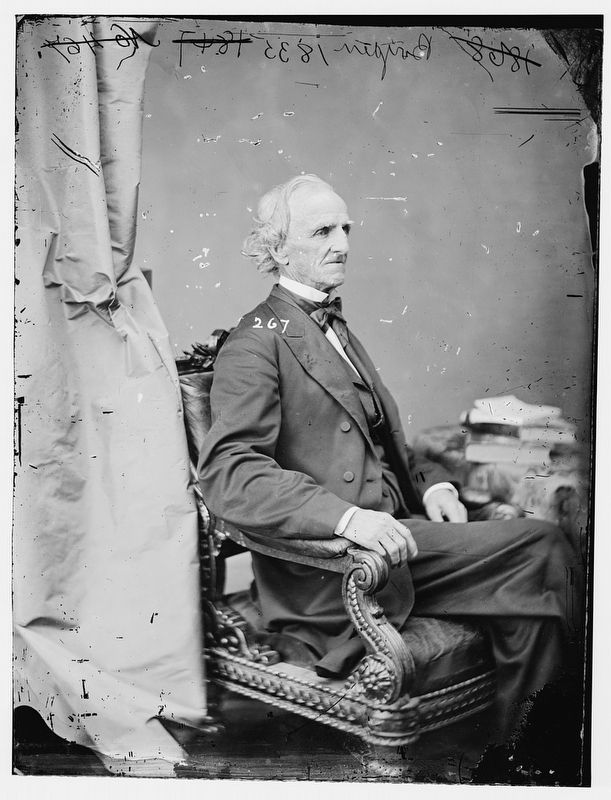
Brady-Handy photograph collection, Library of Congress, Prints and Photographs Division (Public Domain), 1860/73
3. Nathaniel Boyden (1796-1873)
A Massachusetts native, he served two terms 20 years apart in Congress. During his latter term, he was the only non-Republican to vote for the 15th Amendment, which granted voting rights regardless of race.
Credits. This page was last revised on January 2, 2024. It was originally submitted on January 2, 2024, by Duane and Tracy Marsteller of Murfreesboro, Tennessee. This page has been viewed 319 times since then and 33 times this year. Photos: 1, 2, 3. submitted on January 2, 2024, by Duane and Tracy Marsteller of Murfreesboro, Tennessee.
