Brandy Station in Culpeper County, Virginia — The American South (Mid-Atlantic)
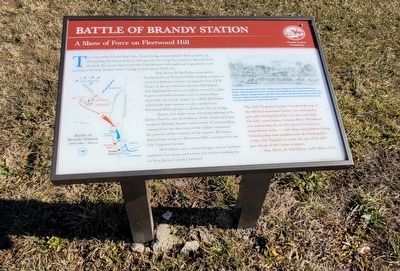
Battle of Brandy Station
A Show of Force on Fleetwood Hill
Photographed by Mike McKeown, December 31, 2023
1. Battle of Brandy Station Marker
Maj. Henry B. McClellan remained at headquarters on Fleetwood Hill, sending couriers to warn Confederate cavalry commander Maj. Gen. J.E.B. Stuart of the new threat to his rear. McClellan's only fighting force was an artillery crew of Lt. John Carter with their howitzer and an ammunition chest that was nearly empty. As a bluff, McClellan ordered the lone cannon to take a position on Fleetwood Hill and open a deliberate fire on Gregg.
Stuart, two miles away, directing fighting at St. James Church, was incredulous of the claims of Union troops in Brandy Station until sounds of cannonading coming from the direction of the village convinced the general of the veracity of the reports. He began dispatching troops to Fleetwood Hill, starting with the 12th Virginia Cavalry.
McClellan's ruse caused Gregg's men to hesitate,
this page online
Erected by Brandy Station Foundation.
Topics. This historical marker is listed in this topic list: War, US Civil. A significant historical date for this entry is June 9, 1863.
Location. 38° 30.451′ N, 77° 53.008′ W. Marker is in Brandy Station, Virginia, in Culpeper County. It is on Fleetwood Heights Road (Virginia Route 685) 0.7 miles east of Alanthus Road ( Route 663), on the right when traveling east. The marker is located on the American Battlefield Trust's Fleetwood Hill overlook area for the Battle of Brandy Station. Touch for map. Marker is in this post office area: Brandy Station VA 22714, United States of America. Touch for directions.

Regionally, this marker is in the Washington Metropolitan Area and in Northern Virginia. It is also in the American South, specifically in the Upper South, and in the Mid-Atlantic. Globally, it is in North America, the Western Hemisphere, the Western World, and the Anglosphere. Historically, it finds itself in what was once the territory of the Mississippian Culture, one of the original Thirteen Colonies,
Photographed by Mike McKeown, December 31, 2023
2. Battle of Brandy Station Marker
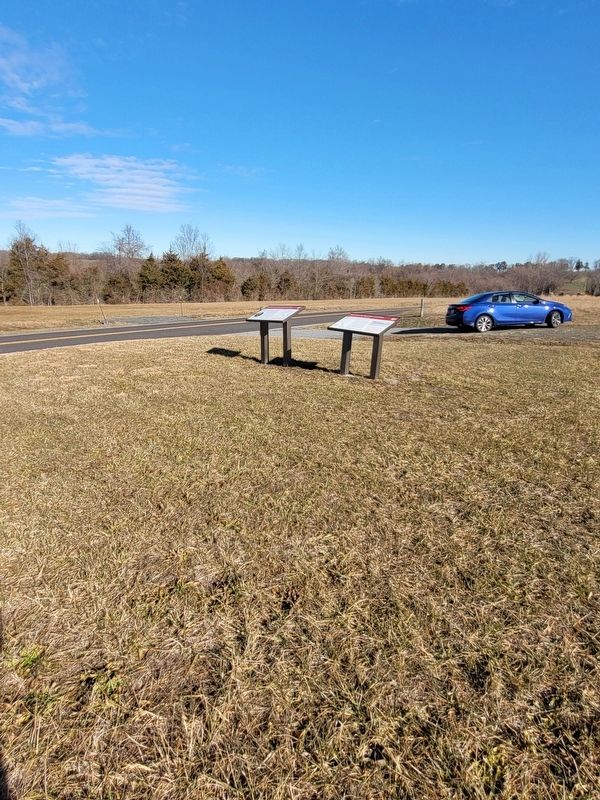
New markers on Fleetwood overlook area
Other nearby markers. At least 8 other markers are within walking distance of this marker: A different marker also named Battle of Brandy Station (here, next to this marker); a different marker also named Battle of Brandy Station (approx. ¼ mile away); a different marker also named Battle of Brandy Station (approx. ¼ mile away); a different marker also named Battle of Brandy Station (approx. ¼ mile away); a different marker also named Battle of Brandy Station (approx. ¼ mile away); a different marker also named Battle of Brandy Station (approx. ¼ mile away); a different marker also named Battle of Brandy Station (approx. ¼ mile away); a different marker also named Battle of Brandy Station (approx. ¼ mile away). Touch for a list and map of all markers in Brandy Station.
Other markers no longer nearby. The Battle of Brandy Station (was a few steps from this marker but has been replaced with another marker now near it); a different marker also named The Battle of Brandy Station (was a few steps from this marker but has been replaced with another marker now near it).
Related marker. Click here for another marker that is related to this marker. Old Marker at this location titled "The Battle of Brandy Station - The Struggle for Fleetwood Hill"
Also see . . .
1. Battle of Brandy Station. Wikipedia (Submitted on January 7, 2024.)
2. Battle of Brandy Station. Brandy Station Foundation (Submitted on January 7, 2024.)
3. Brandy Station - Fleetwood Hill. American Battlefield Trust (Submitted on January 7, 2024.)
Credits. This page was last revised on January 12, 2024. It was originally submitted on January 6, 2024, by Mike McKeown of Baltimore, Maryland. This page has been viewed 360 times since then and 45 times this year. Last updated on January 11, 2024, by Carl Gordon Moore Jr. of North East, Maryland. Photos: 1, 2. submitted on January 6, 2024, by Mike McKeown of Baltimore, Maryland. • J. Makali Bruton was the editor who published this page.
