Centrum in Den Haag, South Holland, Netherlands — Northwestern Europe
Gysbert Karel van Hogendorp
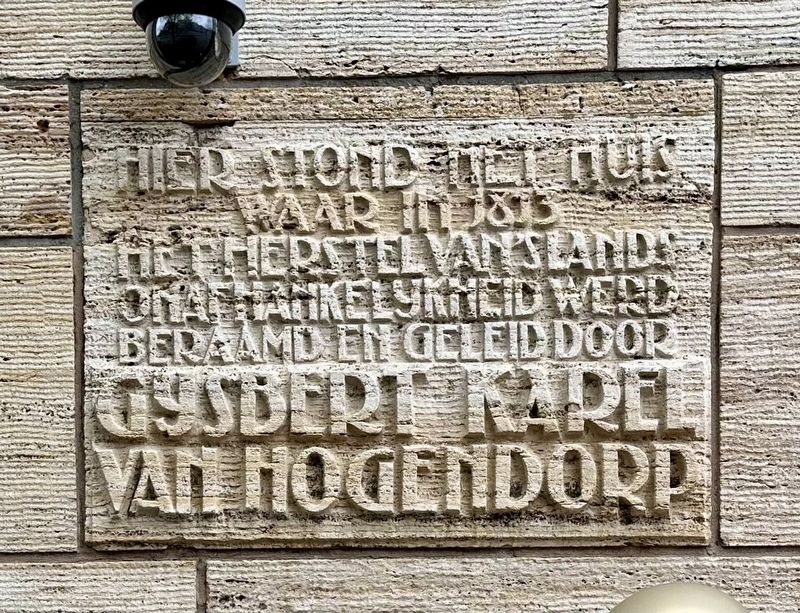
Photographed by Andrew Ruppenstein, May 8, 2023
1. Gysbert Karel van Hogendorp Marker

Hier stond het huis waar in 1813 het herstel van’s lands onafhankelykheid werd beraamd en geleid door Gysbert Karel van Hogendorp
Here stood the house where in 1813 the recovery of the country’s independence was planned and guided by Gysbert Karel van Hogendorp.
Topics. This historical marker is listed in this topic list: Government & Politics. A significant historical date for this entry is December 7, 1813.
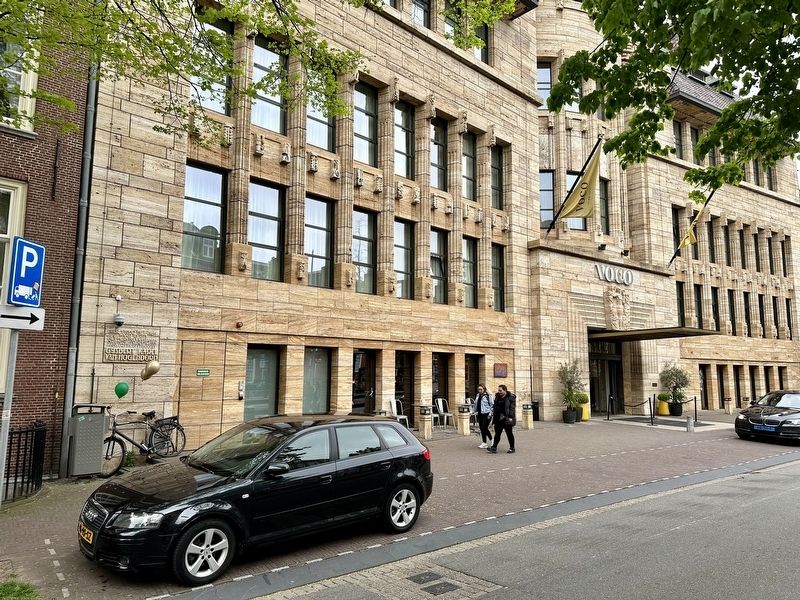
Location. 52° 4.835′ N, 4° 18.548′ E. Marker is in Den Haag, Zuid-Holland (South Holland). It is in Centrum. It is on Kneuterdijk, on the left when traveling south. Touch for map. Marker is at or near this postal address: Kneuterdijk 6, Den Haag, Zuid-Holland 2514 EP, Netherlands. Touch for directions.

Regionally, it is in Europe, the European Union, Atlantic Europe, the Benelux Low Countries, the Schengen Area, Western Europe, and the Western World. Historically, it finds itself in what was once the Roman Empire and specifically also the Holy Roman Empire.
Other nearby markers. At least 8 other markers are within walking distance of this marker: Johan de Witt-Huis / Johan de Witt House
this page online
Also see . . .
1. Gijsbert Karel van Hogendorp (Wikipedia).
Excerpts: Gijsbert Karel, Count van Hogendorp (27 October 1762 – 5 August 1834) was a liberal conservative and liberal Dutch statesman. He was the brother of Dirk van Hogendorp the elder and the father of Dirk van Hogendorp the younger.(Submitted on January 13, 2024.)
In 1812 Van Hogendorp became convinced that the French Empire would collapse in a few years and drafted a paper, a precursor of the Constitution of 1814. He played a decisive role during the revolt of October and November 1813 that restored the Dutch independence.
Hewas part of the Triumvirate of 1813 that invited William Frederick, the eldest son of William V (who died in exile) to become Prince of the new independent Netherlands in late 1813. He served as Foreign Minister from 7 December 1813 to 6 April 1814, and headed the commission that wrote the Constitution of the Netherlands of 1814. On 6 April 1814 he was named the first Vice-President of the Council of State, making him the second most important person in the Netherlands.Photographed by Andrew Ruppenstein, May 8, 20232. Gysbert Karel van Hogendorp Marker - wide view
2. Fellow Founding Fathers: Gijsbert Karel van Hogendorp and Thomas Jefferson (Nationaal Archief). The two had a decades long correspondence, each influencing the other in different ways.
American Vestiges in the Dutch Constitutional Committee (1815): After the monarchy in the Netherlands was reestablished in 1813, Van Hogendorp became chair of the committee entrusted with drafting the new constitution. Now he could use American examples to finetune his thoughts on government into a founding document. He had closely studied the Massachusetts Constitution, in which the executive was the strongest of all of the states. Likewise, the American federal constitution of 1787 had granted extensive powers to the president. Taking his lead from these examples, Van Hogendorp’s draft constitution allocated great power to the executive. In practice, this power would be given to the son of the last stadtholder: King William I (1776-1843).(Submitted on January 13, 2024.)
Credits. This page was last revised on January 13, 2024. It was originally submitted on January 13, 2024, by Andrew Ruppenstein of Lamorinda, California. This page has been viewed 144 times since then and 19 times this year. Photos: 1, 2. submitted on January 13, 2024, by Andrew Ruppenstein of Lamorinda, California.
