Arts-et-Métiers in Paris in Département de Paris, Île-de-France, France — Western Europe
Marc Seguin
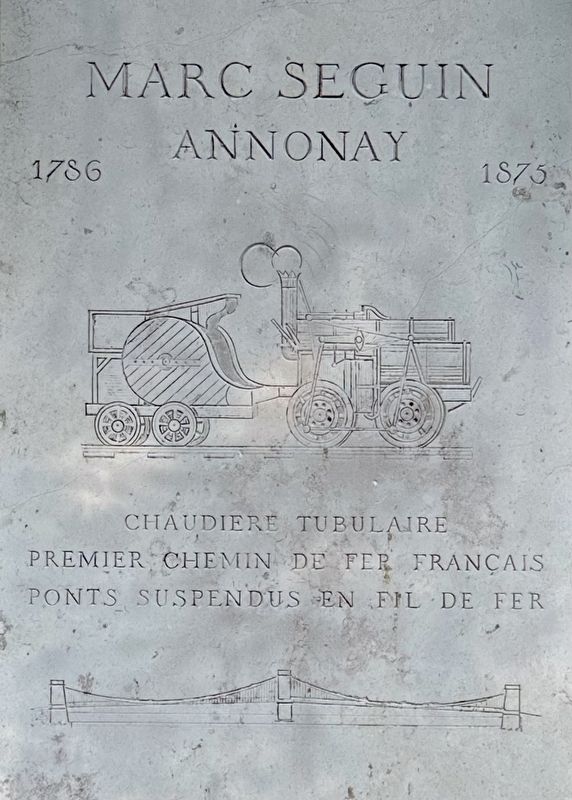
Photographed by Andrew Ruppenstein, August 22, 2023
1. Marc Seguin Marker

Annonay
1786 1875
Chaudiere Tubulaire
Premier Chemin de Fer Français
Pont Suspendus en Fil de Fer
First French Railway
Wire-Cable Suspension Bridge
Erected 1987.
Topics. This historical marker is listed in these topic lists: Bridges & Viaducts • Railroads & Streetcars • Science & Medicine. A significant historical date for this entry is April 20, 1786.
Location. 48° 52.024′ N, 2° 21.257′ E. Marker is in Paris, Île-de-France, in Département de Paris. It is in Arts-et-Métiers. It is on Rue Saint-Martin, on the right when traveling south. Touch for map. Marker is in this post office area: Paris, Île-de-France 75003, France. Touch for directions.

Regionally, it is in the North Atlantic Region, Europe, the European Union, Atlantic Europe, the Schengen Area, Western Europe, a coastal Mediterranean country, and the Western World. Historically, it finds itself in what was once a French colony and also the Roman Empire.
Other nearby markers. At least 8 other markers are within walking distance of this marker: Le Prieuré Saint-Martin-des-Champs (within shouting distance of this marker); Crimean War Commemorative Column (within shouting distance of this marker); Square Émile-Chautemps (1858) (within shouting distance of this marker); Raymond Legrand
this page online
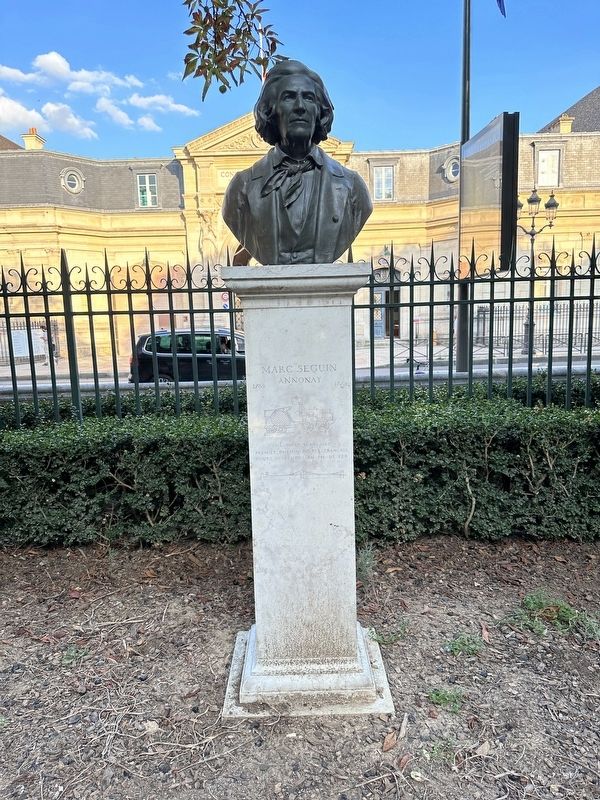
More about this marker. The bust is located on the east side of Square Émile-Chautemps, just a few steps from the entrance on Rue Saint-Martin.
Also see . . . Marc Seguin (Wikipedia).
Excerpt: Marc Seguin (20 April 1786 – 24 February 1875) was a French engineer, inventor of the wire-cable suspension bridge and the multi-tubular steam-engine boiler.(Submitted on January 15, 2024.)
Seguin was an inventor and entrepreneur who developed the first suspension bridge in continental Europe. He built and administered 186 toll-bridges throughout France. At the 1823 Exposition des produits de l'industrie française a model was exhibited of a planned suspension bridge which would span the Rhône from Tain-l'Hermitage to Tournon-sur-Rhône. The bridge, designed by Seguin, was completed in 1825.
Shortly after the Stockton and Darlington Railway in England opened (1825) he visited it and observed George Stephenson's Locomotion in operation and acquired two of his engines, whichhowever proved unreliable in French conditions. In 1829, he delivered two steam locomotives of his own design to the Saint-Étienne–Lyon railway. These used an innovative multi-tube boiler and also prominent mechanically-driven fans to provide draught on the fire, rather than Stephenson's blastpipe…. Seguin's boiler enabled steam-engine trains to increase power and velocity from 4 miles per hour to 25 miles per hour, making railroad a more viable mode of transportation.Photographed by Andrew Ruppenstein, August 22, 20232. Marc Seguin Marker - wide view
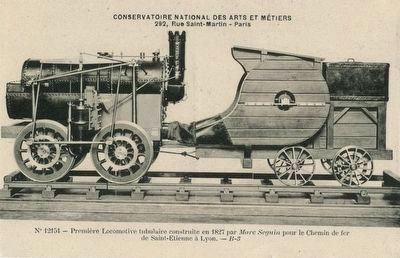
Conservatoire National des Arts et Métiers (courtesy of the New York Public Library)
3. Première locomotive tubulaire / First tubular locomotive
First tubular locomotive built in 1827 by Marc Seguin for the Saint-Etienne to Lyon railway. Note that the Conservatoire National des Arts et Métiers listed on the picture is the building visible behind the bust and across the street in Photo 2.
Credits. This page was last revised on January 15, 2024. It was originally submitted on January 15, 2024, by Andrew Ruppenstein of Lamorinda, California. This page has been viewed 226 times since then and 47 times this year. Photos: 1, 2, 3. submitted on January 15, 2024, by Andrew Ruppenstein of Lamorinda, California.
