Duchesne in Duchesne County, Utah — The American Mountains (Southwest)
Over Almost Impassable Terrain
| — | [Dominguez Escalante Expedition 1776 - 1976] | — |
Photographed by Jeremy Snow, January 18, 2024
1. Dominguez Escalante Expedition 1776 1976 Marker
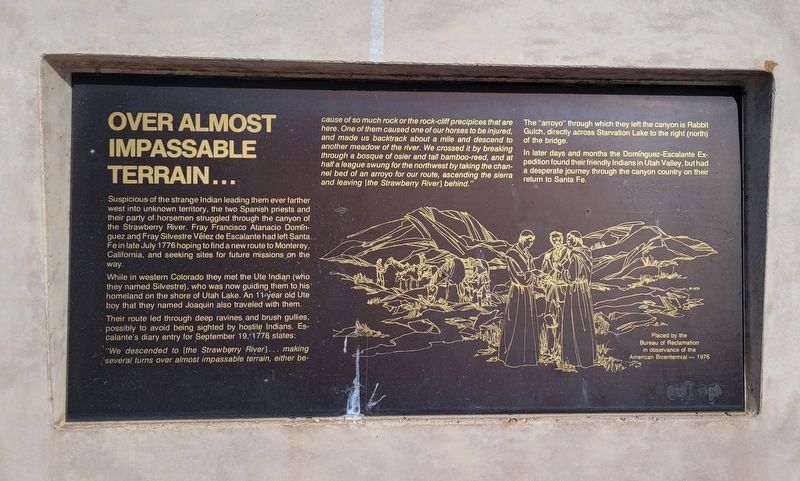
Suspicious of the strange Indian leading them ever farther west into unknown territory, the two Spanish priests and their party of horsemen struggled through the canyon of the Strawberry River. Fray Francisco Atanacio Dominguez and Fray Silvestre Vélez de Escalante had left Santa Fe in late July 1776 hoping to find a new route to Monterey, California, and seeking sites for future missions on the way.
While in western Colorado they met the Ute Indian (who they named Silvestre), who was now guiding them to his homeland on the shore of Utah Lake. An 11-year old Ute boy that they named Joaquin also traveled with them. Their route led through deep ravines and brush gullies, possibly to avoid being sighted by hostile Indians. Escalante's diary entry for September 19, 1776 states:
"We descended to [the Strawberry River]… making several turns over almost impassable terrain, either because of so much rock or the rock-cliff precipices that are here. One of them caused one of our horses to be injured. and made us backtrack about a mile and descend to another meadow of the river. We crossed it by breaking through a bosqueThe "arroyo” through which they left the canyon is Rabbit Gulch, directly across Starvation Lake to the right (north) of the bridge.of osier and tall bamboo-reed, and at half a league swung for the northwest by taking the channel bed of an arroyo for our route, ascending the sierra and leaving [the Strawberry River] behind.”
Click or scan to see
this page online
In later days and months the Dominguez-Escalante Expedition found their friendly Indians in Utah Valley, but had a desperate journey through the canyon country on their return to Santa Fe.
Placed by the Bureau of Reclamation in observance of the American Bicentennial-1976
Erected 1976 by Bureau of Reclamation.
Topics and series. This historical marker is listed in these topic lists: Exploration • Hispanic Americans. In addition, it is included in the Dominguez y Escalante Expedition series list. A significant historical date for this entry is September 19, 1776.
Location. 40° 10.424′ N, 110° 29.52′ W. Marker is in Duchesne, Utah, in Duchesne County. It is on Highway 40 (U.S. 40), on the right when traveling west. Touch for map. Marker is at or near this postal address: 8850 46220W, Duchesne UT 84021, United
Photographed by Jeremy Snow, January 18, 2024
2. Dominguez Escalante Expedition 1776 1976 Marker

Regionally, this marker is in the Uinta Basin and in the Uinta Mountains. It is also in the American Mountain West and on the Colorado Plateau. Globally, it is in North America, the Rocky Mountains, the Western Hemisphere, the Western World, and the Anglosphere. Historically, it finds itself in what was once New Spain and also Mexico’s Alta California.
Other nearby markers. At least 6 other markers are within 17 miles of this marker, measured as the crow flies: Duchesne (approx. 4.7 miles away); Saint Rose Philippine Duchesne (approx. 5.2 miles away); Local Highlights (approx. 5.2 miles away); Father Escalante (approx. 5.2 miles away); Moonlake (approx. 13.9 miles away); Altamont Veterans Memorial (approx. 16.7 miles away).
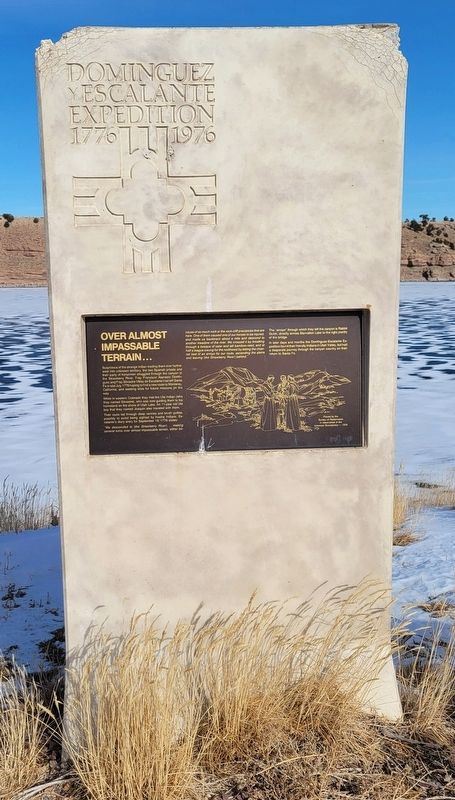
More about this marker. The marker is at the overlook on the north side of US 40 just before that road crosses over Starvation Reservoir in Starvation State Park.
Credits. This page was last revised on June 4, 2024. It was originally submitted on January 18, 2024, by Jeremy Snow of Cedar City, Utah. This page has been viewed 526 times since then and 47 times this year. Photos: 1, 2. submitted on January 18, 2024, by Jeremy Snow of Cedar City, Utah. • Andrew Ruppenstein was the editor who published this page.
