Santiago de Compostela in A Coruña, Galicia, Spain — Southwestern Europe (Iberian Peninsula)
Fundación e Museo Eugenio Granell
⎯⎯⎯
Eugenio Granell Foundation and Museum
| — | Santiago de Compostela | — |
Photographed by Andrew Ruppenstein, September 12, 2023
1. Fundación e Museo Eugenio Granell / Eugenio Granell Foundation and Museum Marker

Fundación e Museo Eugenio Grenell
Pazo de Bendaña
(Galician:)
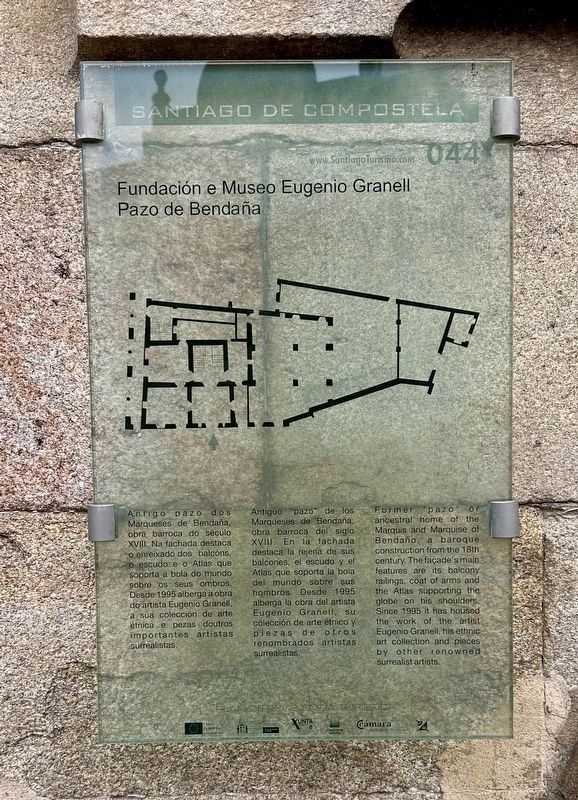
Antigo pazo dos Marqueses de Bendaña, obra barroca do século XVIII. Na fachada destaca o enreixado dos balcóns, o escudo e o Atlas que soporta a bola do mundo sobre os seus ombros. Desde 1995 alberga a obra do artista Eugenio Granell, a súa colección de arte étnica e pezas doutros importantes artistas surrealistas.
Antiguo "pazo" de los Marqueses de Bendaña, obra barroca del siglo XVIII. En la fachada destaca la rejería de sus balcones, el escudo y, el Atlas que soporta la bola del mundo sobre sus hombros. Desde 1995 alberga la obra del artista Eugenio Granell, su colección de arte étnico y piezas de otros renombrados artistas surrealistas.
Former "pazo" or ancestral home of the Marquis and Marquise of Bendaño, a baroque construction from the 18th century. The façade's main features are its balcony railings, coat of arms and the Atlas supporting the globe on his shoulders. Since 1995 it has housed the work of the artist Eugenio Granell, his ethnic art collection and pieces by
this page online
Erected by Concello de Santiago, Xunta de Galicia, Cámara Santiago de Compostela. (Marker Number 044.)
Topics. This historical marker is listed in these topic lists: Architecture • Arts, Letters, Music. A significant historical year for this entry is 1995.
Location. 42° 52.661′ N, 8° 32.697′ W. Marker is in Santiago de Compostela, Galicia, in A Coruña. It is on Praza do Toural, on the right when traveling west. Touch for map. Marker is at or near this postal address: Praza do Toural 8, Santiago de Compostela, Galicia 15705, Spain. Touch for directions.

Regionally, it is in the North Atlantic Region, on the Atlantic Arc, in Europe, in the European Union, in Atlantic Europe, on the Iberian Peninsula, in the Schengen Area, in a coastal Mediterranean country, and in the Western World. Historically, it finds itself in what was once the Roman Empire.
Other nearby markers. At least 8 other markers are within walking distance of this marker: Diego Bernal López (1940-2001) (a few steps from this marker); Jose Maria Fenollera e Ibáñez (within shouting distance of this marker); Victoriano García Martí
Photographed by Andrew Ruppenstein, September 12, 2023
2. Fundación e Museo Eugenio Granell / Eugenio Granell Foundation and Museum and Marker
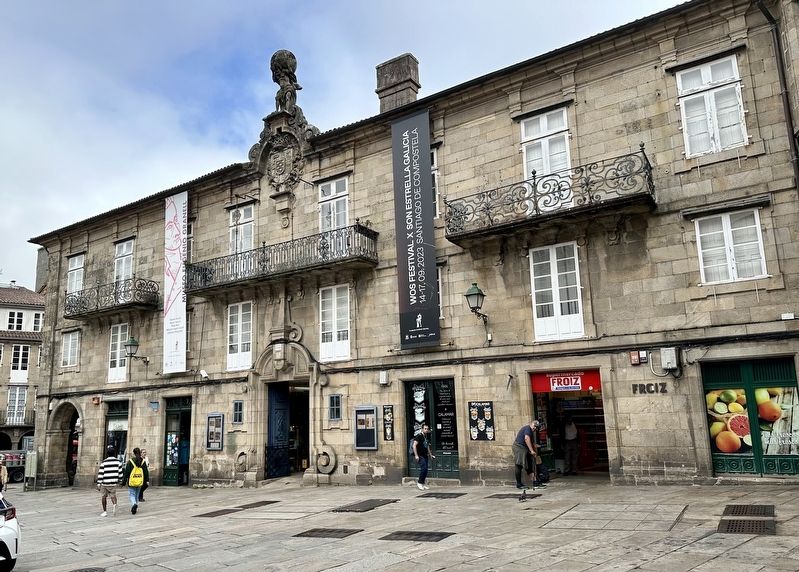
Although difficult to see here, the marker is just to the left of the museum entrance.
Related marker. Click here for another marker that is related to this marker.
Also see . . . Granell Museum (Museos de Galicia).
Excerpt: The Eugenio Granell Foundation museum is located in the Pazo de Bendaña, one of the most emblematic buildings of Santiago - and an example of civil architecture from the mid-18th century. The building designed by Vivente Sarela is located in Praza do Toural and represent the Baroque architecture of Santiago. The façade displays the coat of arms of Bendaña marquisate. The figure of Atlas holding the canopy of heaven crowns the building.(Submitted on January 21, 2024.)
Artist Eugenio Fernández Granell was born in Coruña in1912. He studied in Santiago de Compostela and Madrid. After the Spanish Civil War, Granell took exile firstly in South America and later on in the United States of America. The artist returned to Spain in 1985.
Credits. This page was last revised on January 21, 2024. It was originally submitted on January 21, 2024, by Andrew Ruppenstein of Lamorinda, California. This page has been viewed 133 times since then and 15 times this year. Photos: 1, 2. submitted on January 21, 2024, by Andrew Ruppenstein of Lamorinda, California.
