Tui in Pontevedra, Galicia, Spain — Southwestern Europe (Iberian Peninsula)
Catedral de Santa María
⎯⎯⎯
The Cathedral Complex
Photographed by Andrew Ruppenstein, September 7, 2023
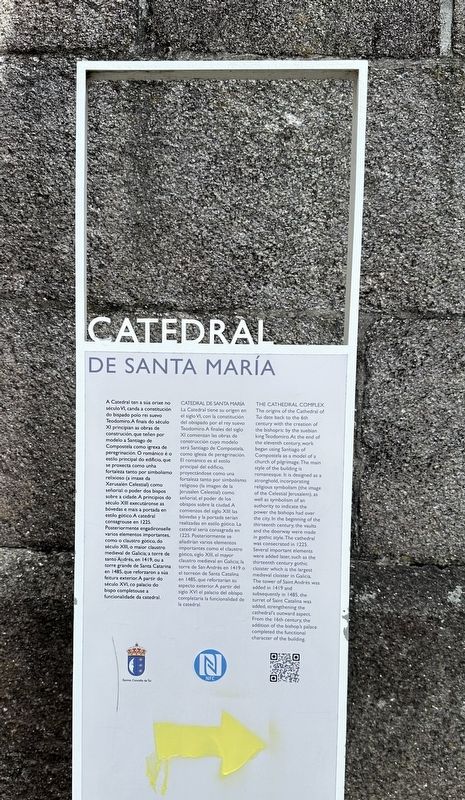
1. Catedral de Santa María / The Cathedral Complex Marker

Catedral de Santa María
A Catedral ten a súa orixe no século VI, canda a constitución do bispado polo rei suevo Teodomiro. A finais do século XI principian as obras de construción, que teñen por modelo a Santiago de Compostela como igrexa de peregrinación. O románico é o estilo principal do edificio, que se proxecta como unha fortaleza tanto por simbolismo relixioso (a imaxe da Xerusalén Celestial) como señorial: o poder dos bispos sobre a cidade. A principios do século XIII executáronse as bóvedas e mais a portada en estilo gótico. A catedral consagrouse en 1225. Posteriormente engadíronselle varios elementos importantes, como o claustro gótico, do século XIII, o maior claustro medieval de Galicia; a torre de santo Andrés, en 1419, ou a torre grande de Santa Catarina en 1485, que reforzaron a súa feitura exterior. A partir do século XVI, co palacio do bispo completouse a funcionalidade da catedral.
Catedral de Santa María
La Catedral tiene su origen en el siglo VI, con la constitución del obispado por el rey suevo Teodomiro. A finales del siglo XI comienzan las obras de construcción cuyo modelo será Santiago de Compostela, como iglesia de peregrinación. El románico es el estilo principal del edificio, proyectándose como una fortaleza tanto por simbolismo religioso (la imagen de la Jerusalen Celestial) como señorial, el poder de los obispos sobre la ciudad. A comienzos del siglo XIII las bóvedas y la portada serían realizadas en estilo gótico. La catedral sería consagrada en 1225. Posteriormente se añadirían varios elementos importantes como el claustro gótico, siglo XIII, el mayor claustro medieval en Galicia; la torre de San Andrés en 1419 0 el torreón de Santa Catalina en 1485, que reforzarían su aspecto exterior.
this page online
The Cathedral Complex
The origins of the Cathedral of Tui date back to the 6th century with the creation of the bishopric by the suebian king Teodomiro. At the end of the eleventh century, work began using Santiago of Compostela as a model of a church of pilgrimage. The main style of the building is romanesque. It is designed as a stronghold, incorporating religious symbolism (the image of the Celestial Jerusalem), as well as symbolism of an authority to indicate the power the bishops had over the city. In the beginning of the thirteenth century, the vaults and the doorway were made in gothic style. The cathedral was consecrated in 1225. Several important elements were added later, such as the thirteenth century gothic cloister which is the largest medieval cloister in Galicia. The tower of Saint Andrés was added in 1419 and subsequently in 1485, the turret of Saint Catalina was added, strengthening the cathedral's outward aspect. From the 16th century, the addition of the bishop's palace completed

Photographed by Andrew Ruppenstein, September 7, 2023
2. Catedral de Santa María / The Cathedral Complex Marker - wide view
The marker is visible here in the lower left corner of the picture.
Erected by Concello de Tui, NFC.
Topics. This historical marker is listed in these topic lists: Architecture • Religion & Religious Structures. A significant historical year for this entry is 1225.
Location. 42° 2.78′ N, 8° 38.694′ W. Marker is in Tui, Galicia, in Pontevedra. It is on Praza do San Fernando, on the left when traveling east. Touch for map. Marker is at or near this postal address: Praza do Concello 2, Tui, Galicia 36700, Spain. Touch for directions.

Regionally, it is in the North Atlantic Region, on the Atlantic Arc, in Europe, in the European Union, in Atlantic Europe, on the Iberian Peninsula, in the Schengen Area, in a coastal Mediterranean country, and in the Western World. Historically, it finds itself in what was once the Roman Empire.
Other nearby markers. At least 8 other markers are within walking distance of this marker: Antigo Hospital de Pobres e Peregrinos / The Hospital for the Poor and for Pilgrims (a few steps from this marker); Escola de María (within shouting distance of this marker); Casa da Botica (within shouting distance of this marker);
Photographed by Andrew Ruppenstein, September 7, 2023
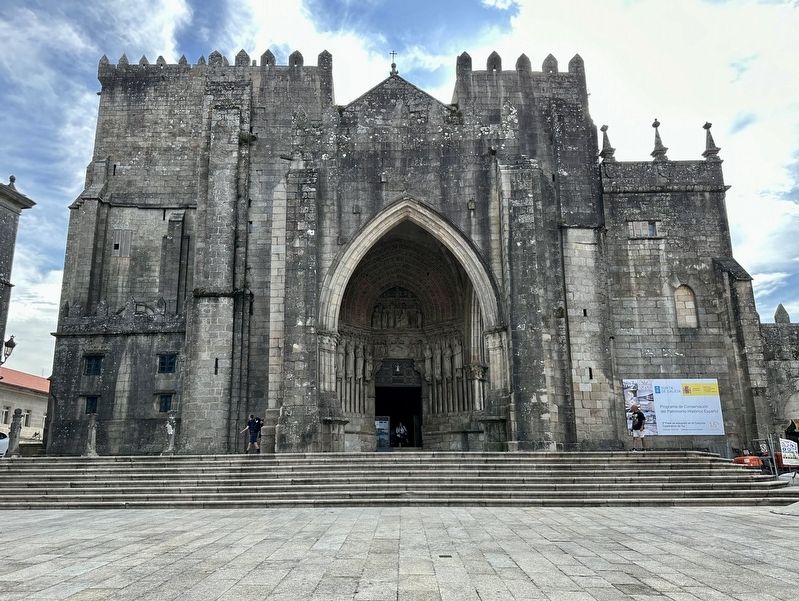
3. Catedral de Santa María
Also see . . . The Cathedral Complex (Turismo Tui). Scanning the QR code leads to a page with roughly the same English text as on the marker. In addition the page has three photographs, plus two plans of the cathedral indicating the changes made to the building over the centuries. (Submitted on January 24, 2024.)
Credits. This page was last revised on January 24, 2024. It was originally submitted on January 24, 2024, by Andrew Ruppenstein of Lamorinda, California. This page has been viewed 119 times since then and 15 times this year. Photos: 1, 2, 3. submitted on January 24, 2024, by Andrew Ruppenstein of Lamorinda, California.
