Key West in Monroe County, Florida — The American South (South Atlantic)
Dr. Mudd's Cell
| — | Dry Tortugas National Park | — |
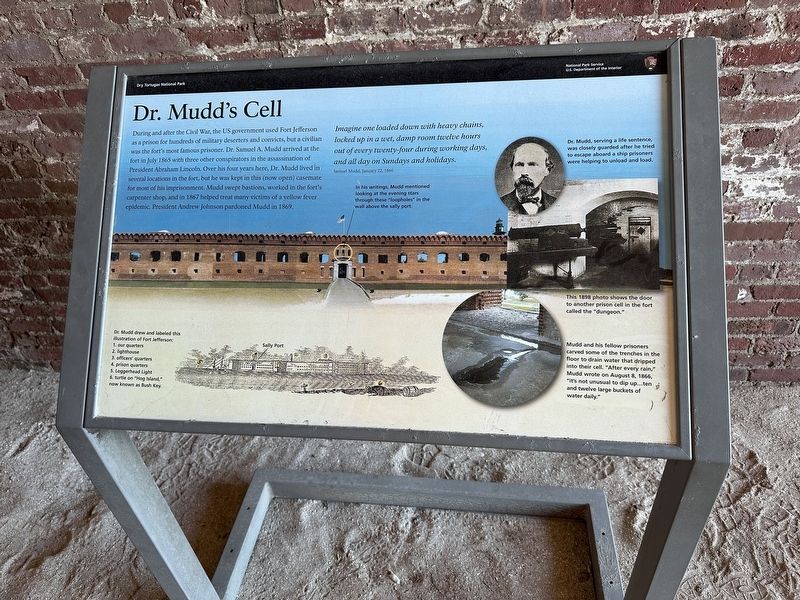
Photographed by Pete Skillman, November 20, 2023
1. Dr. Mudd's Cell Marker
Imagine one loaded down with heavy chains, locked up in a wet, damp room twelve hours out of every twenty-four during working days, and all day on Sundays and holidays.
Samuel Mudd, January 22, 1866
(captions)
In his writings, Mudd mentioned looking at the evening stars through these "loopholes" in the wall above the sally port.
Dr. Mudd, serving a life sentence, was closely guarded after he tried to escape aboard a ship prisoners were helping to unload and load.
This 1898 photo shows the door to another prison cell in the fort called the "dungeon."
Mudd and his fellow prisoners carved some of the trenches in the floor to drain water that dripped into their cell. "After every rain," Mudd wrote on August 8, 1866, "it's not unusual to dip up...ten and twelve large buckets of water daily."
Dr. Mudd drew and labeled this illustration of Fort Jefferson:
1. our quarters
2. lighthouse
3. officers' quarters
4. prison quarters
5. Loggerhead Light
6. turtle on "Hog Island," now known as Bush Key.
Erected by National
this page online
Topics and series. This historical marker is listed in these topic lists: Forts and Castles • War, US Civil. In addition, it is included in the Lighthouses series list.
Location. 24° 37.673′ N, 82° 52.355′ W. Marker is in Key West, Florida, in Monroe County. It can be reached from Fort Jefferson - Key West. Touch for map. Marker is in this post office area: Key West FL 33040, United States of America. Touch for directions.

Regionally, this marker is on the Florida Keys. It is also in the American South and on the Gulf Coast. Globally, it is in the North Atlantic Region, North America, a Gulf of Mexico state, the Western Hemisphere, the Western World, and the Anglosphere. Historically, it finds itself in what was once New Spain, the territory of the Mississippian Culture, one of the Confederate States of America, and the Antebellum South.
Other nearby markers. At least 8 other markers are within walking distance of this marker: Deadly Crossfire (a few steps from this marker); Touring Fort Jefferson (a few steps from

Photographed by James Hulse, January 12, 2026
2. Dr. Mudd's Cell Marker
The view of the marker looking out towards the interior courtyard of the fort.
Also see . . . Dry Tortugas National Park. National Park Service (Submitted on February 1, 2024.)

Photographed by James Hulse, January 12, 2026
3. Dr. Mudd's Cell
The view of trenches dug in the floor to catch rain water. "After every rain," Mudd wrote on August 8, 1866, "it's not unusual to dip up...ten and twelve large buckets of water daily."
Credits. This page was last revised on February 7, 2026. It was originally submitted on January 29, 2024, by Pete Skillman of Wilmington, Delaware. This page has been viewed 1,167 times since then and 148 times this year. Photos: 1. submitted on January 29, 2024, by Pete Skillman of Wilmington, Delaware. 2, 3. submitted on February 7, 2026, by James Hulse of Medina, Texas. • Bernard Fisher was the editor who published this page.
