South Los Angeles in Los Angeles County, California — The American West (Pacific Coastal)
West Angeles Church
Photographed by Craig Baker, January 28, 2024
1. West Angeles Church Marker
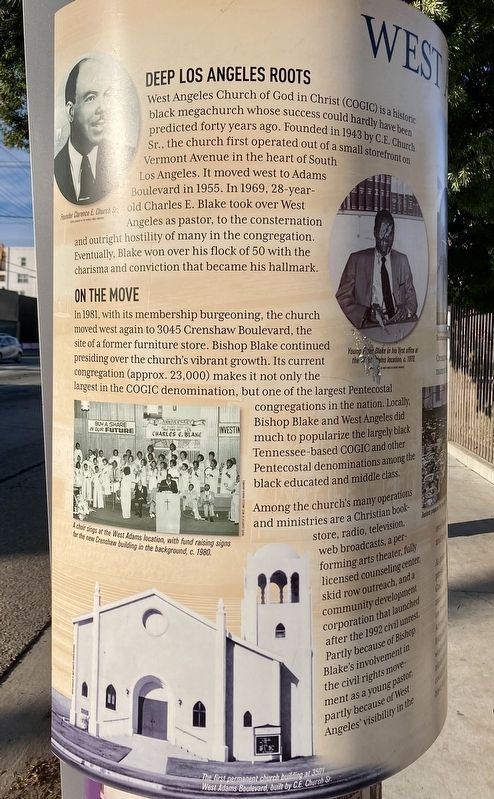
Deep Los Angeles Roots
West Angeles Church of God in Christ (COGIC) is a historic black megachurch whose success could hardly have been predicted forty years ago. Founded in 1943 by C.E. Church Sr., the church first operated out of a small storefront on Vermont Avenue in the heart of South Los Angeles. It moved west to Adams Boulevard in 1955. In 1969, 28-year-old Charles E. Blake took over West Angeles as pastor, to the consternation and outright hostility of many in the congregation. Eventually, Blake won over his flock of 50 with the charisma and conviction that became his hallmark.
On The Move
In 1981, with its membership burgeoning, the church moved west again to 3045 Crenshaw Boulevard, the site of a former furniture store. Bishop Blake continued presiding over the church's vibrant growth. Its current congregation (approx. 23,000) makes it not only the largest in the COGIC denomination, but one of the largest Pentecostal congregations in the nation. Locally, Bishop Blake and West Angeles did uch to popularize the largely black Tennessee-based COGIC and other Pentecostal denominations among the black educated and middle class.
Among the church's many operations and ministries are a Christian bookstore, radio, television. web broadcasts, a per forming arts theater. fully licensed counseling center skid row outreach, and a community development corporation that launched after the 1992 civil unrest Partly because of Bishop Blake's involvement in the civil rights move ment as a young pastor partly because of West Angeles' visibility in the Crenshaw area, and partly because that visibility was expanding at the precise moment the civil unrest hit, West Angeles quickly developed a reputation for being a key player in redevelopment and spiritual
this page online
As pastor of West Angeles Church and presiding bishop of The Church of God in Christ globally, Bishop Blake maintains a high profile. He served on President Obama's White House Advisory Faith-Based Council, and founded Save Africa's Children, which works with other faith-based organizations in two dozen sub-Saharan countries to aid children whose lives have been impacted by the AIDS crisis.
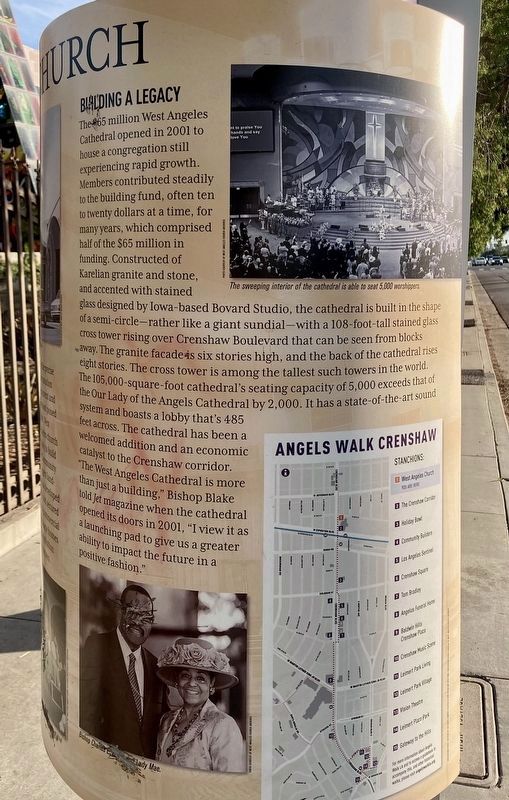
Building a Legacy
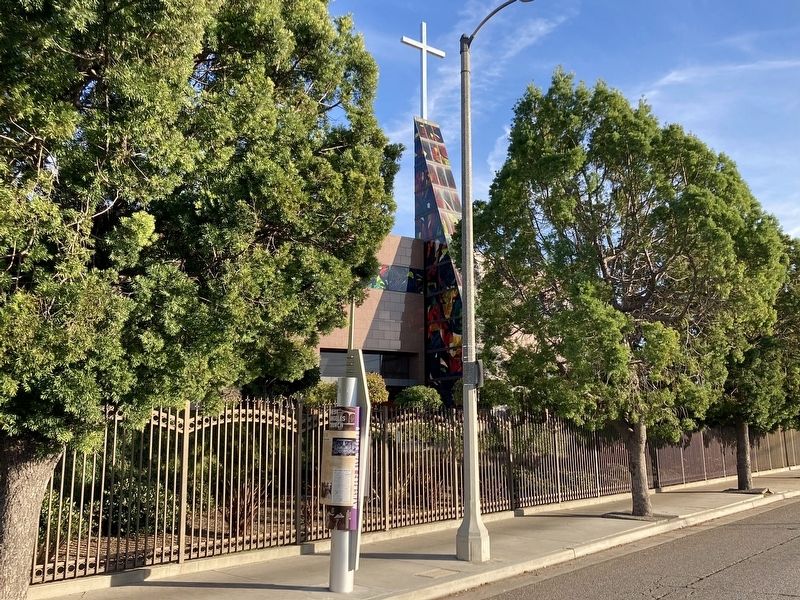
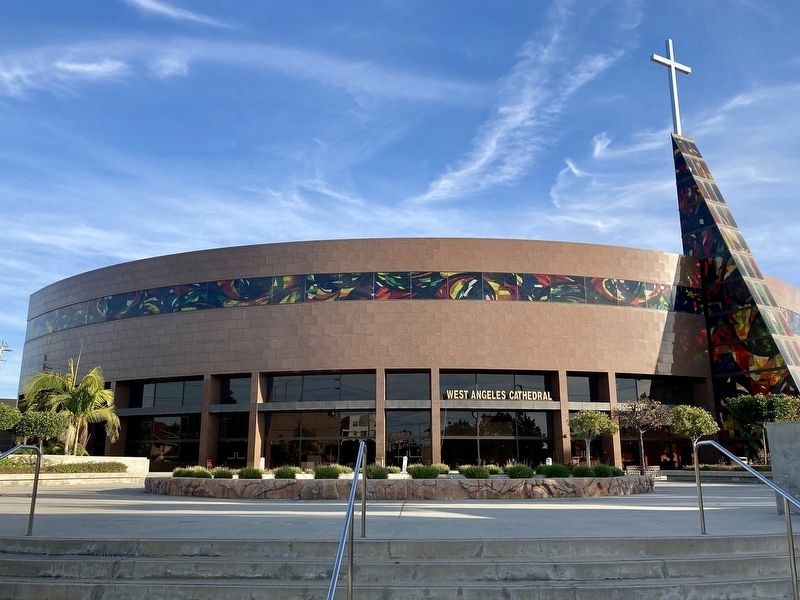
The 65 million West Angeles Cathedral opened in 2001 to house a congregation still experiencing rapid growth. Members

Photographed by Craig Baker
2. West Angeles Church Marker
Erected 2018 by City of Los Angeles.
Topics. This historical marker is listed in this topic list: Religion & Religious Structures. A significant historical year for this entry is 1943.
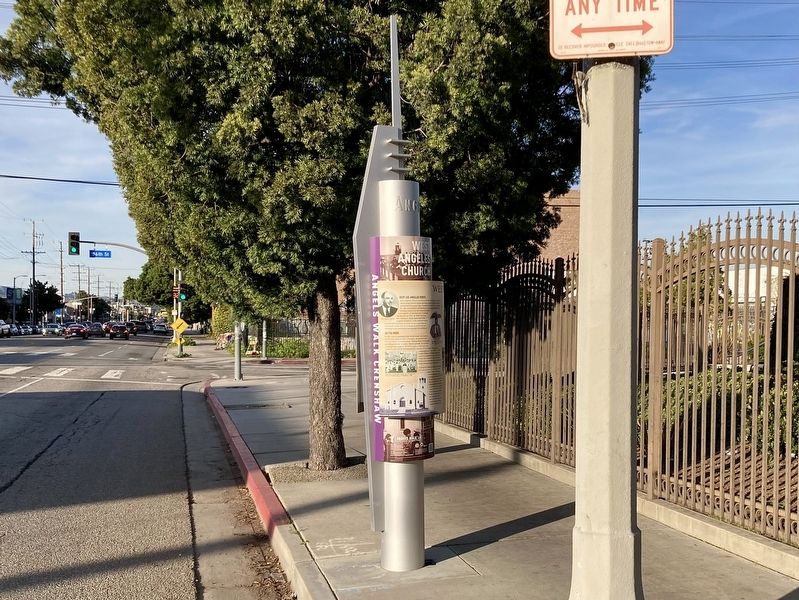
Location. 34° 1.418′ N, 118° 20.1′ W. Marker is in Los Angeles, California, in Los Angeles County. It is in South Los Angeles. It is at the intersection of Crenshaw Boulevard and 36th Street on Crenshaw Boulevard. Touch for map. Marker is at or near this postal address: 3600 Crenshaw Blvd, Los Angeles CA 90018, United States of America. Touch for directions.

Regionally, this marker is in the Transverse Ranges. It is also on the American Pacific Coast. Globally, it is in North
Photographed by Craig Baker, January 28, 2024
3. West Angeles Church Marker
Other nearby markers. At least 8 other markers are within walking distance of this marker: The Crenshaw Corridor (about 300 feet away, measured in a direct line); Pacific Electric (about 600 feet away); Holiday Bowl (approx. 0.3 miles away); Los Angeles Sentinel (approx. half a mile away); Crenshaw Square (approx. half a mile away); Tom Bradley (approx. 0.6 miles away); Tom and Ethel Bradley Residence (approx. 0.7 miles away); Crenshaw Plaza (approx. 0.8 miles away). Touch for a list and map of all markers in Los Angeles.
Also see . . . Angels Walk L.A. Self-guided walking tours of historic neighborhoods in Los Angeles. The West Angeles Church marker is part of the Crenshaw walk. (Submitted on January 29, 2024.)
Photographed by Craig Baker, January 28, 2024
4. West Angeles Church Marker
Photographed by Craig Baker, January 28, 2024
5. West Angeles Church Marker
Photographed by Craig Baker, January 28, 2024
6. West Angeles Cathedral
Credits. This page was last revised on January 29, 2024. It was originally submitted on January 29, 2024, by Craig Baker of Sylmar, California. This page has been viewed 1,678 times since then and 227 times this year. Photos: 1, 2, 3, 4, 5, 6. submitted on January 29, 2024, by Craig Baker of Sylmar, California.
