Santiago de Compostela in A Coruña, Galicia, Spain — Southwestern Europe (Iberian Peninsula)
Valle-Inclán
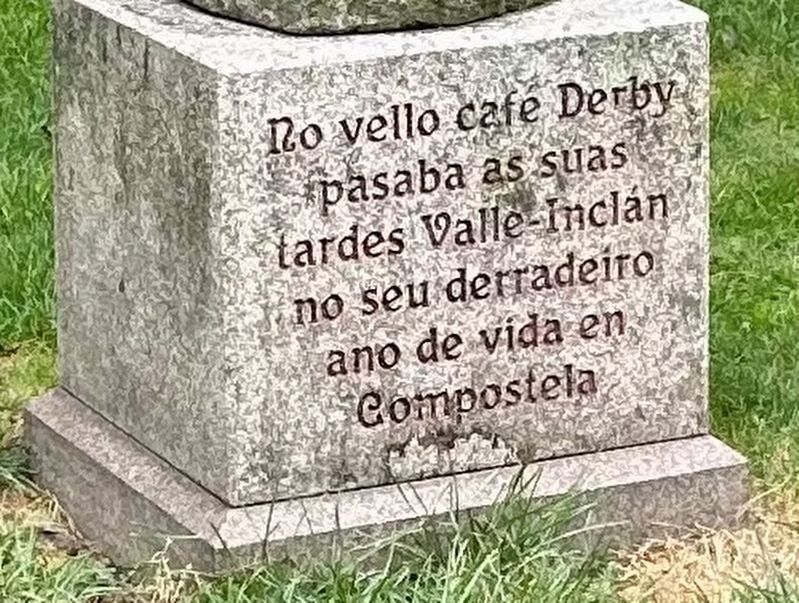
Photographed by Andrew Ruppenstein, September 12, 2023
1. Valle-Inclán Marker

pasaba as suas
tardes Valle-Inclán
no seu derradeiro
ano de vida en
Compostela
In the old Derby Cafe Valle-Inclán passed the afternoons of his last year of life here in Compostela.
Topics. This historical marker is listed in these topic lists: Arts, Letters, Music • Entertainment. A significant historical date for this entry is January 5, 1936.
Location. 42° 52.601′ N, 8° 32.659′ W. Marker is in Santiago de Compostela, Galicia, in A Coruña. It is at the intersection of Rúa do Hórreo and Praza de Galicia, on the left when traveling north on Rúa do Hórreo. Touch for map. Marker is in this post office area: Santiago de Compostela, Galicia 15702, Spain. Touch for directions.

Regionally, it is in the North Atlantic Region, on the Atlantic Arc, in Europe, in the European Union, in Atlantic Europe, on the Iberian Peninsula, in the Schengen Area, in a coastal Mediterranean country, and in the Western World. Historically, it finds itself in what was once the Roman Empire.
Other nearby markers. At least 8 other markers are within walking distance of this marker: Victoriano García Martí (about 90 meters away, measured in a direct line); Fundación e Museo Eugenio Granell / Eugenio Granell Foundation and Museum
this page online
Related markers. Click here for a list of markers that are related to this marker.
Also see . . . Ramón del Valle-Inclán (Wikipedia).
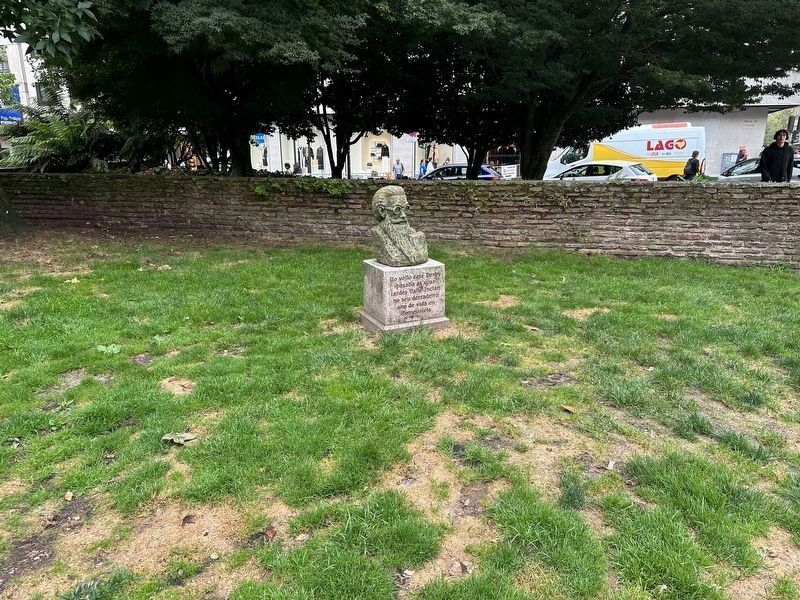
Overview: Ramón María del Valle-Inclán y de la Peña (born in Vilanova de Arousa, Galicia, Spain, on 28 October 1866 – died in Santiago de Compostela on 5 January 1936) was a Spanish dramatist, novelist, and member of the Spanish Generation of 98. He is considered perhaps the most noteworthy and certainly the most radical dramatist to have worked to subvert the traditionalism of the Spanish theatrical establishment in the early part of the 20th century. His influence on later generations of Spanish dramatists makes his drama even more significant. He is honored on National Theatre Day with a statue in Madrid that receives homage from(Submitted on January 31, 2024.)the theatrical profession.Photographed by Andrew Ruppenstein, September 12, 20232. Valle-Inclán bust and markerThe marker is in a grassy area of Praza da Galicia. The Café Derby is across the street, about 30 meters to the north.
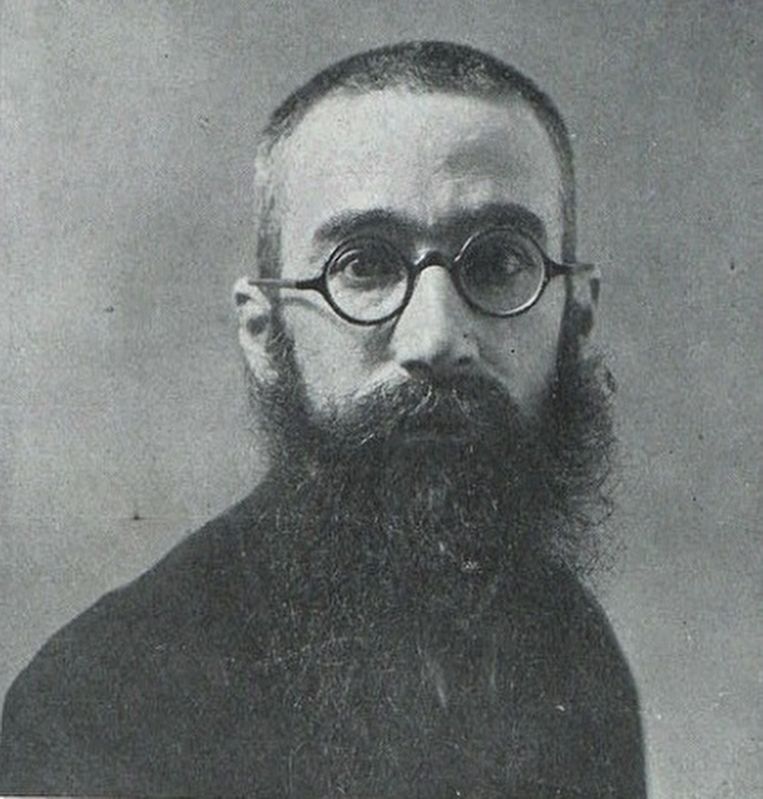
Photographed by Pau Audouard Deglaire (via Wikimedia Commons), circa 1911
3. Ramón María del Valle Inclán
Credits. This page was last revised on January 31, 2024. It was originally submitted on January 31, 2024, by Andrew Ruppenstein of Lamorinda, California. This page has been viewed 118 times since then and 22 times this year. Photos: 1, 2, 3. submitted on January 31, 2024, by Andrew Ruppenstein of Lamorinda, California.
