Bedford in Bedford County, Virginia — The American South (Mid-Atlantic)
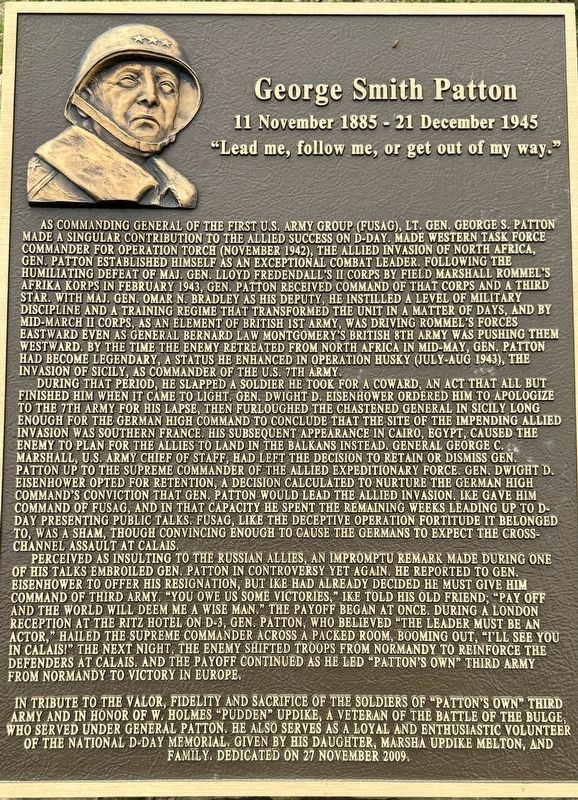
George Smith Patton
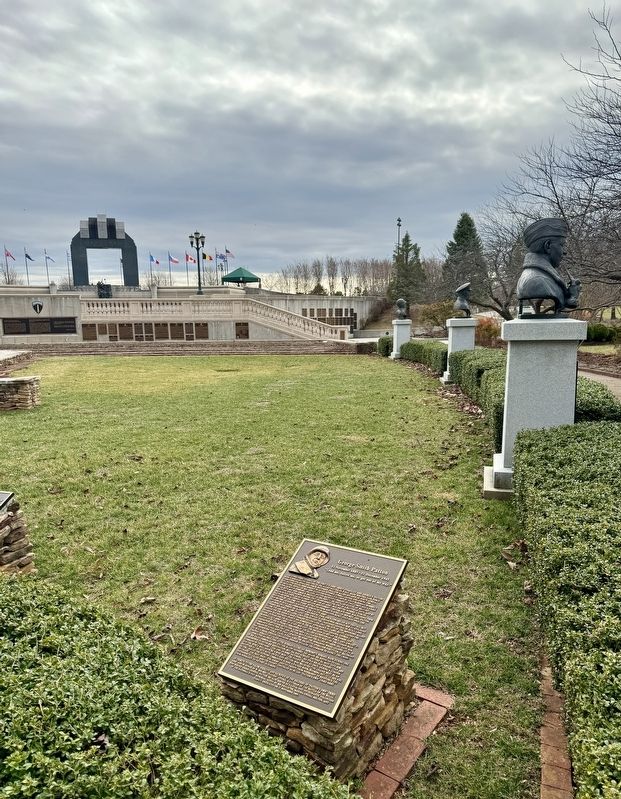
National D-Day Memorial
Photographed by Brandon D Cross
1. George Smith Patton Marker
“Lead me, follow me, or get out of my way.”
As Commanding General of the First U.S. Army Group (FUSAG), Lt. Gen. George S. Patton made a singular contribution to the Allied success on D-Day. Made Western Task Force Commander for Operation Torch (November 1942), the Allied invasion of North Africa, Gen. Patton established himself as an exceptional combat leader. Following the humiliating defeat of Maj. Gen. Lloyd Fredendall’s II Corps by Field Marshall Rommel’s Afrika Korps in February 1943, Gen. Patton received command of that Corps and a third star. With Maj. Gen. Omar N. Bradley as his deputy, he instilled a level of military discipline and a training regime that transformed the unit in a matter of days, and by mid-March II Corps, as an element of British First Army, was driving Rommel’s forces eastward even as General Bernard Law Montgomery’s British Eighth Army was pushing them westward. By the time the enemy retreated from North Africa in mid-May, Gen. Patton had become legendary, a status he enhanced in Operation Husky (July-Aug 1943), the invasion of Sicily, as commander of the U.S. 7th Army.
During that period, he slapped a soldier he took for a coward, an act that all but finished
this page online
Perceived as insulting to the Russian Allies, an impromptu remark made during one of his talks embroiled Gen. Patton in controversy again. He reported to Gen. Eisenhower to offer his resignation, Ike had already decided he must give him command
Photographed by Brandon D Cross
2. George Smith Patton Marker
Erected by National D-Day Memorial.
Topics and series. This memorial is listed in this topic list: War, World II. In addition, it is included in the U.S. National D-Day Memorial series list. A significant historical date for this entry is June 6, 1944.
Location. 37° 19.873′ N, 79° 32.158′ W. Memorial is in Bedford, Virginia, in Bedford County. It can

Wikimedia Commons/Public Domain
3. George Smith Patton

Regionally, this memorial is in Southwest Virginia. It is also in the American South and specifically in the Upper South. Globally, it is in North America, the Western Hemisphere, the Western World, and the Anglosphere. Historically, it finds itself in what was once the territory of the Mississippian Culture, one of the original Thirteen Colonies, one of the Confederate States of America, and the Antebellum South.
Other nearby markers. At least 8 other markers are within walking distance of this marker: Operation Fortitude (here, next to this marker); Chief of Staff to the Supreme Allied Commander (COSSAC) (here, next to this marker); Arthur William Tedder (here, next to this marker); Supreme Headquarters Allied Expeditionary Forces (SHAEF) Insignia (here, next to this marker); Dwight David “Ike” Eisenhower (here, next to this marker); 29th Ranger Battalion (here, next to this marker); Exercise Tiger (a few steps from this marker); Chad Valley Toy Company (a few steps from this marker). Touch for a list and map of all markers in Bedford.
Also see . . .
1. Geroge S. Patton. Wikipedia entry (Submitted on September 6, 2024, by Larry Gertner of New York, New York.)
2. National D-Day Memorial. Encyclopedia Virginia website entry (Submitted on February 1, 2024, by Brandon D Cross of Flagler Beach, Florida.)
Credits. This page was last revised on September 6, 2024. It was originally submitted on February 1, 2024, by Brandon D Cross of Flagler Beach, Florida. This page has been viewed 244 times since then and 40 times this year. Photos: 1, 2, 3. submitted on February 1, 2024, by Brandon D Cross of Flagler Beach, Florida. • Andrew Ruppenstein was the editor who published this page.
