Bedford in Bedford County, Virginia — The American South (Mid-Atlantic)
Exercise Tiger
22-30 April 1944
| — | National D-Day Memorial | — |
Photographed by Brandon D Cross, 2024
1. Exercise Tiger Marker
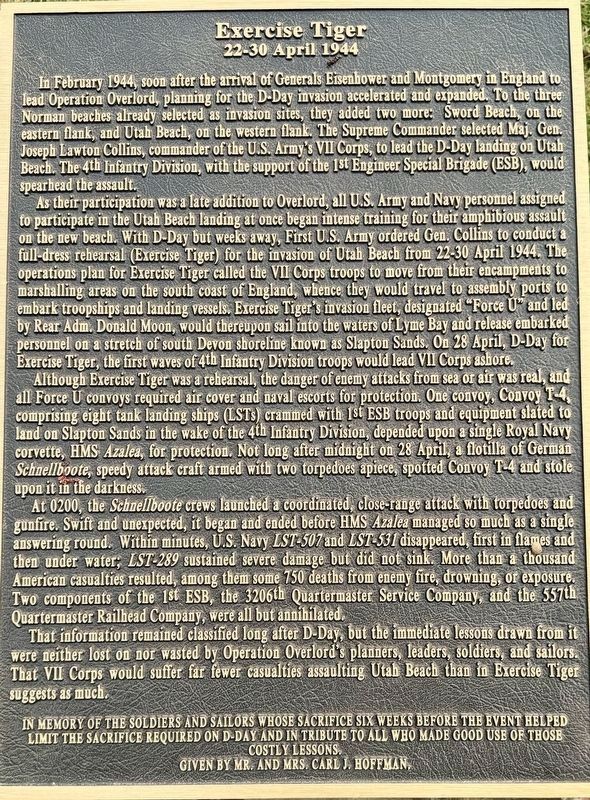
In February 1944, soon after the arrival of Generals Eisenhower and Montgomery in England to lead Operation Overlord, planning for the D-Day invasion accelerated and expanded. To the three Norman beaches already selected as invasion sites, they added two more: Sword Beach, on the eastern flank, and Utah Beach, on the western flank. The Supreme Commander selected Maj. Gen. Joseph Lawton Collins, commander of the U.S. Army's VII Corps, to lead the D-Day landing on Utah Beach. The 4th Infantry Division, with the support of the 1st Engineer Special Brigade (ESB), would spearhead the assault.
As their participation was a late addition to Overlord, all U.S. Army and Navy personnel assigned to participate in the Utah Beach landing at once began intense training for their amphibious assault on the new beach. With D-Day but weeks away, First U.S. Army ordered Gen. Collins to conduct a full-dress rehearsal (Exercise Tiger) for the invasion of Utah Beach from 22-30 April 1944. The operations plan for Exercise Tiger called the VIl Corps troops to move from their encampments to marshaling areas on the south coast of England, whence they would travel to assembly ports to embark troopships and landing vessels. Exercise Tiger's invasion fleet, designated "Force U" and led by Rear Adm. Donald Moon, would thereupon
this page online
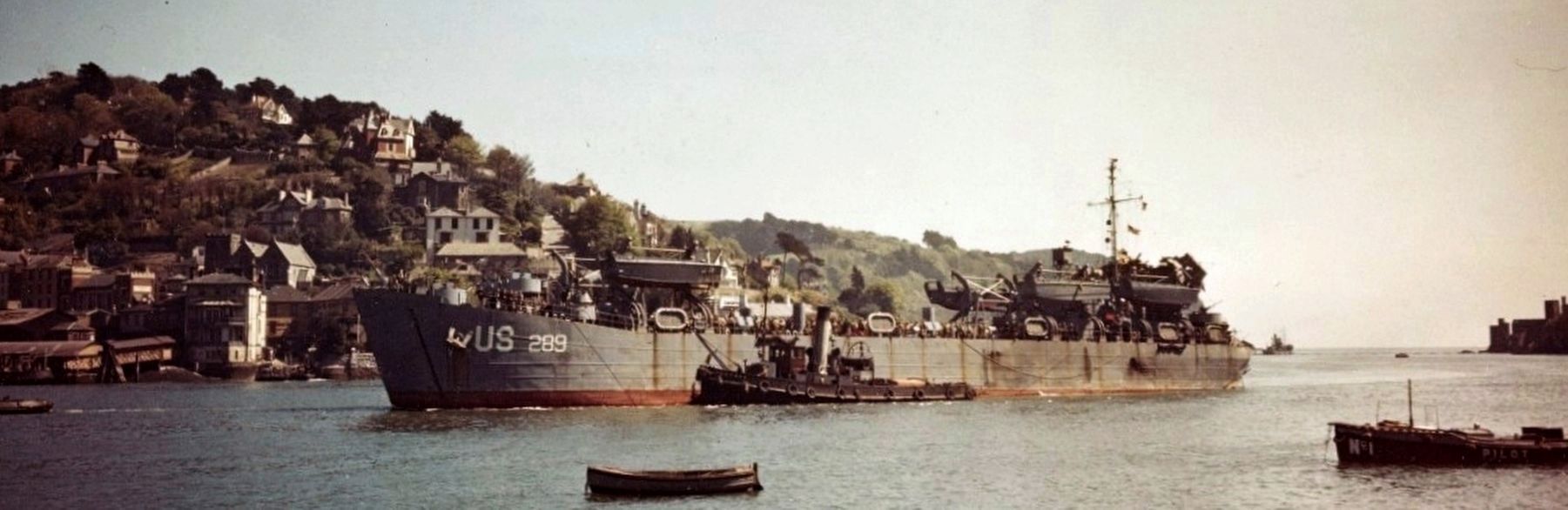
At 0200, the Schnellboote crews launched a coordinated, close-range attack with torpedoes and gunfire. Swift and unexpected, it began and ended before HMS Azalea managed so much as a single answering round. Within minutes, U.S. Navy LST-507 and LST-531 disappeared, first in flames and then under water; LST-289 sustained severe damage but did not sink. More than a thousand American casualties resulted, among them some 150 deaths from enemy fire, drowning, or exposure. Two
via Naval History and Heritage Command, April 8, 1944
2. Exercise Tiger: Disaster at Slapton Sands
Naval History and Heritage Command website entry:
USS LST-289 arrives in Dartmouth Harbor, England, after being torpedoed by German torpedo boats during an invasion rehearsal off Slapton Sands, England, on 28 April 1944 (80-G-K-2054).
Click for more information.
USS LST-289 arrives in Dartmouth Harbor, England, after being torpedoed by German torpedo boats during an invasion rehearsal off Slapton Sands, England, on 28 April 1944 (80-G-K-2054).
Click for more information.
That information remained classified long after D-Day, but the immediate lessons drawn from it were neither lost on nor wasted by Operation Overlord's planners, leaders, soldiers, and sailors. That VII Corps would suffer far fewer casualties assaulting Utah Beach than in Exercise Tiger suggests as much.
Erected by National D-Day Memorial.
Topics and series. This memorial is listed in these topic lists: War, World II • Waterways & Vessels. In addition, it is included in the U.S. National D-Day Memorial series list. A significant historical date for this entry is April 28, 1944.
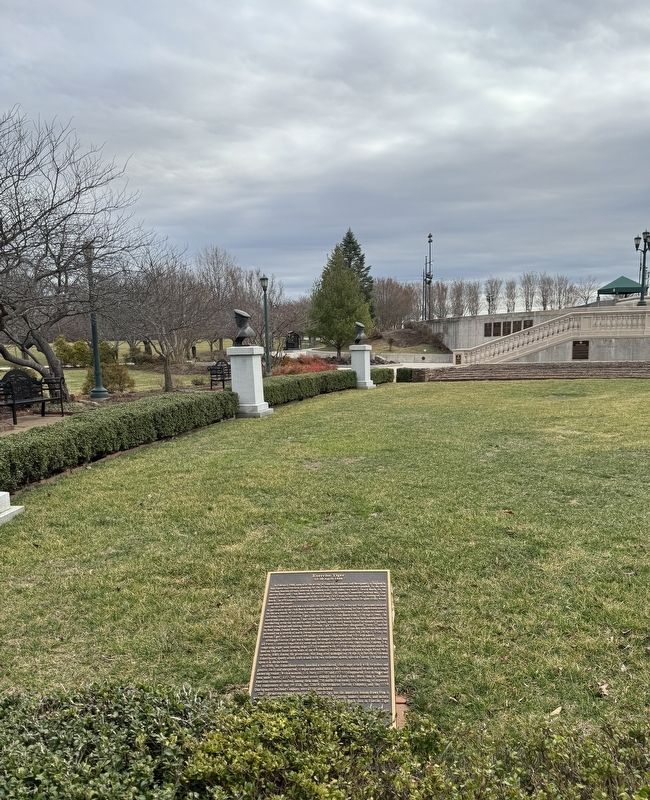
Location. 37° 19.872′ N, 79° 32.151′ W. Memorial is in Bedford, Virginia, in Bedford County. It can be reached from Overlord Circle 0.4 miles west of Burks Hill Road. The Marker is located on the grounds of the National D-Day Memorial. Touch for map. Memorial is at or near this postal address: 3 Overlord Circle, Bedford VA 24523, United States of America. Touch for directions.

Regionally, this memorial is in Southwest Virginia. It is also in the American South and specifically in the Upper South. Globally,
Photographed by Brandon D Cross
3. Exercise Tiger Marker
Other nearby markers. At least 8 other markers are within walking distance of this marker: 29th Ranger Battalion (here, next to this marker); Chad Valley Toy Company (here, next to this marker); Bernard Law “Monty” Montgomery (here, next to this marker); Supreme Headquarters Allied Expeditionary Forces (SHAEF) Insignia (here, next to this marker); Dwight David “Ike” Eisenhower (here, next to this marker); Chief of Staff to the Supreme Allied Commander (COSSAC) (here, next to this marker); Operation Fortitude (a few steps from this marker); George Smith Patton (a few steps from this marker). Touch for a list and map of all markers in Bedford.
Also see . . . National D-Day Memorial. Encyclopedia Virginia website entry (Submitted on February 2, 2024, by Brandon D Cross of Flagler Beach, Florida.)
Credits. This page was last revised on November 12, 2024. It was originally submitted on February 2, 2024, by Brandon D Cross of Flagler Beach, Florida. This page has been viewed 227 times since then and 31 times this year. Photos: 1. submitted on February 2, 2024, by Brandon D Cross of Flagler Beach, Florida. 2. submitted on November 12, 2024, by Larry Gertner of New York, New York. 3. submitted on February 2, 2024, by Brandon D Cross of Flagler Beach, Florida. • Andrew Ruppenstein was the editor who published this page.
