Seaford in Sussex County, Delaware — The American Northeast (Mid-Atlantic)
St. Luke's Episcopal Church
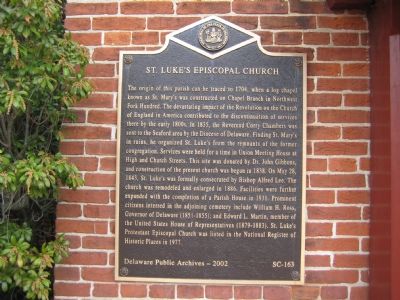
Photographed by F. Robby, December 8, 2007
1. St. Luke's Episcopal Church Marker
this page online
Erected 2002 by Delaware Public Archives. (Marker Number SC-163.)
Topics and series. This historical marker is listed in these topic lists: Government & Politics • Religion & Religious Structures • War, US Revolutionary. In addition, it is included in the Delaware Public Archives, and the National Register of Historic Places (NRHP) series lists. A significant historical date for this entry is May 28, 1843.
Location. 38° 38.626′ N, 75° 36.543′ W. Marker is in Seaford, Delaware, in Sussex County. It is on Front Street (Business U.S. 13) 0.1 miles High Street, on the right when traveling north. Between King and Poplar streets, attached to the church building. Touch for map. Marker is in this post office area: Seaford DE 19973, United States of America. Touch for directions.

Regionally, this marker is in the American Mid-Atlantic, on the Delmarva Peninsula, and on the Eastern Seaboard. Globally, it is in the North Atlantic Region, North America, the Western Hemisphere, the Western World, and the Anglosphere. Historically, it finds itself in what was once New Netherland, one of the original
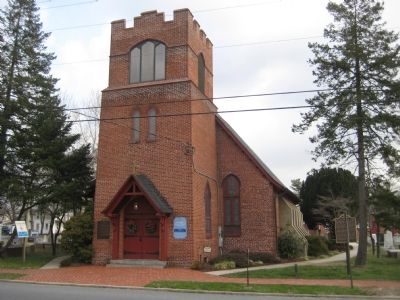
Photographed by F. Robby, December 8, 2007
2. St. Luke's Church
Other nearby markers. At least 8 other markers are within walking distance of this marker: Governor William H. H. Ross (a few steps from this marker); Forty & Eight Boxcar (within shouting distance of this marker); Killed in Action Memorial (within shouting distance of this marker); Nanticoke Post No. 6 (about 300 feet away, measured in a direct line); Veterans Memorial (about 300 feet away); Gateway to Freedom: The Tilly Escape (about 700 feet away); Mount Olivet United Methodist Church (approx. ¼ mile away); St. John's United Methodist Church (approx. ¼ mile away). Touch for a list and map of all markers in Seaford.
More about this marker. Governor Ross is the subject of his own marker, just to the right of the church building.
Also see . . . St. Luke's Protestant Episcopal Church - National Register of Historic Places Nomination Form.
Although it is Seaford's oldest church building still in use, St. Luke's is architecturally significant primarily for its 1904 Gothic-revival reconstruction which remains in a high state of preservation. It faithfully repeats English country church architecture in detail, even including the traditional yew tree near the southeast corner. In other respects, the Gothic model was altered to conform to modern practice. For example, the main door rather than being in the south, is in the west, through the tower. On the whole, however, the architect successfully captured the style and spirit of his prototype.(Submitted on April 24, 2025, by Pete Skillman of Wilmington, Delaware.)
Credits. This page was last revised on April 24, 2025. It was originally submitted on January 27, 2008, by F. Robby of Baltimore, Maryland. This page has been viewed 2,342 times since then and 53 times this year. Last updated on November 3, 2009, by Christopher T. George of Baltimore, Maryland. Photos: 1, 2. submitted on January 27, 2008, by F. Robby of Baltimore, Maryland. • Kevin W. was the editor who published this page.
