Womack Hill near Gilbertown in Choctaw County, Alabama — The American South (East South Central)
Little Place Cemetery
⎯⎯⎯
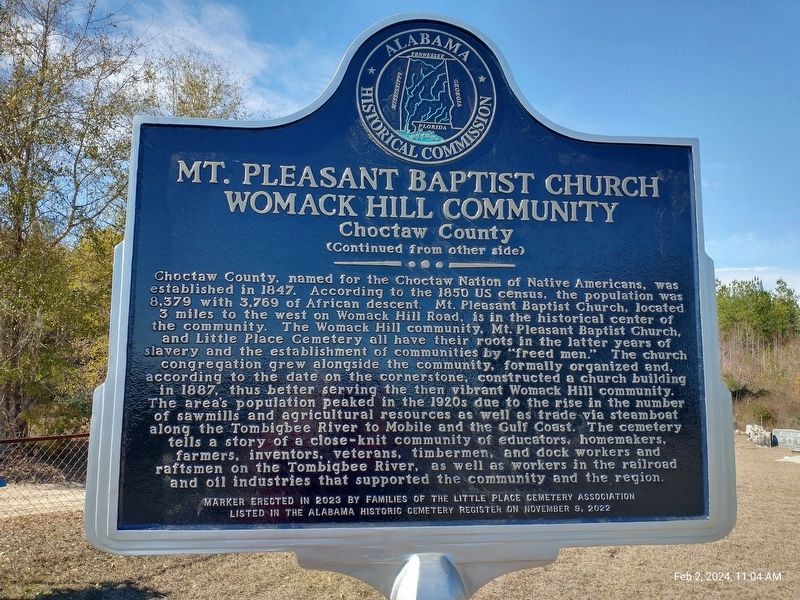
Mt. Pleasant Baptist Church Womack Hill Community
Choctaw County
Photographed by Jim Ellis, February 2, 2024
1. Side 1 Little Place Cemetery
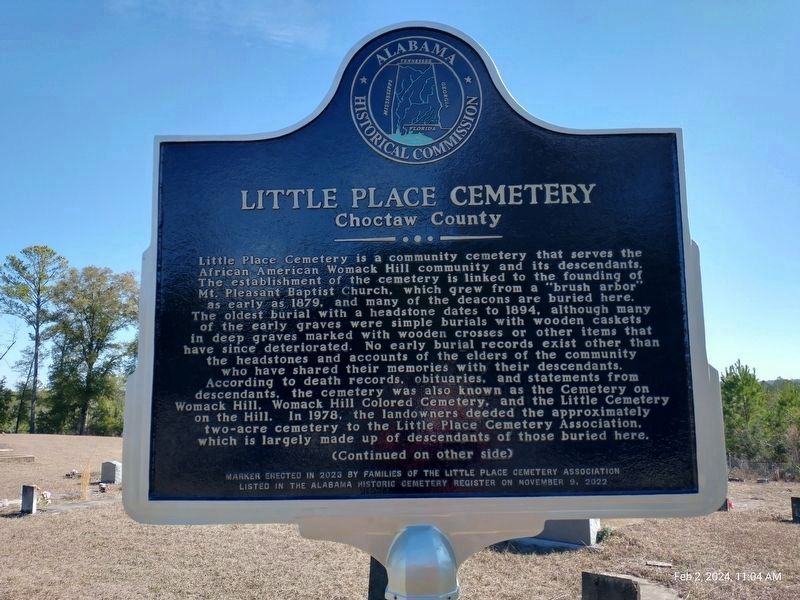
Little Place Cemetery is a community cemetery that serves the African American Womack Hill community and its descendants. The establishment of the cemetery is linked to the founding of Mt. Pleasant Baptist Church, which grew from a “brush arbor” as early as 1879, and many of the deacons are buried here. The oldest burial with a headstone dates to 1894, although many of the early graves were simple burials with wooden caskets in deep graves marked with wooden crosses or other items that have since deteriorated. No early burial records exist other than the headstones and accounts of the elders of the community who have shared their memories with their descendants. According to death records, obituaries, and statements from descendants, the cemetery was also known as the Cemetery on Womack Hill, Womack Hill Colored Cemetery, and the Little Cemetery on the Hill. In 1978, the landowners deeded the approximately two-acre cemetery to the Little Place Cemetery Association, which is largely made up of descendants of those buried here. (Continued on Other Side)
(Continued
this page online
Photographed by Jim Ellis, February 1, 2024
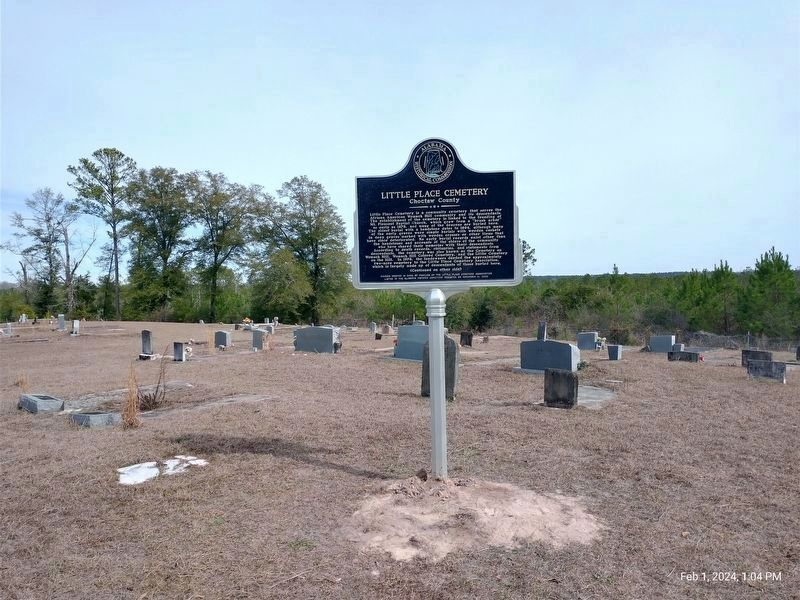
2. Side 1. Marker as seen from the entrance of the cemetery.
Erected 2023 by Families of the Little Place Cemetery Association and Alabama Historical Commission.
Topics and series. This historical marker is listed in these topic lists: African Americans • Cemeteries & Burial Sites • Religion & Religious Structures. In addition, it is included in the Alabama Historical Commission series list. A significant historical year for this entry is 1887.
Location. 31° 52.533′ N, 88° 10.68′ W. Marker is near Gilbertown, Alabama, in Choctaw County. It is in Womack Hill. It is on Little Drive (Little Place Cemetery Drive) 0.2 miles east of Ararat Road (County Route 23), on the left when traveling east. The road way to the cemetery is a sandy soil unimproved roadway that is subject to erosion as well as standing water. Many efforts have been made to place signs at the Ararat Road turn onto Little Drive, including temporary yard signs which may or may not be present. The road is currently named Little Drive however it has been historically known as Little Place Cemetery
Photographed by Jim Ellis, February 2, 2024
3. Side 2. Mt. Pleasant Baptist Church Womack Hill Community

Regionally, this marker is in the American South, specifically in the Deep South, and in the Black Belt. Globally, it is in North America, a Gulf of Mexico state, the Western Hemisphere, the Western World, and the Anglosphere. Historically, it finds itself in what was once New Spain, the territory of the Mississippian Culture, one of the Confederate States of America, and the Antebellum South.
Other nearby markers. At least 8 other markers are within 10 miles of this marker, measured as the crow flies: West Bend
Photographed by Jim Ellis, February 2, 2024
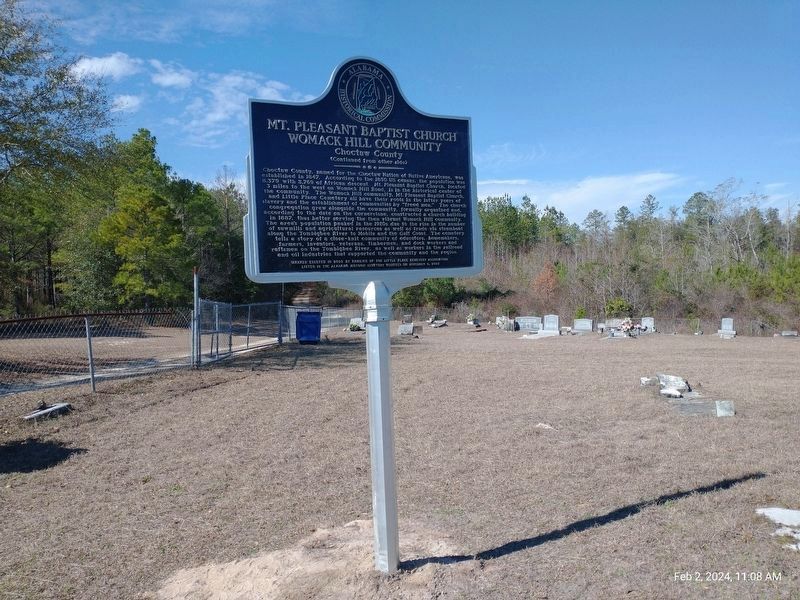
4. Side 2. Marker view to north from inside the cemetery.
More about this marker. The marker is locate near the highest point on the cemetery property inside the entrance gate as one faces the southern horizon. Many of the earliest graves are located nearby the marker.
Although ordered in the Spring of 2023, production backlogs associated with the COVID years delayed final production/delivery until January 2024 and installation on February 1, 2024 - the first day of African American History month.
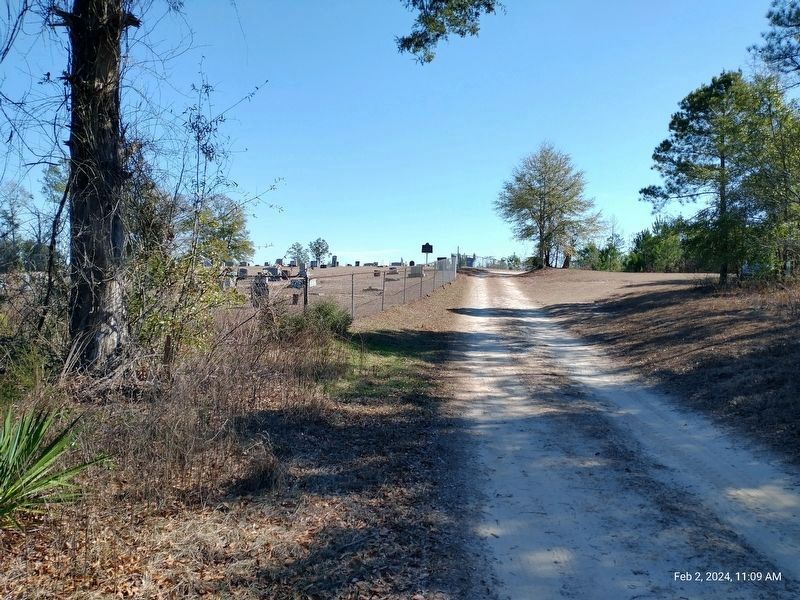
Photographed by Jim Ellis, February 2, 2024
5. Cemetery with marker as seen from Little Drive approach to the cemetery from the north.
Credits. This page was last revised on February 4, 2024. It was originally submitted on February 4, 2024, by Jim Ellis of Theodore, Alabama. This page has been viewed 768 times since then and 88 times this year. Photos: 1, 2, 3, 4, 5. submitted on February 4, 2024, by Jim Ellis of Theodore, Alabama. • James Hulse was the editor who published this page.
