Near Salina in Sevier County, Utah — The American Mountains (Southwest)
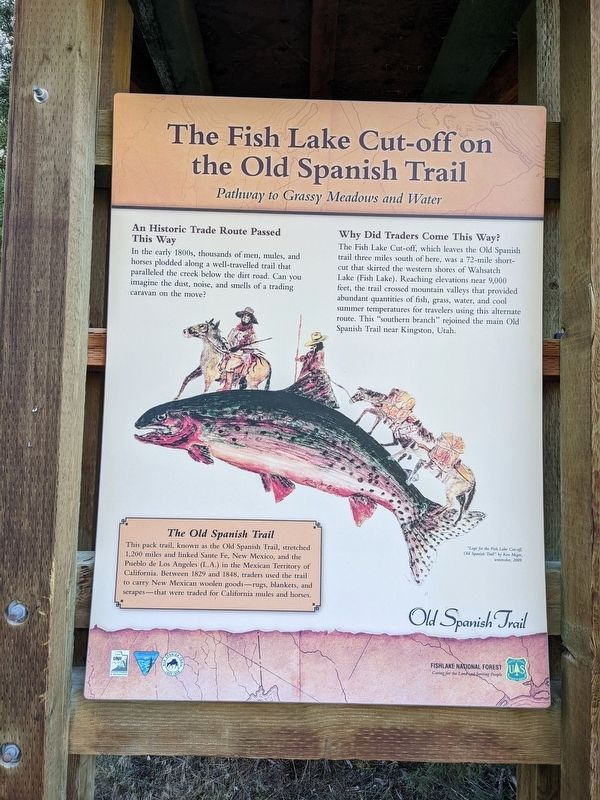
The Fish Lake Cut-off on the Old Spanish Trail
Pathway to Grassy Meadows and Water
Photographed by Jeremy Snow, July 6, 2023
1. The Fish Lake Cut-off on the Old Spanish Trail Marker
An Historic Trade Route Passed This Way
In the early 1800s, thousands of men, mules, and horses plodded along a well-travelled trail that paralleled the creek below the dirt road. Can you imagine the dust, noise, and smells of a trading caravan on the move?
The Old Spanish Trail
This pack trail, known as the Old Spanish Trail, stretched 1,200 miles and linked Sante Fe, New Mexico, and the Pueblo de Los Angeles (L.A.) in the Mexican Territory of California. Between 1829 and 1848, traders used the trail to carry New Mexican woolen goods-rugs, blankets, and serapes that were traded for California mules and horses.
Why Did Traders Come This Way?
The Fish Lake Cut-off, which leaves the Old Spanish trail three miles south of here, was a 72-mile short-cut that skirted the western shores of Wahsatch Lake (Fish Lake). Reaching elevations near 9,000 feet, the trail crossed mountain valleys that provided abundant quantities of fish, grass, water, and cool summer temperatures for travelers using this alternate route. This "southern branch" rejoined the main Old Spanish Trail near Kingston, Utah.
Erected by Forest Service,
this page online
Topics and series. This historical marker is listed in this topic list: Roads & Vehicles. In addition, it is included in the Old Spanish National Trail series list. A significant historical year for this entry is 1829.
Location. 38° 45.712′ N, 111° 27.81′ W. Marker is near Salina, Utah, in Sevier County. It is on FR 1421, on the right when traveling north. Touch for map. Marker is at or near this postal address: FR 1421, Salina UT 84654, United States of America. Touch for directions.

Regionally, this marker is in the Central Utah Valleys. It is also in the American Mountain West and on the Colorado Plateau. Globally, it is in North America, the Western Hemisphere, the Western World, and the Anglosphere. Historically, it finds itself in what was once New Spain and also Mexico’s Alta California.
Credits. This page was last revised on December 30, 2024. It was originally submitted on February 7, 2024, by Jeremy Snow of Cedar City, Utah. This page has been viewed 263 times since then and 36 times this year. Photo 1. submitted on February 7, 2024, by Jeremy Snow of Cedar City, Utah. • Andrew Ruppenstein was the editor who published this page.
Editor’s want-list for this marker. photo of marker within its surroundings • Can you help?
