Hagley Museum near Wilmington in New Castle County, Delaware — The American Northeast (Mid-Atlantic)
Roll Mill
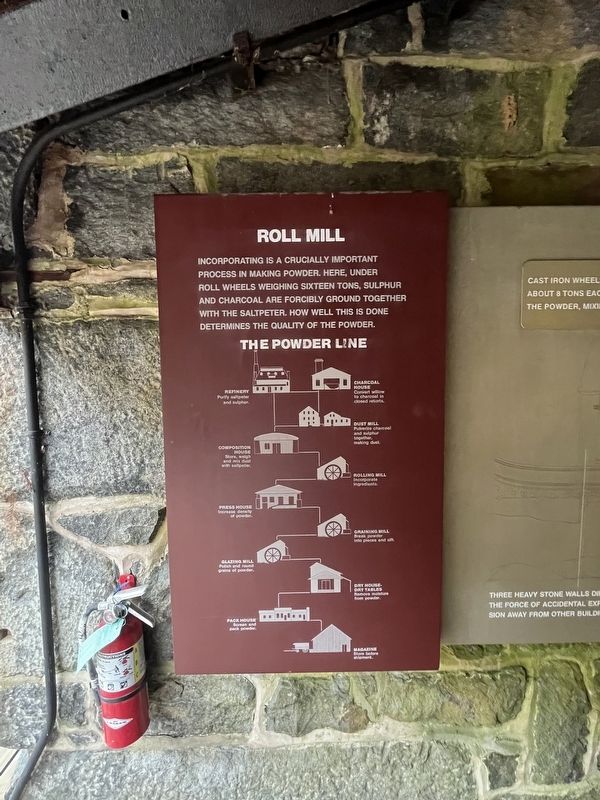
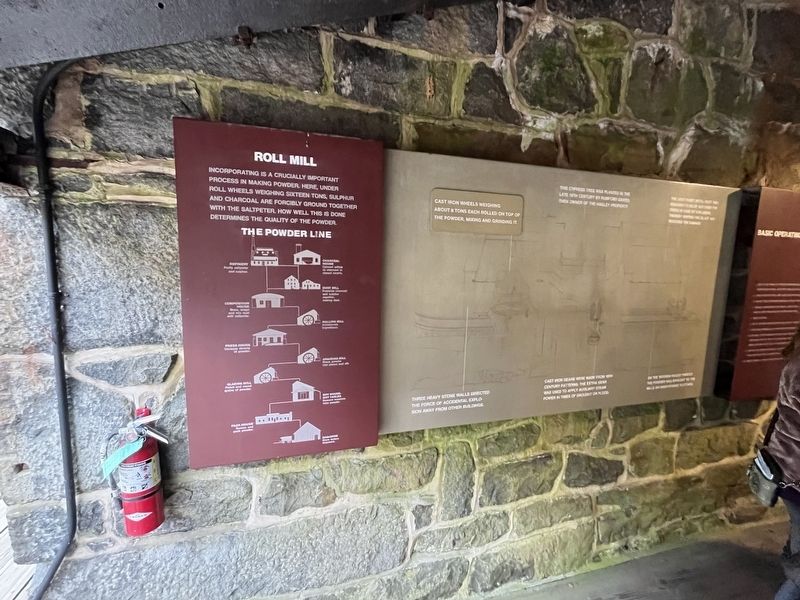
Incorporating is a crucially important process in making powder. Here, under roll wheels weighing sixteen tons, sulphur and charcoal are forcibly ground together with the saltpeter. How well this is done determines the quality of the powder.
The Powder Line Refinery Purify saltpeter and sulphur. • Charcoal House Convert willow to charcoal in closed retorts. • Dust Mill Pulverize charcoal and sulphur together, making dust. • Composition House Store, weigh and mix dust with saltpeter. • Rolling Mill Incorporate ingredients. • Press House Increase density of powder. • Graining Mill Break powder into pieces and sift. • Glazing Mill Polish and round grains of powder. • Dry House-Dry Tables Remove moisture from powder. • Pack House Screen and pack powder. • Magazine Store before shipment.
Cast iron wheels weighing about 8 tons each rolled on top of the powder, mixing and grinding it.
This cypress tree was planted in the late 18th century by Rumford Dawes, then owner of the Hagley property.
The light sheet metal roof was designed to blow out over the creek in case of explosion, thereby venting
this page online
Three heavy stone walls directed the force of accidental explosion away from other buildings.
Cast iron gears were made from 18th century patterns. The extra gear was used to apply auxiliary steam power in times of drought or flood.
On the wooden railed trestle the powder was brought to the mills on hand-pushed flatcarts.
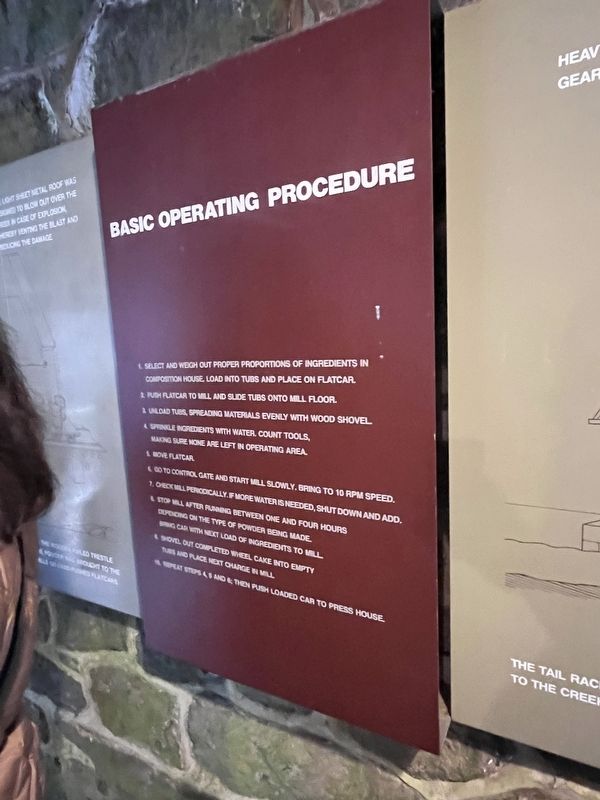
Basic Operating Procedure 1. Select and weigh out proper proportions of ingredients in composition house. Load into tubs and place on flagcar.
2. Push flatcar to mill and slide tubs onto mill floor.
3. Unload tubs, spreading materials evenly with wood shovel.
4. Sprinkle ingredients with water. Count tools, making sure none are left in operating area.
5. Move flatcar.
6. Go to control gate and start mill slowly. Bring to 10 rpm speed.
7. Check mill periodically. If more water is needed, shut down and add.
8. Stop mill after running between one and four hours depending on the type of powder being made.
9. Shovel out completed wheel cake into empty tubs and place next charge in mill.
10. Repeat steps 4,5 and 6; then push loaded car to press house.
Heavy "I"
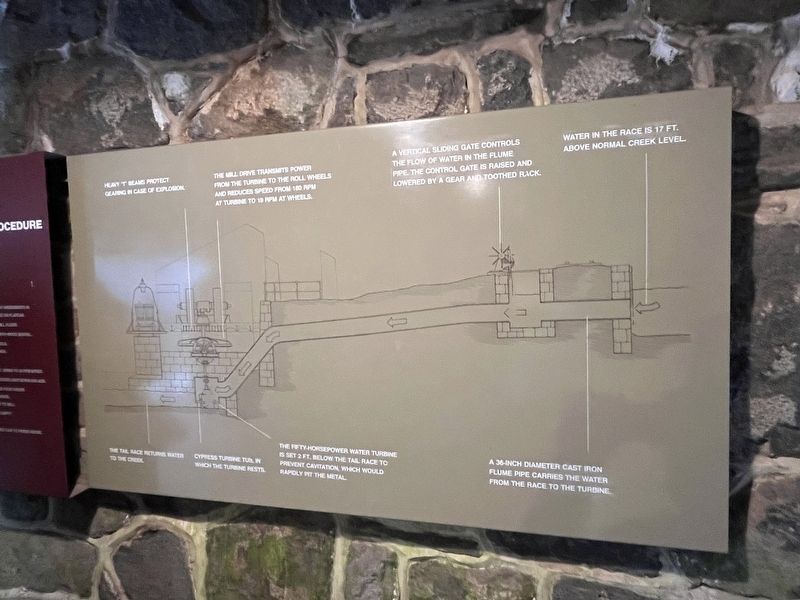
The mill drive transmits power from the turbine to the roll wheels and reduces speed from 180 rpm at turbine to 10 rpm at wheels.
A vertical sliding gate controls the flow of water in the flume pipe. The control gate is raised and lowered by a gear and toothed rack.
Water in the race is 17 ft. above normal creek level.
The tail race returns water to the creek.
Cypress turbine tub, in which the turbine rests.
The fifty-horsepower water turbine is set 2 ft. below the tail race to prevent cavitation, which would rapidly pit the metal.
A 36-inch diameter cast iron flume pipe carries the water from the race to the turbine.
Erected by Hagley Museum.
Topics. This historical marker is listed in these topic lists: Industry & Commerce • Waterways & Vessels.
Location. 39° 46.693′ N, 75° 34.41′ W. Marker is near Wilmington, Delaware, in New Castle County. It is in Hagley Museum. It can be reached from Hagley Creek Road south of Blacksmith Hill Road, on the right when traveling north. The marker is inside an open-air structure.

Regionally, this marker is in Greater Philadelphia. It is also in the American Mid-Atlantic, on the Delmarva Peninsula, and on the Eastern Seaboard. Globally, it is in the North Atlantic Region, North America, the Western Hemisphere, the Western World, and the Anglosphere. Historically, it finds itself in what was once New Netherland and also one of the original Thirteen Colonies.
Other nearby markers. At least 8 other markers are within walking distance of this marker: J.E. Rhoads & Sons of Delaware Tanbark Stone (here, next to this marker); The Evolution of the Incorporating Process (here, next to this marker); Eagle Roll Mills (within shouting distance of this marker); The Powder Yard (within shouting distance of this marker); Millwright Shop (within shouting distance of this marker); Site A: Millwright Shop (within shouting distance of this marker); The DuPont Company Grows Quickly (within shouting distance of this marker); Sourcing Materials (within shouting distance of
Credits. This page was last revised on February 11, 2024. It was originally submitted on February 11, 2024, by Devry Becker Jones of Washington, District of Columbia. This page has been viewed 198 times since then and 13 times this year. Photos: 1, 2, 3, 4. submitted on February 11, 2024, by Devry Becker Jones of Washington, District of Columbia.
