Wildwood in St. Louis County, Missouri — The American Midwest (Upper Plains)
Historic Kelpe
c.1852
Wildwood
Photographed by Jason Voigt, February 14, 2024
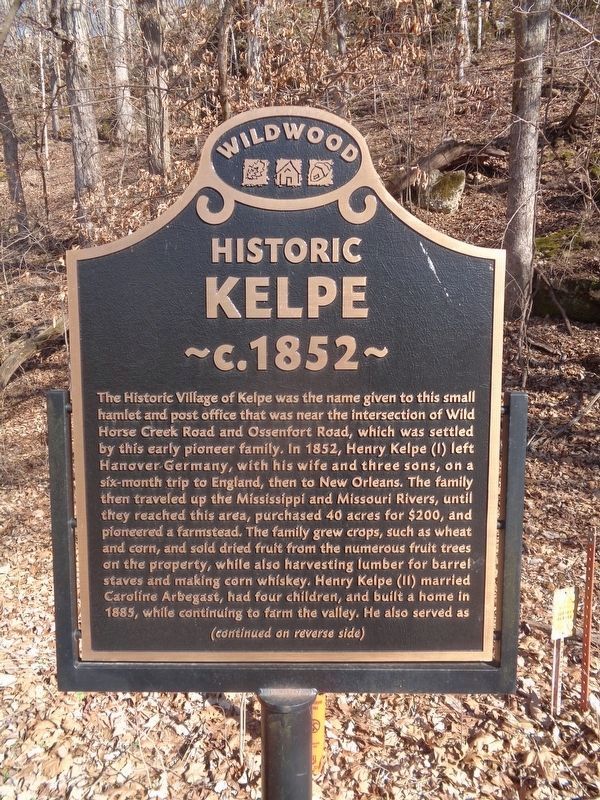
1. Historic Kelpe Marker
front side
Inscription.
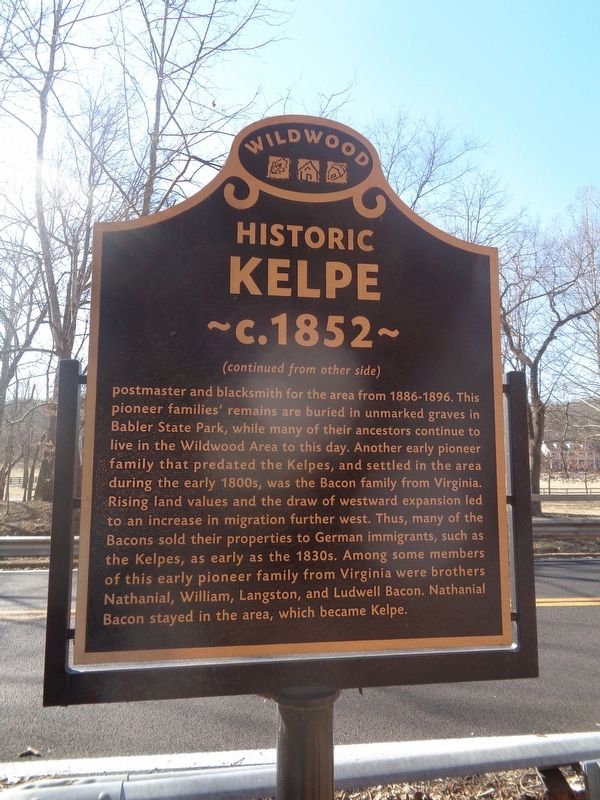
Historic Kelpe. c.1852. The Historic Village of Kelpe was the name given to this small hamlet and post office that was near the intersection of Wild Horse Creek Road and Ossenfort Road, which was settled by this early pioneer family. In 1852, Henry Kelpe (I) left Hanover, Germany, with his wife and three sons, on a six-month trip to England, then to New Orleans. The family then traveled up the Mississippi and Missouri Rivers, until they reached this area, purchased 40 acres for $200, and pioneered a farmstead. The family grew crops, such as wheat and corn, and sold dried fruit from the numerous fruit trees on the property, while also harvesting lumber for barrel staves and making corn whiskey. Henry Kelpe (II) married Caroline Arbegast, had four children, and built a home in 1885, while continuing to farm the valley. He also served as postmaster and blacksmith for the area from 1886-1896. This pioneer families' remains are buried in unmarked graves in Babler State Park, while many of their ancestors continue to live in the Wildwood Area to this day. Another early pioneer family that predated the Kelpes, and settled in the area during the early 1800s, was the Bacon family from Virginia. Rising land values and the draw of westward expansion led to an increase in migration further west. Thus, many of the Bacons sold their properties to German immigrants, such as the Kelpes, as early as the 1830s. Among some members of this early pioneer family from Virginia were brothers Nathanial, William, Langston, and Ludwell Bacon. Nathanial Bacon stayed in the area, which became Kelpe.
The Historic Village of Kelpe was the name given to this small hamlet and post office that was near the intersection of Wild Horse Creek Road and Ossenfort Road, which was settled by this early pioneer family. In 1852, Henry Kelpe (I) left Hanover, Germany, with his wife and three sons, on a six-month trip to England, then to New Orleans. The family then traveled up the Mississippi and Missouri Rivers, until they reached this area, purchased 40 acres for $200, and pioneered a farmstead. The family grew crops, such as wheat and corn, and sold dried fruit from the numerous fruit trees on the property, while also harvesting lumber for barrel staves and making corn whiskey. Henry Kelpe (II) married Caroline Arbegast, had four children, and built a home in 1885, while continuing to farm the valley. He also served as postmaster and blacksmith for the area from 1886-1896. This pioneer families' remains are buried in unmarked graves in Babler State Park, while many of their ancestors continue to live in the Wildwood Area to this day. Another early pioneer family that predated the Kelpes, and settled in the area during the early 1800s, was the Bacon family from Virginia. Rising land values and the draw of westward expansion led to an increase in migration further west. Thus, many of the Bacons sold their properties to German immigrants, such as
Click or scan to see this page online
the Kelpes, as early as the 1830s. Among some members of this early pioneer family from Virginia were brothers Nathanial, William, Langston, and Ludwell Bacon. Nathanial Bacon stayed in the area, which became Kelpe.
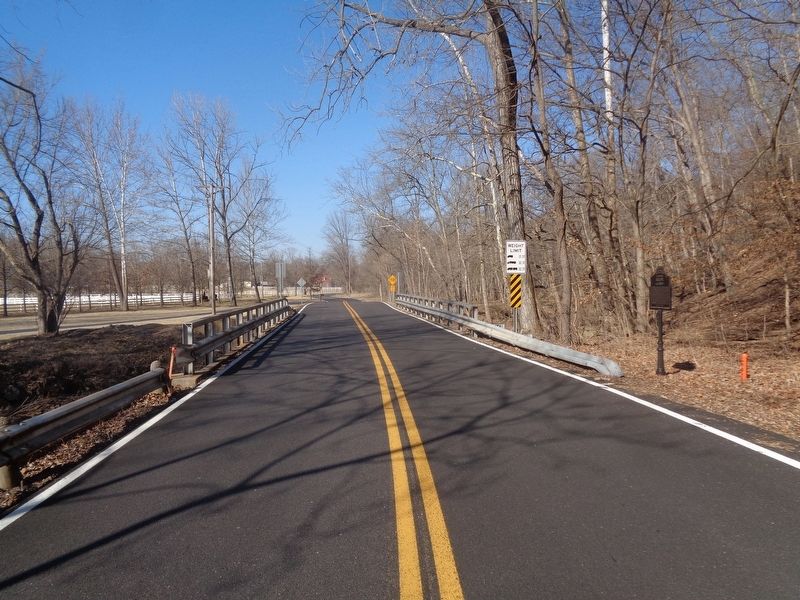
Location. 38° 36.747′ N, 90° 42.845′ W. Marker is in Wildwood, Missouri, in St. Louis County. It is on Wild Horse Creek Road north of Ossenfort Road, on the right when traveling north. Touch for map. Marker is at or near this postal address: 1301 Wild Horse Creek Rd, Chesterfield MO 63005, United States of America. Touch for directions.

Regionally, this marker is in Greater St. Louis. It is also in the American Midwest, in the Lewis & Clark Corridor, in the Corn Belt, and in the Great River Road Region. Globally, it is in North America, the Western Hemisphere, the Western World, and the Anglosphere. Historically, it finds itself in what was once the Viceroyalty of New France, the territory of the Mississippian Culture, the Louisiana Purchase, and the Antebellum South.
Credits. This page was last revised on July 13, 2025. It was originally submitted on February 14, 2024, by Jason Voigt of Glen Carbon, Illinois. This page has been viewed 728 times since then and 21 times this year. Photos:1, 2, 3. submitted on February 14, 2024, by Jason Voigt of Glen Carbon, Illinois.