Gent in Oost-Vlaanderen, Flanders, Belgium — Northwestern Europe
Albrecht Dürer
Photographed by Andrew Ruppenstein, May 13, 2023
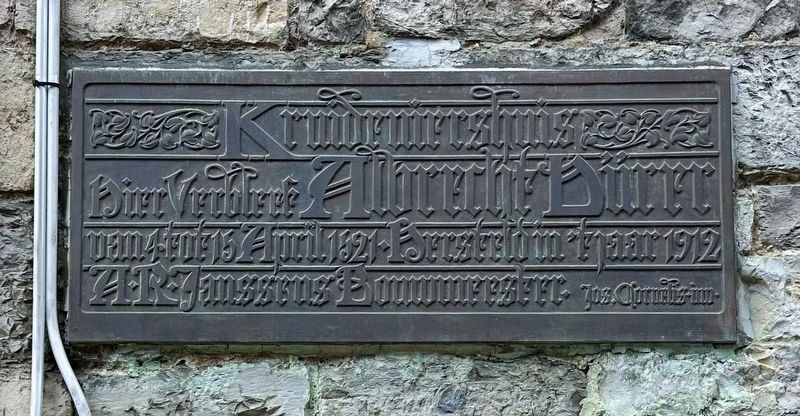
1. Albrecht Dürer Marker

Hier verbleef Albrecht Dürer van 4 tot 15 april 1521
Hersteld in't jaar 1912. • A.R. Janssens Bouwmeester. • Jos. Cornelis Inn.
Grocers House
Here stayed Albrecht Dürer from April 4-15, 1521.
Installed in the year 1912. A.R. Janssens, Builder; Joseph Cornelis, Inn.
Erected 1912.
Topics. This historical marker is listed in this topic list: Arts, Letters, Music. A significant historical date for this entry is April 15, 1521.
Location. 51° 3.256′ N, 3° 43.383′ E. Marker is in Gent, Vlaanderen (Flanders), in Oost-Vlaanderen. It is on Klein Turkije, on the left when traveling east. Touch for map. Marker is at or near this postal address: Klein Turkije 6, Gent, Vlaanderen 9000, Belgium. Touch for directions.

Regionally, it is in Europe, the European Union, Atlantic Europe, the Benelux Low Countries, the Schengen Area, Western Europe, and the Western World. Historically, it finds itself in what was once the Roman Empire and specifically also the Holy Roman Empire.
Other nearby markers. At least 8 other markers are within walking distance of this marker: Sint-Niklaaskerk / L’église Saint-Nicolas / St. Nicholas’ Church
this page online
Also see . . .
1. Albrecht Dürer - German artist (Britannica).
Overview: Albrecht Dürer (born May 21, 1471, Imperial Free City of Nürnberg [Germany]—died April 6, 1528, Nürnberg) painter and printmaker generally regarded as the greatest German Renaissance artist. His vast body of work includes altarpieces and religious works, numerous portraits and self-portraits, and copper engravings. His woodcuts, such as the Apocalypse series (1498), retain a more Gothic flavour than the rest of his work.(Submitted on February 16, 2024.)
2. Albrecht Dürer (Wikipedia).
Photographed by Andrew Ruppenstein, May 13, 2023
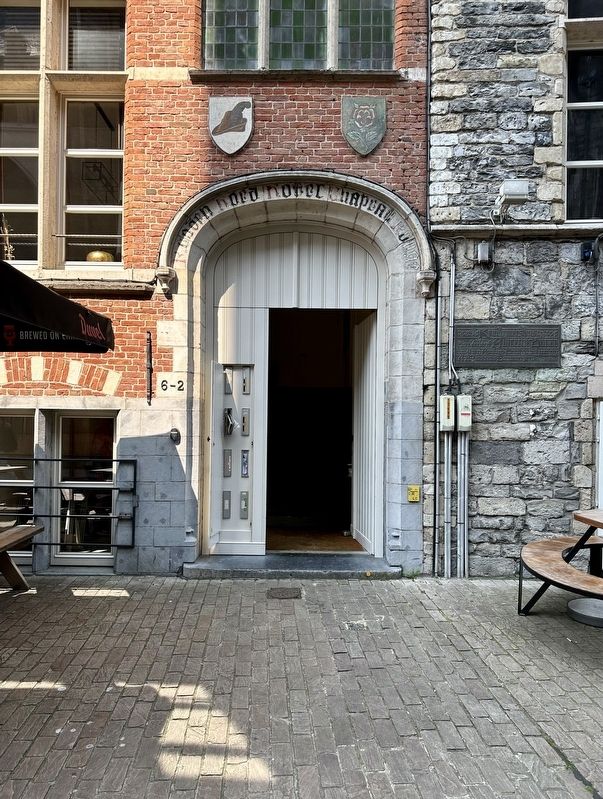
2. Albrecht Dürer Marker - wide view
Journey to the Netherlands (1520–1521): Maximilian's death came at a time when Dürer was concerned he was losing "my sight and freedom of hand" (perhaps caused by arthritis) and increasingly affected by the writings of Martin Luther. In July 1520 Dürer made his fourth and last major journey, to renew the Imperial pension Maximilian had given him and to secure the patronage of the new emperor, Charles V, who was to be crowned at Aachen. Dürer journeyed with his wife and her maid via the Rhine to Cologne and then to Antwerp, where he was well received and produced numerous drawings in silverpoint, chalk and charcoal. In addition to attending the coronation, he visited Cologne (where he admired the painting of Stefan Lochner), Nijmegen, 's-Hertogenbosch, Bruges (where he saw Michelangelo's Madonna of Bruges), Ghent (where he admired van Eyck's Ghent altarpiece), and Zeeland.(Submitted on February 16, 2024.)
Photographed by Andrew Ruppenstein, May 13, 2023
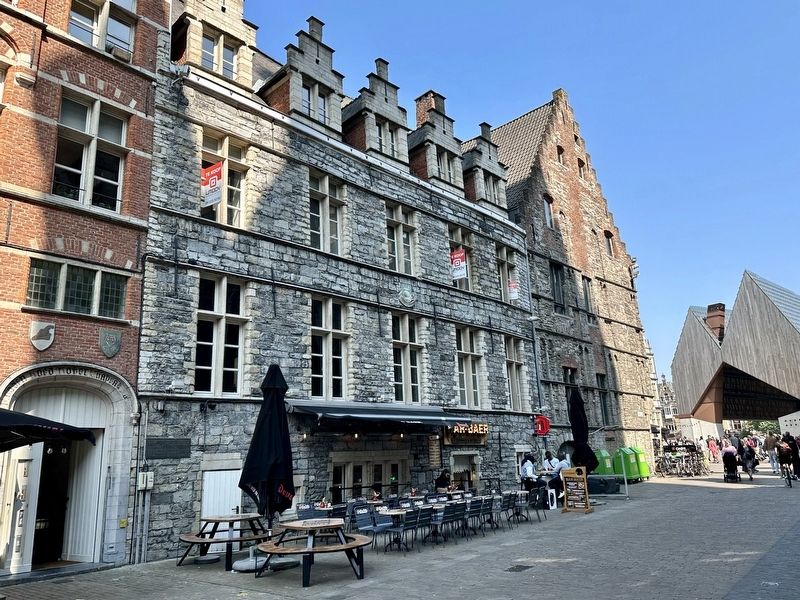
3. Albrecht Dürer Marker - wider view
Credits. This page was last revised on October 26, 2025. It was originally submitted on February 16, 2024, by Andrew Ruppenstein of Lamorinda, California. This page has been viewed 221 times since then and 29 times this year. Photos: 1, 2, 3. submitted on February 16, 2024, by Andrew Ruppenstein of Lamorinda, California.
