Delaware in Delaware County, Ohio — The American Midwest (Great Lakes)
President Hayes Memorial
Photographed by Dale K. Benington, July 29, 2010
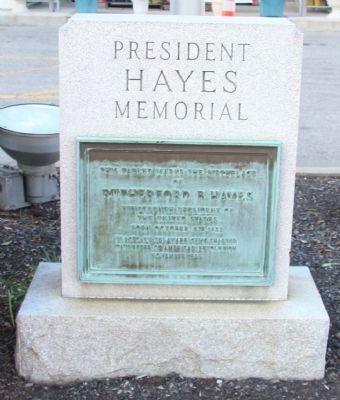
1. President Hayes Memorial Marker
President
Hayes
Memorial
This tablet marks the birthplace
of
Rutherford B. Hayes
Nineteenth President of
The United States
Born October 4th, 1822
Placed by The Delaware City Chapter
Daughters of American Revolution
November 1926
Erected 1926 by The Delaware City Chapter, Daughters of the American Revolution (DAR).
Topics and series. This historical marker and memorial is listed in this topic list: Government & Politics. In addition, it is included in the Daughters of the American Revolution (DAR), and the Former U.S. Presidents: #19 Rutherford B. Hayes series lists. A significant historical month for this entry is October 1919.
Location. Marker has been permanently removed. It was located near 40° 17.933′ N, 83° 4.015′ W. Marker was in Delaware, Ohio, in Delaware County. It was on East Williams Street (U.S. 36) east of North Sandusky Street. This historical marker was located in the downtown Delaware business district, about two and a half blocks west of US 23, in front of what is currently a BP gasoline service station. Touch for map. Marker was in this post office area: Delaware OH 43015, United States of
this page online
We have been informed that this marker is no longer there and will not be replaced. This page is an archival view of what was.
Regionally, this marker and memorial was in the Scioto Valley and in the Columbus Metropolitan Area. It was also in the American Midwest and in the Corn Belt. Globally, it was in North America, the Western Hemisphere, the Western World, and the Anglosphere. Historically, it found itself in what was once the Haudenosaunee (Iroquois) Confederacy, the territory of the Mississippian Culture, and the Northwest Territory.

Other nearby markers. At least 8 other markers are within walking distance of this location: Rutherford B. Hayes Birthplace (here, next to this marker); Old City Hall and Opera House (within shouting distance of this marker); African-American Civil War Soldiers (about 300 feet away, measured in a direct line); Rutherford B. Hayes (about 300 feet away); Frederick Douglass And William Tecumseh Sherman Spoke Here (about 400 feet away); Delaware Run Storm Net (about 500 feet away); 41 North Sandusky Street (about 500 feet away); Welcome To The Labyrinth (about 700 feet away). Touch for a list and map
Photographed by Dale K. Benington, July 29, 2010
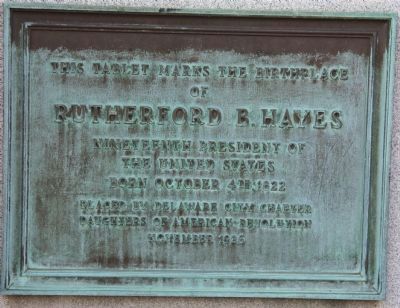
2. President Hayes Memorial Marker
Close-up view of the text that is on the historical marker.
Photographed by Dale K. Benington, July 29, 2010
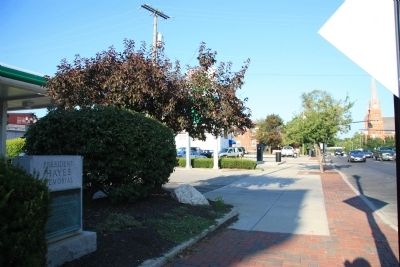
3. President Hayes Memorial Marker
View of historical marker in the left foreground of picture, looking east along East Williams Street.
Photographed by Dale K. Benington, July 29, 2010
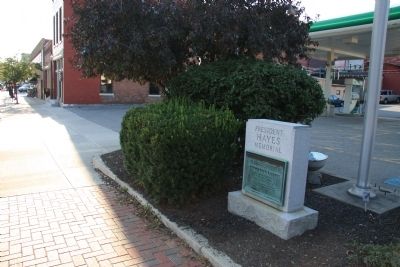
4. President Hayes Memorial Marker
View of historical marker in the right foreground, looking west along East Williams Street.
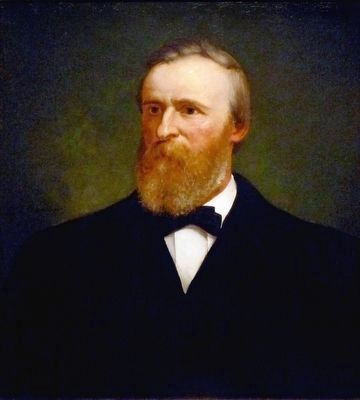
Photographed by Allen C. Browne, August 9, 2015
5. Rutherford B. Hayes
This 1881 portrait by Eliphalet Andrews of Rutherford B. Hayes hangs in the National Portrait Gallery in Washington, DC.
“The presidential election of 1876 was among the closest in American history. Although Democratic candidate Samuel J. Tilden won the popular vote by 250,000, his Electoral College total was one short of the majority needed for election. Republican Rutherford B.Hayes would not concede because of disputed results in Florida, Louisiana, South Carolina, and Oregon. Both parties agreed to appoint an electoral Commission, which awarded the Florida vote and presidency to Hayes. A prior secret agreement between Republicans and Democrats made Hayes president in return for his withdrawal of federal troops from the South. This effectively ended Reconstruction and black political participation in the South and it restored the rule of the Democratic Party there. Even though he was not a strong president, Hayes did take initial steps toward curbing corruption in the civil service.
Hayes's portraitist, Eliphalet Andrews, was the founding director of Washington, D.C.'s Corcoran School of Art.” — National Portrait Gallery
“The presidential election of 1876 was among the closest in American history. Although Democratic candidate Samuel J. Tilden won the popular vote by 250,000, his Electoral College total was one short of the majority needed for election. Republican Rutherford B.Hayes would not concede because of disputed results in Florida, Louisiana, South Carolina, and Oregon. Both parties agreed to appoint an electoral Commission, which awarded the Florida vote and presidency to Hayes. A prior secret agreement between Republicans and Democrats made Hayes president in return for his withdrawal of federal troops from the South. This effectively ended Reconstruction and black political participation in the South and it restored the rule of the Democratic Party there. Even though he was not a strong president, Hayes did take initial steps toward curbing corruption in the civil service.
Hayes's portraitist, Eliphalet Andrews, was the founding director of Washington, D.C.'s Corcoran School of Art.” — National Portrait Gallery
Credits. This page was last revised on February 24, 2024. It was originally submitted on January 17, 2011, by Dale K. Benington of Toledo, Ohio. This page has been viewed 1,590 times since then and 55 times this year. Last updated on February 23, 2024, by Carolyn Sanders of Plano, Texas. Photos: 1, 2, 3, 4. submitted on January 17, 2011, by Dale K. Benington of Toledo, Ohio. 5. submitted on August 24, 2015, by Allen C. Browne of Silver Spring, Maryland. • J. Makali Bruton was the editor who published this page.
