Binnenstad in Delft, South Holland, Netherlands — Northwestern Europe
Het Leven van Johannes Vermeer
⎯⎯⎯
Johannes Vermeer’s Life
Photographed by Andrew Ruppenstein, March 11, 2023
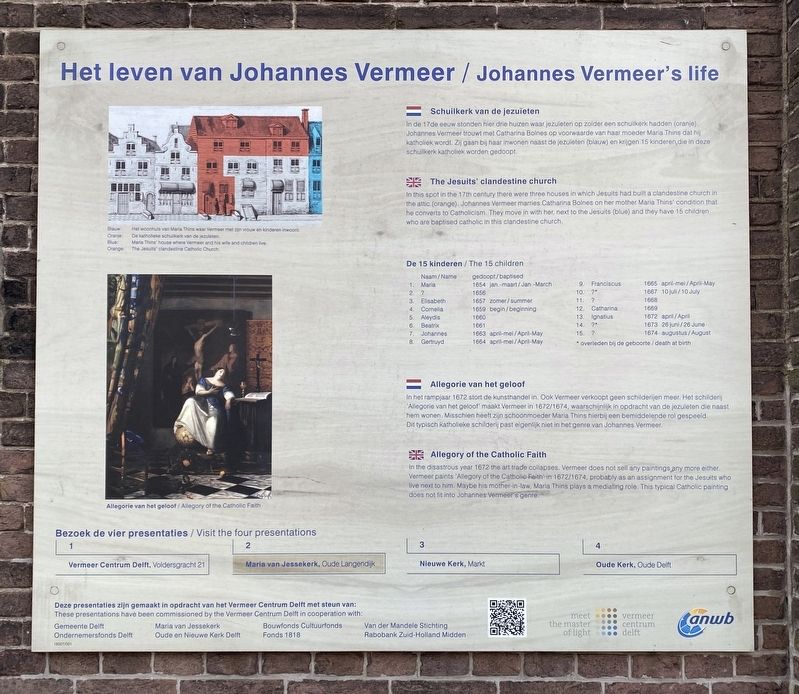
1. Het Leven van Johannes Vermeer / Johannes Vermeer’s Life Marker

In de 17de eeuw stonden hier drie huizen waar jezuïeten op zolder een schuilkerk hadden (oranje). Johannes Vermeer trouwt met Catharina Bolnes op voorwaarde van haar moeder Maria Thins dat hij katholiek wordt. Zij gaan bij haar inwonen naast de jezuïeten (blauw) en krijgen 15 kinderen, die in deze schuilkerk katholiek worden gedoopt.
In this spot in the 17th century there were three houses in which Jesuits had built a clandestine church in the attic (orange). Johannes Vermeer marries Catharina Bolnes on her mother Maria Thins' condition that he converts to Catholicism. They move in with her, next to the Jesuits (blue) and they have 15 children who are baptised catholic in this clandestine church.
De 15 kinderen / The 15 children
Naam/Name gedoopt/baptized
1. Maria 1654 jan.-maart/Jan.-March
2. ? 1656
3. Elisabeth 1657 zomer/summer
4. Cornelia 1659 begin/beginning
5. Aleydis 1660
6. Beatrix 1661
7. Johannes 1663 april-mei/April-May
8. Gertruyd 1664 april-mei/April-May
9. Franciscus 1665 april-mei/April-May
10. ?* 1667 10 juli/10
this page online
11. ? 1668
12. Catharina 1669
13. Ignatius 1672 april/April
14. ?* 1673 26 juni/26 June
15. ? 1674 augustus / August
* overleden bij de geboorte / death at birth
Allegorie van het geloof
In het rampjaar 1672 stort de kunsthandel in. Ook Vermeer verkoopt geen schilderijen meer. Het schilderij 'Allegorie van het geloof maakt Vermeer in 1672/1674, waarschijnlijk in opdracht van de jezuïeten die naast hem wonen, Misschien heeft zijn schoonmoeder Maria Thins hierbij een bemiddelende rol gespeeld. Dit typisch katholieke schilderij past eigenlijk niet in het genre van Johannes Vermeer.
In the disastrous year 1672 the art trade collapses. Vermeer does not sell any paintings any more either. Vermeer paints 'Allegory of the Catholic Faith' in 1672/1674, probably as an assignment for the Jesuits who live next to him. Maybe his mother-in-law, Maria Thins plays a mediating role. This typical Catholic painting does not fit into Johannes Vermeer's genre.
Topics. This historical marker is listed in this topic list: Arts, Letters, Music. A significant historical year for this entry is 1672.
Location. 52° 0.708′ N, 4° 21.647′ E.
Photographed by Andrew Ruppenstein, March 11, 2023
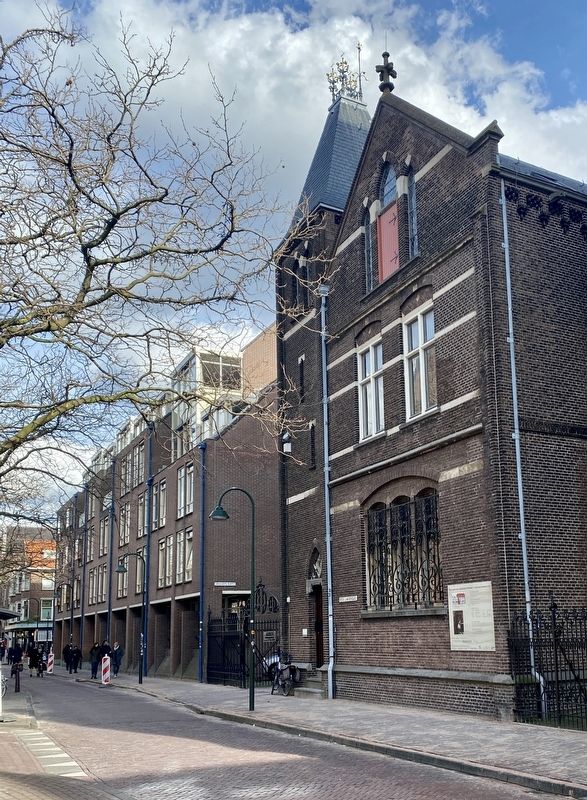
2. Het Leven van Johannes Vermeer / Johannes Vermeer’s Life Marker - wide view

Regionally, it is in Europe, the European Union, Atlantic Europe, the Benelux Low Countries, the Schengen Area, Western Europe, and the Western World. Historically, it finds itself in what was once the Roman Empire and specifically also the Holy Roman Empire.
Other nearby markers. At least 8 other markers are within walking distance of this marker: Johannes Vermeer (within shouting distance of this marker); Nieuwe Kerk / New Church (within shouting distance of this marker); Stadsleenbank / Municipal Loan Office (about 90 meters away, measured in a direct line); Jan Vermeer (about 90 meters away); Stadhuis / Town Hall (about 150 meters away); Heilige Geesthuis (about 150 meters away); Vleeshal / Meathall (about 210 meters away); Gezicht op Delft… / The View of Delft… (about 210 meters away). Touch for a list and map of all markers in Delft.
Credits. This page was last revised on August 13, 2026. It was originally submitted on March 4, 2024, by Andrew Ruppenstein of Lamorinda, California. This page has been viewed 102 times since then and 14 times this year. Photos: 1, 2. submitted on March 4, 2024, by Andrew Ruppenstein of Lamorinda, California. • J. Makali Bruton was the editor who published this page.
