Speckmannshof in Amberg, Bavaria, Germany — Central Europe
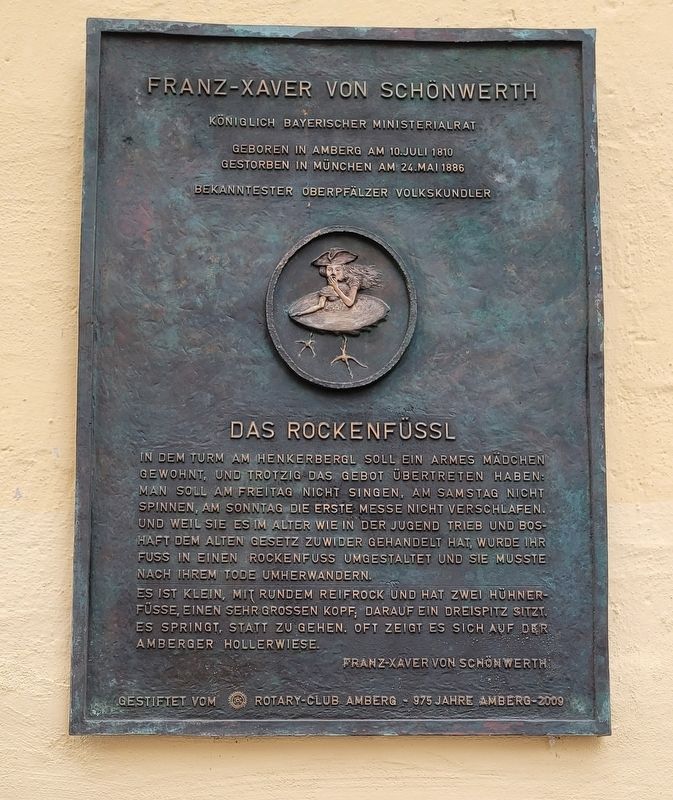
Franz-Xaver von Schönwerth
Photographed by James Hulse, February 19, 2024
1. Franz-Xaver von Schönwerth Marker

Geboren in Amberg Am 10.Juli 1810
Gestorben in München Am 24.Mai 1886
Bekanntester Oberpfälzer Volkskundler
Das Rockenfüssl
Es ist klein, mit rundem reifrock und hat zwei hühnerfüsse, einen sehr grossen kopf, darauf ein dreispitz sitzt. Es springt, statt zu gehen. Oft zeigt es sich auf der amberger hollerwiese.
Franz-Xaver von Schönwerth
Born in Amberg on July 10, 1810
Died in Munich on May 24, 1886
Best-known Upper Palatinate Folklorist
The Distaff
this page online
It is small, with a round hoop skirt and has two chicken feet, a very large head with a tricorn hat sitting on it. It jumps instead of walking. It often shows up on the Amberg holler meadow.
Franz Xavier von Schönwerth
Erected 2009 by Gestiftet Vom and Rotary-Club Amberg - 975 Years of Amberg-2009.
Topics and series. This historical marker is listed in this topic list: Arts, Letters, Music. In addition, it is included in the Rotary International series list. A significant historical date for this entry is May 24, 1886.
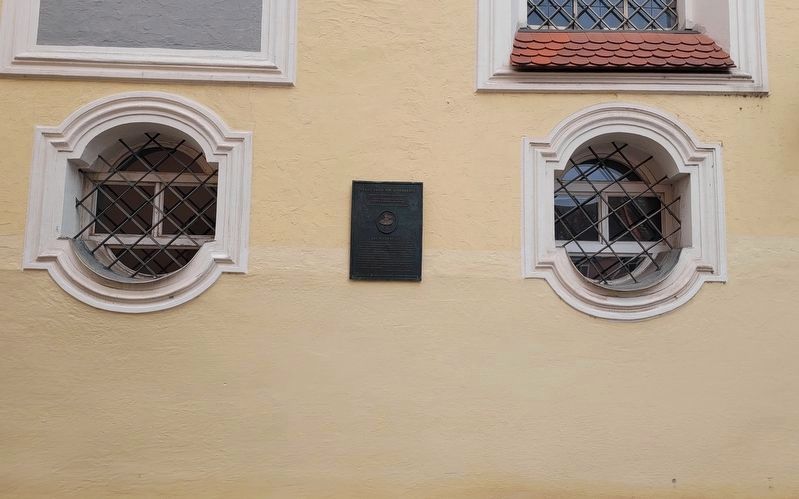
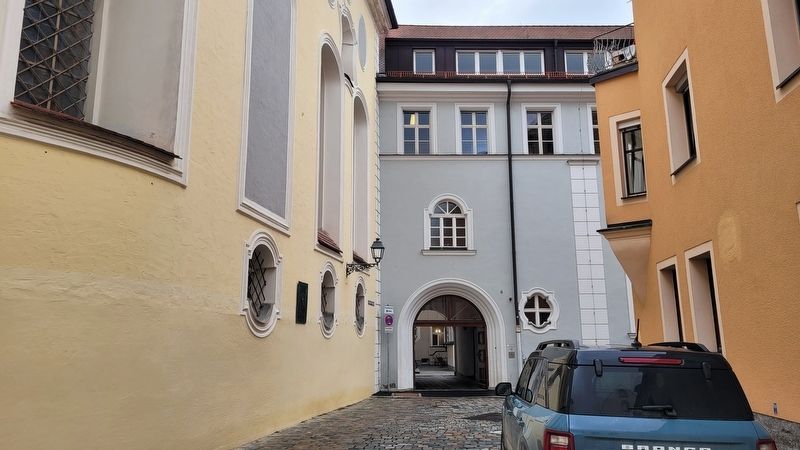
Location. 49° 26.732′ N, 11° 51.321′ E. Marker is in Amberg, Bayern (Bavaria). It is in Speckmannshof. It is on Deutsche Schulgasse just east of Löwenwirtsgäßchen, on the left when traveling east. The marker is located on the southeast side of the church wall. Touch for map. Marker is at or near this postal address: Deutsche Schulgasse 4, Amberg BY 92224,
Photographed by James Hulse, February 19, 2024
2. The Franz-Xaver von Schönwerth Marker on the exterior south wall of the school church

Regionally, it is in Europe, the European Union, Atlantic Europe, Central Europe, the Schengen Area, Western Europe, and the Western World. Historically, it finds itself in what was once the Holy Roman Empire and also the former West Germany.
Other nearby markers. At least 8 other markers are within walking distance of this marker: Amberger Kulturstadel (a few steps from this marker); Schulkirche / School Church (within shouting distance of this marker); Stadttheater / Town Theatre (within shouting distance of this marker); Erna Strauss (about 120 meters away, measured in a direct line); Karl Haymann (about 120 meters away); Fanny Haymann (about 120 meters away); Alte Veste / Old Fortress (about 150 meters away); Ratstrinkstube / Council Taproom (about 180 meters away). Touch for a list and map of all markers in Amberg.
Also see . . . Franz Xaver von Schönwerth. Wikipedia
Schönwerth recorded legends, fairytales, comic stories, children's games, nursery rhymes, children's songs and proverbs. He also observed how people lived, describing the everyday life of peasants, their customs(Submitted on March 6, 2024, by James Hulse of Medina, Texas.)and their traditional costumes. Grimm wrote in a review: "Nowhere in the whole of Germany has anyone collected more circumspectly, more completely, or leaving so few traces." His questionnaires and the care with which he recorded the dialect of responses served as models as folklore collecting became more objective and scientific; Grimm, with whom he corresponded from 1858 on, recommended his methods in a letter to Karl Julius Schröer and told the king that Schönwerth was the only person who could continue his and his brother's work after their deaths. Unlike Grimm, Schönwerth did not seek a unified picture of Germanic folk culture and its pre-Christian origins, but focussed on the distinct features of the Upper Palatinate; he held a now discredited view that the regional dialect showed close parallels to Gothic.Photographed by James Hulse, February 19, 20243. The view of the Franz-Xaver von Schönwerth Marker along the street
Credits. This page was last revised on March 6, 2024. It was originally submitted on March 6, 2024, by James Hulse of Medina, Texas. This page has been viewed 150 times since then and 15 times this year. Photos: 1, 2, 3. submitted on March 6, 2024, by James Hulse of Medina, Texas.
