Kaymoor in Fayette County, West Virginia — The American South (Appalachia)
Protecting Bats
New River Gorge National Park and Preserve
| — | National Park Service, U.S. Department of the Interior | — |
Photographed by Craig Doda, March 2, 2024
1. Protecting Bats Marker
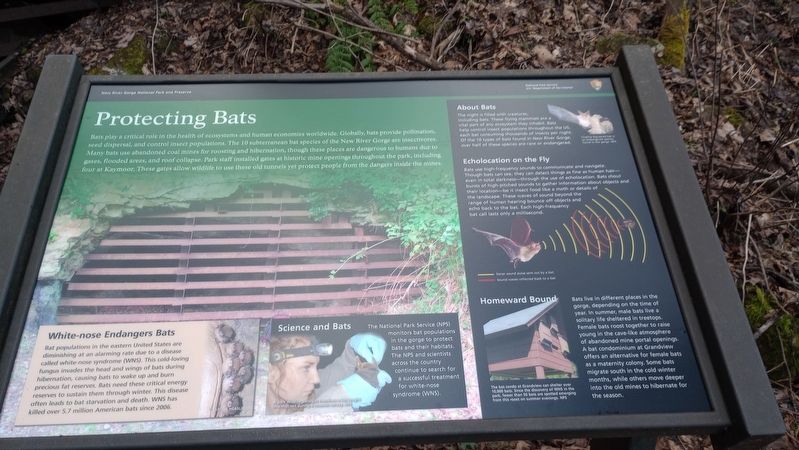
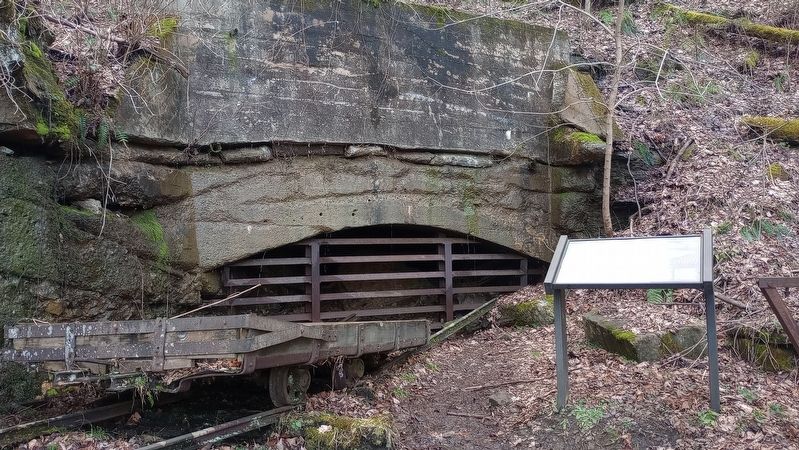
Bats play a critical role in the health of ecosystems and human economies worldwide. Globally, bats provide pollination, seed dispersal, and control insect populations. The 10 subterranean bat species of the New River Gorge are insectivores. Many bats use abandoned coal mines for roosting and hibernation, though these places are dangerous to humans due to gases, flooded areas, and roof collapse. Park staff installed gates at historic mine openings throughout the park, including four at Kaymoor. These gates allow wildlife to use these old tunnels yet protect people from the dangers inside the mines.
White-nose Endangers Bats
Bat populations in the eastern United States are diminishing at an alarming rate due to a disease called white-nose syndrome (WNS). This cold-loving fungus invades the head and wings of bats during hibernation, causing bats to wake up and burn precious fat reserves. Bats need these critical energy reserves to sustain them through winter. This disease often leads to bat starvation and death. WNS has killed over 5.7 million American bats since 2006.
Science and Bats
The National Park Service
this page online
A park wildlife biologist examines a bat caught in a mist net during a research survey NPS
About Bats
The night is filled with creatures, including bats. These flying mammals are a vital part of any ecosystem they inhabit. Sats help control insect populations throughout the US, each bat consuming thousands of insects per night. Of the 10 types of bats found in New River Gorge, over half of these species are rare or endangered.
Echolocation on the Fly
Bats use high-frequency sounds to communicate and navigate. Though bats can see, they can detect things as fine as human hair- even in total darkness-through the use of echolocation. Bats shout bursts of high-pitched sounds to gather information about objects and their location-be it insect food like a moth or details of the landscape. These waves of sound beyond the range of human hearing bounce off objects and echo back to the bat. Each high-frequency bat call lasts only a millisecond.
Homeward Bound
The
Photographed by Craig Doda, March 2, 2024
2. Protecting Bats Marker
Bats live in different places in the gorge, depending on the time of year. In summer, male bats live a solitary life sheltered in treetops. Female bats roost together to raise young in the cave-like atmosphere of abandoned mine portal openings. A bat condominium at Grandview offers an alternative for female bats as a maternity colony. Some bats migrate south in the cold winter months, while others move deeper into the old mines to hibernate for the season.
Erected by National Park Service, U.S. Department of the Interior.
Topics. This historical marker is listed in these topic lists: Animals • Environment. A significant historical year for this entry is 2006.
Location. 38° 2.831′ N, 81° 3.972′ W. Marker is in Kaymoor, West Virginia, in Fayette County. It is at the intersection of Kaymoor Miners Trail and Kaymoor Trail, on the left when traveling west on Kaymoor Miners Trail. Touch for map. Marker is at or near this postal address: 881 Kaymoor Miners Trail, Fayetteville WV 25840, United States of America. Touch for directions.

Regionally, this marker is in the New River Gorge and in Greater Charleston Area. It is also in the American South, specifically in the Upper South, in Appalachia, and specifically in Southern Appalachia. Globally, it is in North America, the Western Hemisphere, the Western World, and the Anglosphere. Historically, it finds itself in what was once the territory of the Mississippian Culture.
Other nearby markers. At least 8 other markers are within walking distance of this marker: From Top to Bottom (here, next to this marker); Getting Coal Down (here, next to this marker); A Busy Bench (within shouting distance of this marker); Valuable Air (about 300 feet away, measured in a direct line); Going Up? (about 500 feet away); Mountain Haulage (approx. 0.2 miles away); Kaymoor One Mine (approx. 0.2 miles away); Kaymoor Bottom (approx. ¼ mile away). Touch for a list and map of all markers in Kaymoor.
Credits. This page was last revised on March 14, 2024. It was originally submitted on March 7, 2024, by Craig Doda of Napoleon, Ohio. This page has been viewed 186 times since then and 26 times this year. Photos: 1, 2. submitted on March 7, 2024, by Craig Doda of Napoleon, Ohio. • Devry Becker Jones was the editor who published this page.
