Washington Hill in Baltimore, Maryland — The American Northeast (Mid-Atlantic)
Site of Poe’s Death
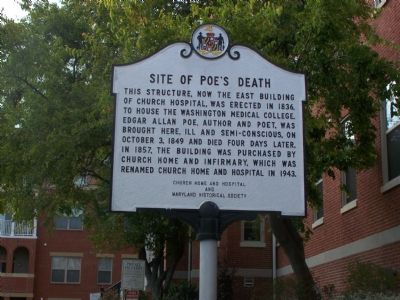
Photographed by William Pfingsten, September 9, 2007
1. Site of Poe's Death Marker
Erected 1986 by Church Home and Hospital and Maryland Historical Society.
Topics and series. This historical marker is listed in these topic lists: Arts, Letters, Music • Religion & Religious Structures • Science & Medicine. In addition, it is included in the Maryland Historical Trust series list. A significant historical month for this entry is October 1930.
Location. 39° 17.595′ N, 76° 35.652′ W. Marker is in Baltimore, Maryland. It is in Washington Hill. It is on North Broadway 0.1 miles south of Fayette Street, on the right when traveling south. Touch for map. Marker is at or near this postal address: 100 North Broadway, Baltimore MD 21231, United States of America. Touch for directions.

Regionally, this marker is in Central Maryland. It is also in the American
this page online
Other nearby markers. At least 8 other markers are within walking distance of this marker: Church Home and Hospital (a few steps from this marker); Thomas Wildey Monument (a few steps from this marker); José Martí (about 300 feet away, measured in a direct line); Ferdinand Clairborne Latrobe (about 500 feet away); Dr. Charles W. Simmons (approx. 0.3 miles away); Notre Dame Convent (approx. 0.3 miles away); “The General’s Highway” (approx. 0.3 miles away); First Baptist Church (approx. 0.3 miles away). Touch for a list and map of all markers in Baltimore.
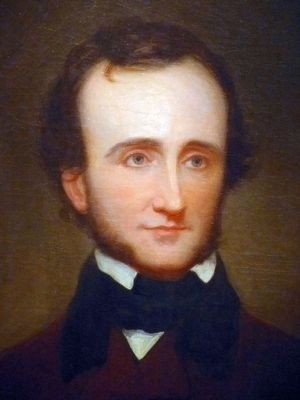
Photographed by Allen C. Browne, February 16, 2015
2. Edgar Allan Poe
This 1845 portrait of Edgar Allan Poe by Samuel Stillman Osgood hangs in the National Portrait Gallery in Washington, DC.
“Edgar Allan Poe is popularly known for his poem ‘The Raven’ (1844), and like the raven itself, Poe was a dark presence amid the optimism of early American culture. Not for him was the glorification of the individual or the celebration of nature as life-giving. Poe peeled back the underside of America to sketch a world in which nothing, especially human motivation, was transparent, predictable, or even knowable. In their dark, hallucinatory imagery, Poe's writings profoundly influenced such European poets as Baudelaire and Rimbaud. In America, his voice is still singular for the strength with which it spoke against the spirit of the Romantic age in which he lived. Poe's great subject was death, and he seemed to court it in his life as well as art, dying early after proving himself unable to function in the society he dissected so remorselessly.” — National Portrait Gallery
“Edgar Allan Poe is popularly known for his poem ‘The Raven’ (1844), and like the raven itself, Poe was a dark presence amid the optimism of early American culture. Not for him was the glorification of the individual or the celebration of nature as life-giving. Poe peeled back the underside of America to sketch a world in which nothing, especially human motivation, was transparent, predictable, or even knowable. In their dark, hallucinatory imagery, Poe's writings profoundly influenced such European poets as Baudelaire and Rimbaud. In America, his voice is still singular for the strength with which it spoke against the spirit of the Romantic age in which he lived. Poe's great subject was death, and he seemed to court it in his life as well as art, dying early after proving himself unable to function in the society he dissected so remorselessly.” — National Portrait Gallery
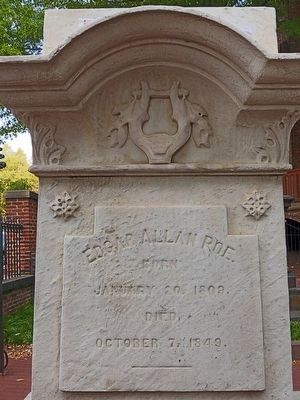
Photographed by Allen C. Browne, September 5, 2015
3. Poe's Grave
Born
January 20, 1809
Died
October 7, 1849
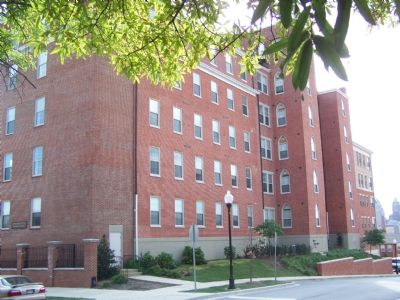
Photographed by William Pfingsten, September 9, 2007
4. Church Home and Hospital
Credits. This page was last revised on December 18, 2024. It was originally submitted on September 10, 2007, by Bill Pfingsten of Bel Air, Maryland. This page has been viewed 3,474 times since then and 95 times this year. Photos: 1. submitted on September 10, 2007, by Bill Pfingsten of Bel Air, Maryland. 2, 3. submitted on November 5, 2015, by Allen C. Browne of Silver Spring, Maryland. 4. submitted on September 10, 2007, by Bill Pfingsten of Bel Air, Maryland. • J. J. Prats was the editor who published this page.
