Mount Hope in Fayette County, West Virginia — The American South (Appalachia)
The Coal Companies
Mt. Hope
| — | Coal Heritage Trail | — |

Photographed by Craig Doda, March 3, 2024
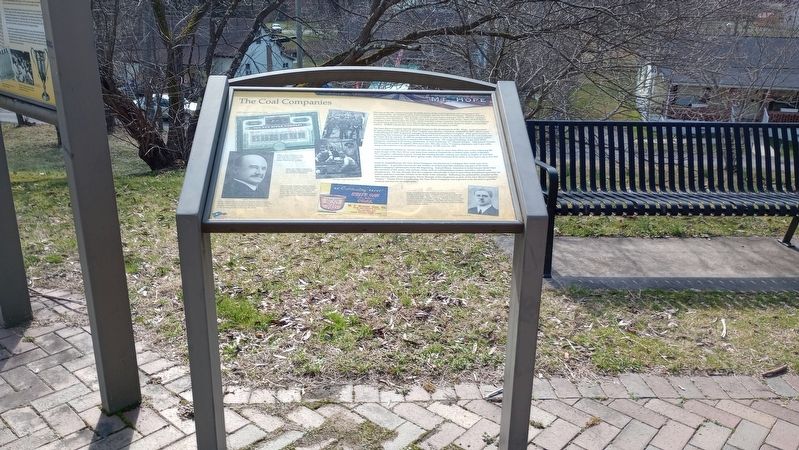
1. The Coal Companies Marker
The New River Company had the greatest impact on the development of Mt. Hope. It was founded by Samuel Dixon, who arrived in West Virginia from Shelton, Yorkshire, England in 1877. Dixon came to MacDonald in 1893 as general manager of the MacDonald Colliery Company. After great success in expanding that company, he formed the White Oak Coal Company to market and sell the coal produced by mines that he owned. In 1905 he joined with investors to form the New River Fuel Company,
this page online
These properties formed an almost unbroken area of coal for more than thirty-five miles, following the main trough of the New River coal seam from north of Fayetteville to fifteen miles south of Beckley. The company continued to grow during the ensuing decade, sinking new shafts to depths of over five hundred feet to reach the New River group coals, which thickened from three to four feet to up to five feet under the plateau.
From its establishment, the New River Company was known as a company that "took care of its employees." A genuine concern for the welfare of miners and their families was part of the New River Company's philosophy from the beginning. Samuel Dixon intended to build houses better than the standard of the times, and include extras such as
Photographed by Craig Doda, March 3, 2024
2. The Coal Companies Marker
Topics and series. This historical marker is listed in these topic lists: Industry & Commerce • Natural Resources. In addition, it is included in the Coal Heritage Trail series list. A significant historical year for this entry is 1893.
Location. 37° 53.441′ N, 81° 10.31′ W. Marker is in Mount Hope, West Virginia, in Fayette County. It is on Main Street, on the right when traveling east. This marker is one of a set of markers that form a National Coal Area Interpretive Site. Touch for map. Marker is at or near this postal address: 267 WV-211, Mount Hope WV 25880, United States of America. Touch for directions.

Regionally, this marker is in the New River Gorge

Photographed by Craig Doda, March 3, 2024
3. The Coal Companies Marker
Other nearby markers. At least 8 other markers are within walking distance of this marker: Mine Safety (here, next to this marker); Phoenix City of the New River (here, next to this marker); New River Coalfield (here, next to this marker); The Coming of the Railroads (here, next to this marker); The Dunloup Creek Watershed (approx. 0.2 miles away); a different marker also named The Dunloup Creek Watershed (approx. 0.2 miles away); a different marker also named The Dunloup Creek Watershed (approx. 0.2 miles away); Siltix Mine Disaster (approx. ¼ mile away). Touch for a list and map of all markers in Mount Hope.

Photographed by Craig Doda, March 3, 2024
4. The Coal Companies Marker
Credits. This page was last revised on March 12, 2024. It was originally submitted on March 8, 2024, by Craig Doda of Napoleon, Ohio. This page has been viewed 570 times since then and 84 times this year. Photos: 1, 2, 3, 4. submitted on March 8, 2024, by Craig Doda of Napoleon, Ohio. • Andrew Ruppenstein was the editor who published this page.
