Leeds in Washington County, Utah — The American Mountains (Southwest)
"They Were Poor, Hungry, and They Built to Last"
The Civilian Conservation Corps
Photographed by Mh
1. "They Were Poor, Hungry, and They Built to Last" Marker
Inscription.
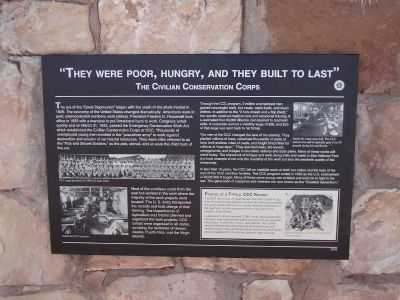
"They Were Poor, Hungry, and They Built to Last". The Civilian Conservation Corps. The era of the "Great Depression" began with the crash of the stock market in 1929. The economy of the United States changed dramatically. Americans were in peril; unprecedented numbers were jobless. President Franklin D. Roosevelt took office in 1933 with a mandate to put Americans back to work. Congress acted quickly and on March 31, 1933, passed the Emergency Conservation Work Act which established the Civilian Conservation Corps or CCC. Thousands of unemployed young men enrolled in the “peacetime army” to work against destruction and erosion of our natural resources. They were often referred to as the “Pick and Shovel Soldiers,” as the pick, shovel, and ax were the chief tools of the era., Most of the enrollees came from the east but worked in the west where the majority of the work projects were located. The U.S. Army transported the recruits and took charge of their training. The Departments of Agriculture and Interior planned and organized the work projects. CCC camps were organized in all states, including the territories of Hawaii, Alaska, Puerto Rico, and the Virgin Islands. , Through the CCC program, 3 million unemployed men gained meaningful work, hot meals, warm beds, and clean clothes. In addition to the “3 hots (meal) and a flop (bed),” the recruits received medical care and vocational training. It is estimated that 40,000 illiterate men learned to read and write. A corpsman earned a monthly wage of $30, and $25 of that wage was sent back to the family., The men of the CCC changed the face of the country. They planted millions of trees, reclaimed thousands of acres of land, built endless miles of roads, and fought forest fires for millions of “man days.” They also built trails, fire towers, campgrounds, and bridges in countless national and state parks. Many of these works still stand today. The stonework of bridges and walls along trails and roads in Zion National Park is a local example of not only the durability of the work but also the aesthetic quality of the artisanship., In less than 10 years, the CCC left an indelible mark on both our nation and the lives of the men of the CCC and their families. The CCC program ended in 1942 as the U.S. involvement in World War II began. Many of these same young men enlisted and went on to fight in the war. This generation of corpsman and veterans are now known as the “Greatest Generation.”
The era of the "Great Depression" began with the crash of the stock market in 1929. The economy of the United States changed dramatically. Americans were in peril; unprecedented numbers were jobless. President Franklin D. Roosevelt took office in 1933 with a mandate to put Americans back to work. Congress acted quickly and on March 31, 1933, passed the Emergency Conservation Work Act which established the Civilian Conservation Corps or CCC. Thousands of unemployed young men enrolled in the “peacetime army” to work against destruction and erosion of our natural resources. They were often referred to as the “Pick and Shovel Soldiers,” as the pick, shovel, and ax were the chief tools of the era.
Most of the enrollees came from the east but worked in the west where the majority of the work projects were located. The U.S. Army transported the recruits and took charge of their training. The Departments of Agriculture and Interior planned and organized the work projects. CCC camps were organized in all states, including the territories of Hawaii, Alaska, Puerto Rico, and the Virgin Islands.
Through the CCC program, 3 million
Click or scan to see this page online
unemployed men gained meaningful work, hot meals, warm beds, and clean clothes. In addition to the “3 hots (meal) and a flop (bed),” the recruits received medical care and vocational training. It is estimated that 40,000 illiterate men learned to read and write. A corpsman earned a monthly wage of $30, and $25 of that wage was sent back to the family.
The men of the CCC changed the face of the country. They planted millions of trees, reclaimed thousands of acres of land, built endless miles of roads, and fought forest fires for millions of “man days.” They also built trails, fire towers, campgrounds, and bridges in countless national and state parks. Many of these works still stand today. The stonework of bridges and walls along trails and roads in Zion National Park is a local example of not only the durability of the work but also the aesthetic quality of the artisanship.
In less than 10 years, the CCC left an indelible mark on both our nation and the lives of the men of the CCC and their families. The CCC program ended in 1942 as the U.S. involvement in World War II began. Many of these same young men enlisted and went on to fight
Photographed by Bill Kirchner
2. "They Were Poor, Hungry, and They Built to Last"
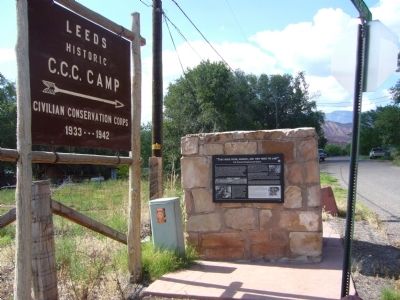
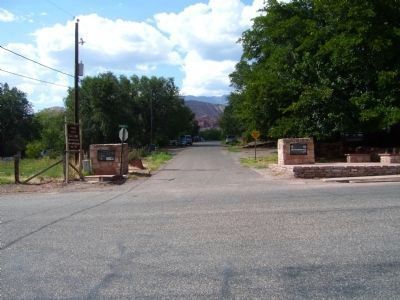
Marker at entrance to Mulberry Lane.
in the war. This generation of corpsman and veterans are now known as the “Greatest Generation.”
Location. 37° 14.003′ N, 113° 21.994′ W. Marker is in Leeds, Utah, in Washington County. It is on West Mulberry Lane north of South Main Street. Touch for map. Marker is in this post office area: Leeds UT 84746, United States of America. Touch for directions.
Regionally, this marker is in Utah’s Color Country. It is also in the American Southwest, in the Mountain West, and in Colorado Plateau. Globally, it is in North America, the Rocky Mountains, the Western Hemisphere, the Western World, and the Anglosphere. Historically, it finds itself in what was once New Spain and also Mexico’s Alta California.
Credits. This page was last revised on March 18, 2024. It was originally submitted on September 30, 2012, by Bill Kirchner of Tucson, Arizona. This page has been viewed 679 times since then and 10 times this year. Last updated on March 17, 2024, by Jeremy Snow of Cedar City, Utah. Photos:1. submitted on May 30, 2012, by Mh of Las Vegas, Nevada. 2, 3. submitted on September 20, 2012, by Bill Kirchner of Tucson, Arizona. • Bill Pfingsten was the editor who published this page.