Manti in Sanpete County, Utah — The American Mountains (Southwest)
Bridging the Past, Present, Future
⎯⎯⎯
Building Bridges

Photographed by Jeremy Snow, March 19, 2024
1. Bridging the Past, Present, Future Marker
Bridging the Past, Present, Future
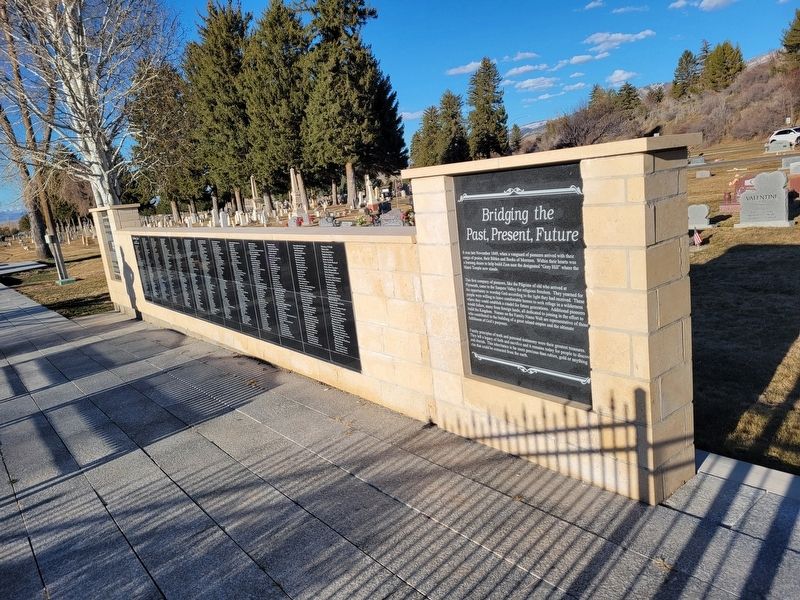
It was late November 1849, when a vanguard of pioneers arrived with their songs of praise, their Bibles and Books of Mormon. Within their hearts was a burning desire to help build Zion near the designated "Gray Hill" where the Manti Temple now stands.
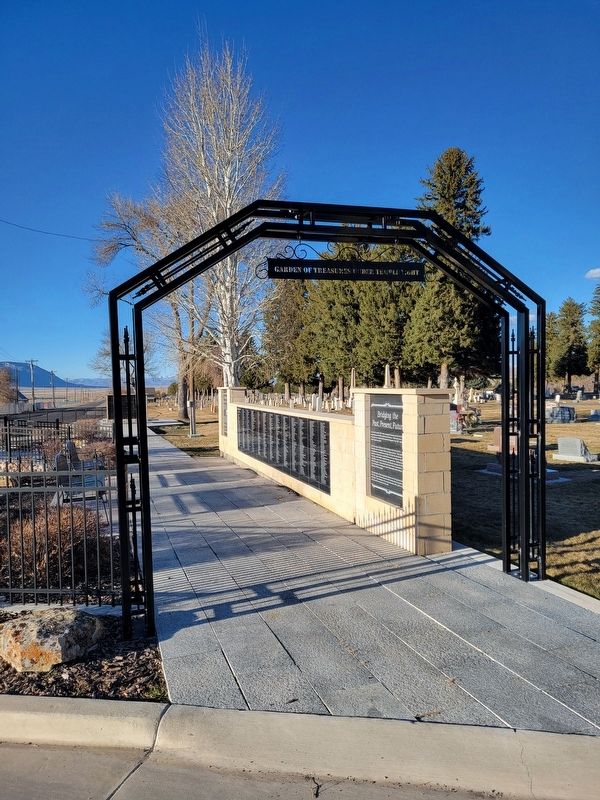
This first company of pioneers, like the Pilgrims of old who arrived at Plymouth, came to the Sanpete Valley for religious freedom. They yearned for the opportunity to worship God according to the light they had received. These people were willing to leave comfortable homes to seek refuge in a wilderness where they could establish a citadel for future generations. Additional pioneers would follow, many from foreign lands, all dedicated to joining in the effort to build the Kingdom. Names on the Family Name Wall are representative of those who contributed to the building of a great inland empire and the ultimate fulfillment of God's purposes.
Family principles of truth and personal testimony were their greatest treasures. They left a legacy of faith and sacrifice and it remains today for people to discover and cherish. This inheritance
this page online
Building Bridges
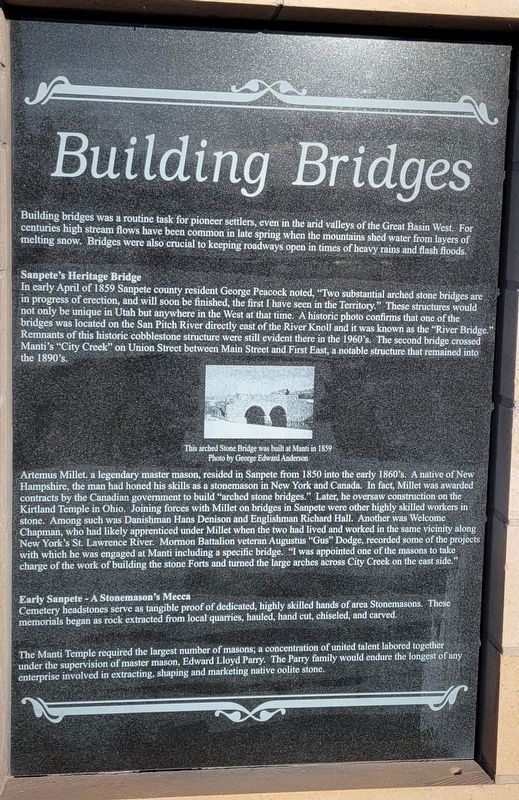
Building bridges was a routine task for pioneer settlers, even in the arid valleys of the Great Basin West. For centuries high stream flows have been common in late spring when the mountains shed water from layers of melting snow. Bridges were also crucial to keeping roadways open in times of heavy rains and flash floods.
Sanpete's Heritage Bridge
In early April of 1859 Sanpete county resident George Peacock noted, "Two substantial arched stone bridges are in progress of erection, and will soon be finished, the first I have seen in the Territory.” These structures would not only be unique in Utah but anywhere in the West at that time. A historic photo confirms that one of the bridges was located on the San Pitch River directly east of the River Knoll and it was known as the "River Bridge." Remnants of this historic cobblestone structure were still evident there in the 1960's. The second bridge crossed Manti's "City Creek” on Union Street between Main Street and First East, a notable structure that remained into the 1890's.
Artemus
Photographed by Jeremy Snow, March 19, 2024
2. Building Bridges
Early Sanpete - A Stonemason's Mecca
Cemetery headstones serve as tangible proof of dedicated, highly skilled hands of area Stonemasons. These memorials began as rock extracted from local quarries, hauled, hand cut, chiseled, and carved.
The Manti Temple required the largest number of masons; a concentration of united talent labored together under the supervision of master mason, Edward Lloyd Parry. The Parry family would endure the longest of any enterprise involved in extracting, shaping and marketing native oolite stone.
Caption
This arched Stone Bridge was built at Manti in 1859
Photo by George Edward Anderson
Topics. This historical marker is listed in these topic lists: Religion & Religious Structures • Settlements & Settlers. A significant historical year for this entry is 1849.
Location. 39° 16.463′ N, 111° 38.101′ W. Marker is in Manti, Utah, in Sanpete County. It
Photographed by Jeremy Snow, March 19, 2024
3. Bridging the Past, Present, Future Marker

Regionally, this marker is in the Central Utah Valleys. It is also in the American Mountain West and on the Colorado Plateau. Globally, it is in North America, the Western Hemisphere, the Western World, and the Anglosphere. Historically, it finds itself in what was once New Spain and also Mexico’s Alta California.
Other nearby markers. At least 8 other markers are within walking distance of this marker: A Unique Way to Conquer the West (a few steps from this marker); Pioneer Values: Cooperation (a few steps from this marker); New Home, New Neighbors (within shouting distance of this marker); Gathering Zion (within shouting distance of this marker); Welcome to Historic Manti City Cemetery (within shouting distance of this marker); The Manti Pioneers (within shouting distance of this marker); Faith and Miracles (within shouting distance of this marker); A Temple in Zion (within shouting distance of this marker). Touch for a list and map of all markers in Manti.
Photographed by Jeremy Snow, March 19, 2024
4. Bridging the Past, Present, Future Marker
Credits. This page was last revised on May 1, 2024. It was originally submitted on March 20, 2024, by Jeremy Snow of Cedar City, Utah. This page has been viewed 295 times since then and 43 times this year. Photos: 1, 2, 3, 4. submitted on March 20, 2024, by Jeremy Snow of Cedar City, Utah. • J. Makali Bruton was the editor who published this page.
