Pigtown in Baltimore, Maryland — The American Northeast (Mid-Atlantic)
The Underground Railroad
The Historic National Road, America's First Federally Funded Highway
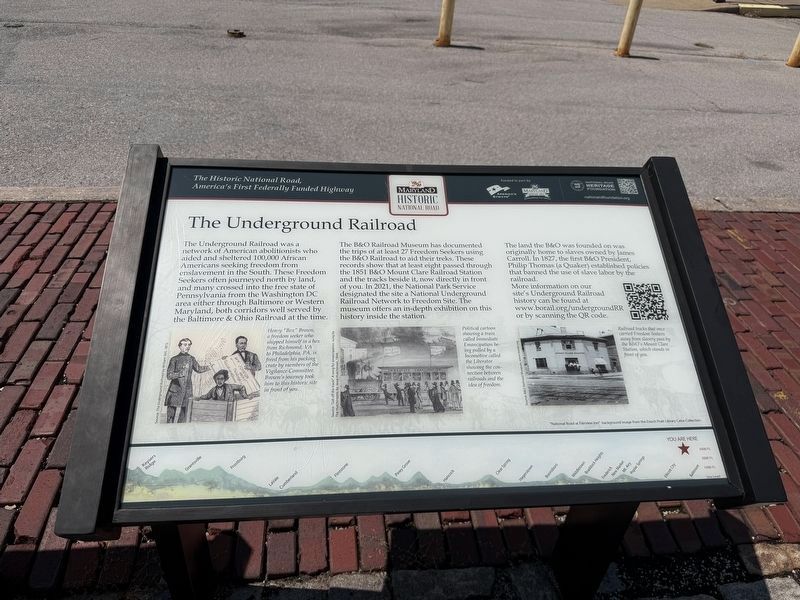
The Underground Railroad was a network of American abolitionists who aided and sheltered 100,000 African Americans seeking freedom from enslavement in the South. These Freedom Seekers often journeyed north by land, and many crossed into the free state of Pennsylvania from the Washington DC. area either through Baltimore or Western Maryland, both corridors well served by the Baltimore & Ohio Railroad at the time.
The B&O Railroad Museum has documented the trips of at least 27 Freedom Seekers using the B&O Railroad to aid their treks. These records show that at least eight passed through the 1851 B&O Mount Clare Railroad Station and the tracks beside it, now directly in front of you. In 2021, the National Park Service designated the site a National Underground Railroad Network to Freedom Site. The museum offers an in-depth exhibition on this history inside the station.
The land the B&O was founded on was originally home to slaves owned by James Carroll. In 1827, the first B&O President Philip Thomas (a Quaker) established policies that banned the use of slave labor by the railroad.
More information on our site's
this page online
[Captions:]
Henry "Box" Brown, a freedom seeker who shipped himself in a box from Richmond, VA to Philadelphia, PA, is freed from his packing crate by members of the Vigilance Committee. Brown's journey took him to this historic site in front of you.
Political cartoon showing a train called Immediate Emancipation being pulled by a locomotive called the Liberator showing the connection between the railroads and the idea of freedom.
Railroad tracks that once carried Freedom Seekers away from slavery pass by the B&O's Mount Clare Station, which stands in front of you.
Erected by America's Byways; Maryland Heritage Areas Authority; National Road Heritage Foundation.
Topics and series. This historical marker is listed in these topic lists: Abolition & Underground RR • African Americans • Railroads & Streetcars • Religion & Religious Structures. In addition, it is included in the Baltimore and Ohio Railroad (B&O), the Network to Freedom, the Quakerism, and the The Historic National Road series lists. A significant historical year for this entry is 1851.
Location. 39° 17.117′ N,
Photographed by Devry Becker Jones (CC0), August 23, 2026
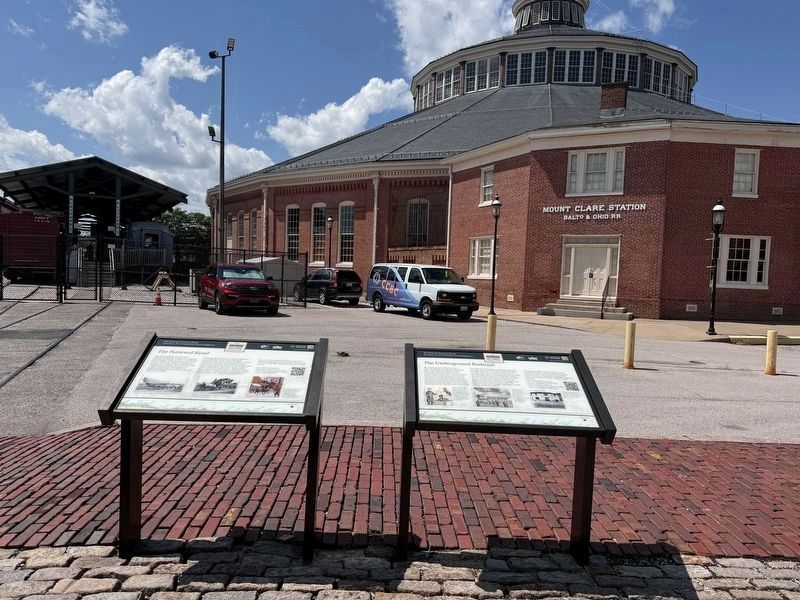
2. Historic National Road Markers at the parking lot of the B&O Railroad Museum

Regionally, this marker is in Central Maryland. It is also in the American Mid-Atlantic, in the Chesapeake Bay Region, and on the Eastern Seaboard. Globally, it is in the North Atlantic Region, North America, the Western Hemisphere, the Western World, and the Anglosphere. Historically, it finds itself in what was once one of the original Thirteen Colonies and also the Antebellum South.
Other nearby markers. At least 8 other markers are within walking distance of this marker: The National Road (here, next to this marker); Mount Clare Shops (a few steps from this marker); Site of Old Relay Station and Hotel (within shouting distance of this marker); Pullman Troop Sleeper No. 7437 (within shouting distance of this marker); First Stone of the Balt. & Ohio Rail Road (within shouting distance of this marker); Luther G. Smith (about 300 feet away); The Car That Carried Ike on His Last Trip (about 300 feet away); American Freedom Train No. 1 (about 300 feet away). Touch for a list and map of all markers in Baltimore.
Other markers no longer nearby. Railroads Eclipse a National Road (was here, next to this marker but has been replaced with another marker now near it); a different marker also named The National Road (was here, next to this marker but has been replaced with another marker now near it); The Chessie's Famous "Big Mike" (was a few steps from this marker but has been permanently removed); Baltimore & Ohio Railroad (was within shouting distance of this marker but has been replaced with another marker now near it); Working for the Railroad: African Americans (was about 300 feet away, measured in a direct line but has been permanently removed).
Credits. This page was last revised on August 23, 2026. It was originally submitted on March 23, 2024, by Devry Becker Jones of Washington, District of Columbia. This page has been viewed 629 times since then and 59 times this year. Photos: 1, 2. submitted on August 23, 2026, by Devry Becker Jones of Washington, District of Columbia.
