Pigtown in Baltimore, Maryland — The American Northeast (Mid-Atlantic)
The National Road
The Historic National Road, America's First Federally Funded Highway
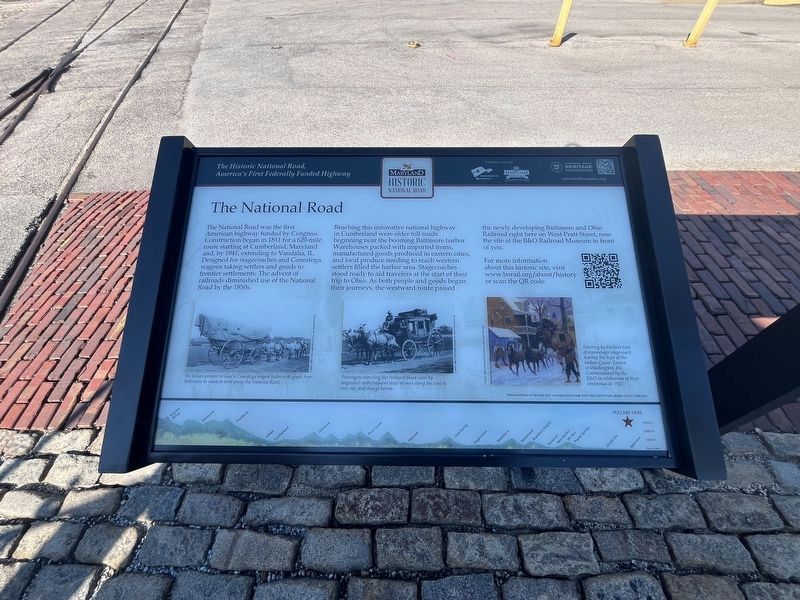
The National Road was the first American highway funded by Congress. Construction began in 1811 for a 620-mile route starting at Cumberland, Maryland, and, by 1841, extending to Vandalia, IL. Designed for stagecoaches and Conestoga wagons taking settlers and goods to frontier settlements. The advent of railroads diminished use of the National Road by the 1850s.
Reaching this innovative national highway in Cumberland were older toll roads beginning near the booming Baltimore harbor. Warehouses packed with imported items, manufactured goods produced in eastern cities, and local produce needing to reach western settlers filled the harbor area. Stagecoaches stood ready to aid travelers at the start of their trip to Ohio. As both people and goods began their journeys, the westward route passed the newly developing Baltimore and Ohio Railroad right here on West Pratt Street, now the site of the B&O Railroad Museum in front of you.
For more information about this historic site, visit www.borail.org/about/history or scan the QR code.
[Captions:]
Six horses prepare to haul a Conestoga wagon laden with goods from Baltimore to markets west along the National Road.
Passengers traveling the National Road went by stagecoach with frequent stops at inns along the way to rest, eat, and change horses.
Painting by Herbert Stitt of a passenger stagecoach leaving the Sign of the Indian Queen Tavern at Washington, PA. Commissioned by the B&O in celebration of their centennial in 1927.
Erected by America's
this page online
Topics and series. This historical marker is listed in these topic lists: Industry & Commerce • Railroads & Streetcars • Roads & Vehicles • Settlements & Settlers. In addition, it is included in the Baltimore and Ohio Railroad (B&O), and the The Historic National Road series lists. A significant historical year for this entry is 1811.
Location. 39° 17.116′ N, 76° 37.91′ W. Marker is in Baltimore, Maryland. It is in Pigtown. It is on South Poppleton Street just south of West Pratt Street, on the left when traveling south. Touch for map. Marker is at or near this postal address: 837 W Pratt St, Baltimore MD 21201, United States of America. Touch for directions.

Regionally, this marker is in Central Maryland. It is also in the American Mid-Atlantic, in the Chesapeake Bay Region, and on the Eastern Seaboard. Globally, it is in the North Atlantic Region, North America, the Western Hemisphere, the Western World, and the Anglosphere. Historically, it finds itself in what was once one of the original Thirteen Colonies and also the Antebellum
Photographed by Devry Becker Jones (CC0), August 23, 2026
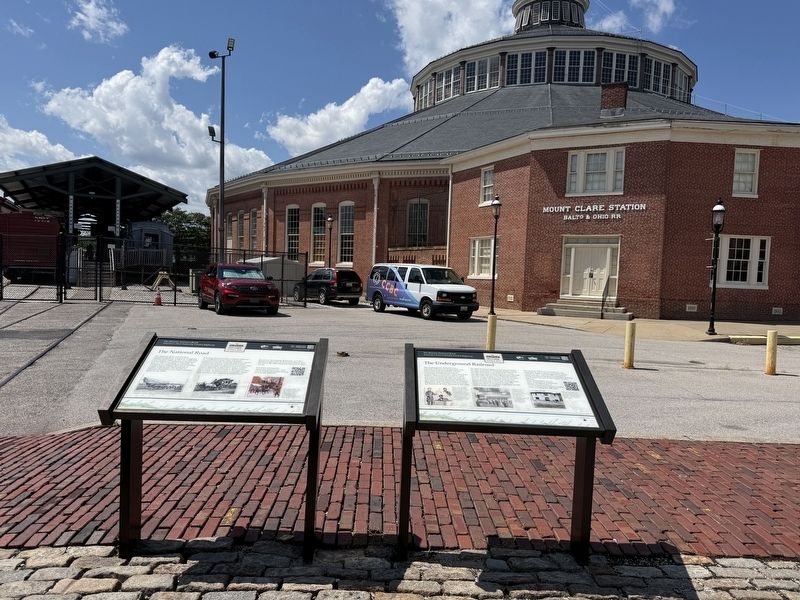
2. Historic National Road Markers at the parking lot of the B&O Railroad Museum
Other nearby markers. At least 8 other markers are within walking distance of this marker: The Underground Railroad (here, next to this marker); Mount Clare Shops (a few steps from this marker); Site of Old Relay Station and Hotel (within shouting distance of this marker); Pullman Troop Sleeper No. 7437 (within shouting distance of this marker); First Stone of the Balt. & Ohio Rail Road (within shouting distance of this marker); Luther G. Smith (about 300 feet away, measured in a direct line); The Car That Carried Ike on His Last Trip (about 300 feet away); American Freedom Train No. 1 (about 300 feet away). Touch for a list and map of all markers in Baltimore.
Other markers no longer nearby. The National Road (has been replaced with this marker); Railroads Eclipse a National Road (was here, next to this marker but has been replaced with another marker now near it); The Chessie's Famous "Big Mike" (was within shouting distance of this marker but has been permanently removed); Baltimore & Ohio Railroad (was within shouting distance of this marker but has been replaced with another marker now near it); Working for the Railroad: African Americans (was within shouting distance of this marker but has been permanently removed).
Related marker. Click here for another marker that is related to this marker. This marker has replaced the linked marker.
Credits. This page was last revised on August 23, 2026. It was originally submitted on March 23, 2024, by Devry Becker Jones of Washington, District of Columbia. This page has been viewed 369 times since then and 39 times this year. Photos: 1. submitted on March 23, 2024, by Devry Becker Jones of Washington, District of Columbia. 2. submitted on August 23, 2026, by Devry Becker Jones of Washington, District of Columbia.
