Terry Sanford in Fayetteville in Cumberland County, North Carolina — The American South (South Atlantic)
Fayetteville Arsenal
"Batter … into piles of rubble"
| — | Carolinas Campaign | — |
Photographed by William Fischer, Jr., July 27, 2009
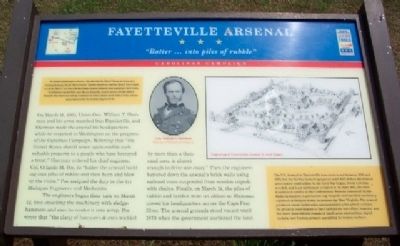
1. Fayetteville Arsenal Marker
The Carolinas Campaign began on February 1, 1865, when Union Gen. William T. Sherman led his army north from Savannah, Georgia, after the “March to the Sea.” Sherman's objective was to join Gen. Ulysses S. Grant in Virginia to crush Gen. Robert E. Lee's Army of Northern Virginia. Scattered Confederate forces consolidated in North Carolina, the Confederacy's logistical lifeline, where Sherman defeated Gen. Joseph E. Johnston's last-ditch attack at Bentonville. After Sherman was reinforced at Goldsboro late in March, Johnston saw the futility of further resistance and surrendered on April 26, essentially ending the Civil War.
On March 11, 1865, Union Gen. William T. Sherman and his army marched into Fayetteville, and Sherman made the arsenal his headquarters while he reported to Washington on the progress of the Carolinas Campaign. Believing that “the United States should never again confide such valuable property to a people who have betrayed a trust,” Sherman ordered his chief engineer, Col. Orlando M. Poe, to “batter the arsenal building into piles of rubble and then burn and blow up the ruins.” Poe assigned the duty
this page online
The engineers began their task on March 12, first attacking the machinery with sledgehammers and axes to render it into scrap. Poe wrote that “the clang of hammers & axes wielded by more than a thousand men, is almost enough to drive one crazy.” Then the engineers battered down the arsenal's brick walls using railroad irons suspended from wooden tripods with chains. Finally, on March 14, the piles of rubble and lumber were set ablaze as Sherman moved his headquarters across the Cape Fear River. The arsenal grounds stood vacant until 1873 when the government auctioned the land.
[Sidebar:]
The U.S. Arsenal at Fayetteville was constructed between 1838 and 1853, but the facility lacked equipment until 1857. Before the federal government could utilize it, the Civil War began, North Carolina seceded, and local militiamen occupied it. In June 1861, the state transferred control to the Confederacy. Workers converted 36,000 flintlock muskets to percussion-cap weapons and installed machinery captured at Harper's Ferry, in present-day West Virginia. The arsenal produced about 10,000 rifles and assembled a few pistol carbines. Its greatest contribution to the Confederate war effort, however, was the more than 900,000 rounds of small arms ammunition, signal rockets, and friction primers assembled by women workers.
Erected by North
Photographed by William Fischer, Jr., July 27, 2009
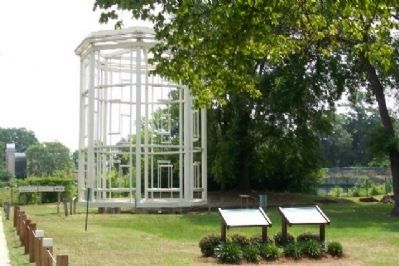
2. Fayetteville Arsenal Marker
"Ghost Tower" in background, with U.S. 401 beyond tower in road cut.
Topics and series. This historical marker is listed in these topic lists: Industry & Commerce • War, US Civil. In addition, it is included in the North Carolina Civil War Trails series list. A significant historical date for this entry is February 1, 1865.
Location. 35° 3.279′ N, 78° 53.678′ W. Marker is in Fayetteville, North Carolina, in Cumberland County. It is in Terry Sanford. It is on Arsenal Avenue, on the right when traveling west. Marker is in Arsenal Park, about 30 feet west of the "Ghost Tower," which abuts the Martin Luther King, Jr. Freeway (U.S. 401) to the east. Touch for map. Marker is at or near this postal address: 827 Arsenal Ave, Fayetteville NC 28305, United States of America. Touch for directions.

Regionally, this marker is in North Carolina’s Coastal Plain. It is also in the American South and specifically in the Upper South. Globally, it is in North America, the Western Hemisphere, the Western World, and the Anglosphere. Historically, it finds itself in what was once the territory of the Mississippian Culture, one of the original Thirteen Colonies, one of the Confederate States of America, and the Antebellum South.
Other nearby markers. At least 8 other markers are within walking distance of this marker: North Carolina (here, next to this marker); The "Ghost" Tower (within shouting distance of this marker); Forging and Casting [and] Smith's Shops (1839 - 1842) (within shouting distance of this marker); Engine House (1838 - 1848) (about 300 feet away, measured in a direct line); North Carolina Arsenal (about 300 feet away); Arsenal Park (about 400 feet away); Arsenal Stones (about 400 feet away); Gun Carriage and Turning Shop (1842 - 1849) (about 400 feet away). Touch for a list and map of all markers in Fayetteville.
Related markers. Click here for a list of markers that are related to this marker. Markers detailing the Fayetteville Arsenal
Also see . . . Fayetteville Arsenal. (Submitted on November 10, 2009, by William Fischer, Jr. of Reynoldsburg, Ohio.)
Credits. This page was last revised on December 25, 2025. It was originally submitted on November 10, 2009, by William Fischer, Jr. of Reynoldsburg, Ohio. This page has been viewed 2,911 times since then and 52 times this year. Photos: 1, 2. submitted on November 10, 2009, by William Fischer, Jr. of Reynoldsburg, Ohio.
