Thunder Bay in Thunder Bay District, Ontario — Central Canada (North America)
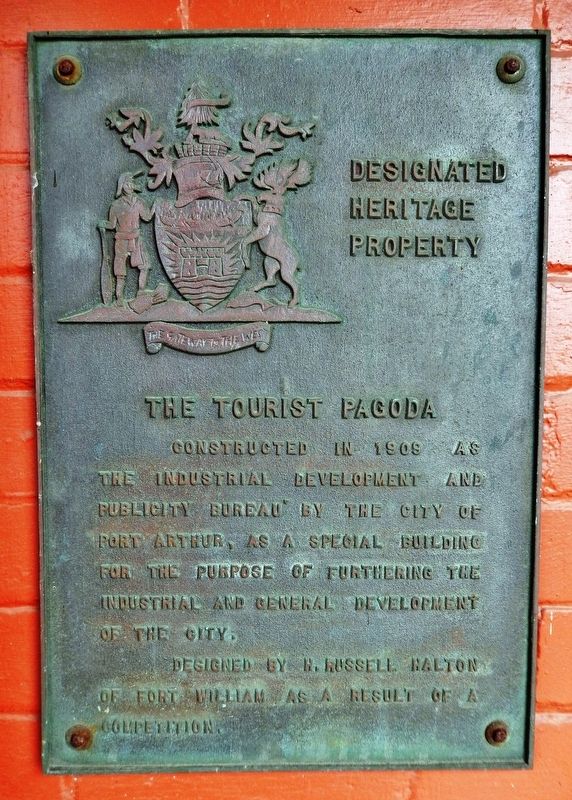
The Tourist Pagoda
Designated Heritage Property
Photographed by Cosmos Mariner, June 10, 2022
1. The Tourist Pagoda Marker
Designed by H. Russell Halton of Fort William as a result of a competition.
Topics. This historical marker is listed in these topic lists: Architecture • Industry & Commerce • Notable Buildings. A significant historical year for this entry is 1909.
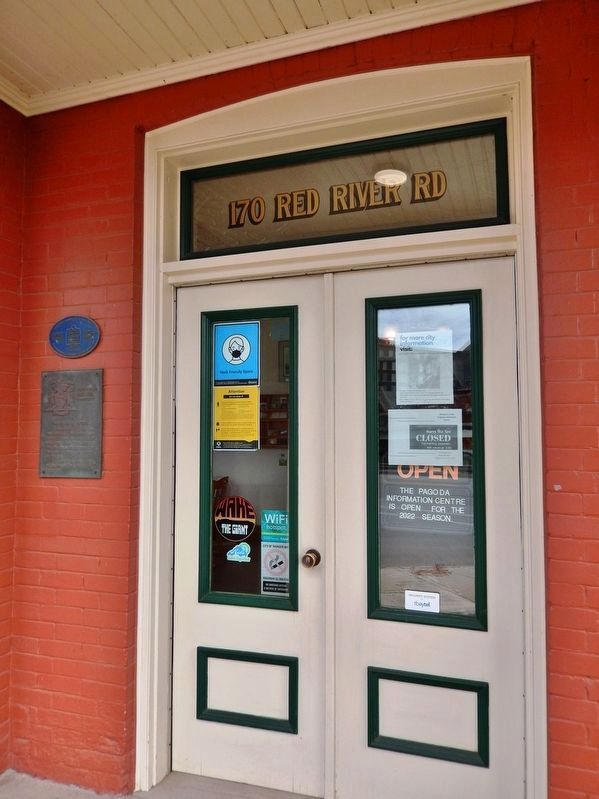
Location. 48° 26.069′ N, 89° 13.087′ W. Marker is in Thunder Bay, Ontario, in Thunder Bay District. It is at the intersection of Red River Road and North Water Street, on the right when traveling west on Red River Road. The marker is mounted at eye-level, directly on the subject building, on the left side of the southeast corner entrance. Touch for map. Marker is at or near this postal address: 170 Red River Road, Thunder Bay ON P7A 4K8, Canada. Touch for directions.

Regionally, this marker is in Northern Ontario and specifically in Northwest Ontario. It is also in Central Canada. Globally, it is in North America, in the Great North Woods, on the Great Lakes,
this page online
Other nearby markers. At least 8 other markers are within walking distance of this marker: Thunder Bay Tourist Pagoda (here, next to this marker); Port Arthur and its Harbour (a few steps from this marker); Port Arthur (within shouting distance of this marker); The Railway (within shouting distance of this marker); Red River Road (within shouting distance of this marker); Canadian Northern Railway Station (within shouting distance of this marker); Canadian Navy (about 120 meters away, measured in a direct line); Whalen Building (about 150 meters away). Touch for a list and map of all markers in Thunder Bay.
Related markers. Click here for a list of markers that are related to this marker.
Also see . . .
1. Thunder Bay Tourist Pagoda National Historic Site of Canada. Excerpt:
Thunder Bay Tourist Pagoda National Historic Site of Canada is an early tourism(Submitted on March 31, 2024, by Cosmos Mariner of Cape Canaveral, Florida.)bureau built in a novelty design inspired by a mixture of classical and Asian architecture. Thunder Bay Tourist Pagoda was designated a national historic site of Canada in 1986 because it symbolizes the themes of civic boosterism and inter-city rivalry in the early 20th century; and it has an eccentric but carefully conceived design. It was an early tourism bureau designed to attract the attention of train and ship passengers traveling through Port Arthur, in order to promote the town's advantages as an industrial and tourism centre at a time when it's rival, nearby Fort William, was becoming an increasingly important transportation hub.Photographed by Cosmos Mariner, June 10, 20222. The Tourist Pagoda MarkerThe marker is mounted on the left side of the southeast corner entrance.
2. Tourist Pagoda (Ontario Heritage Trust). Excerpt:
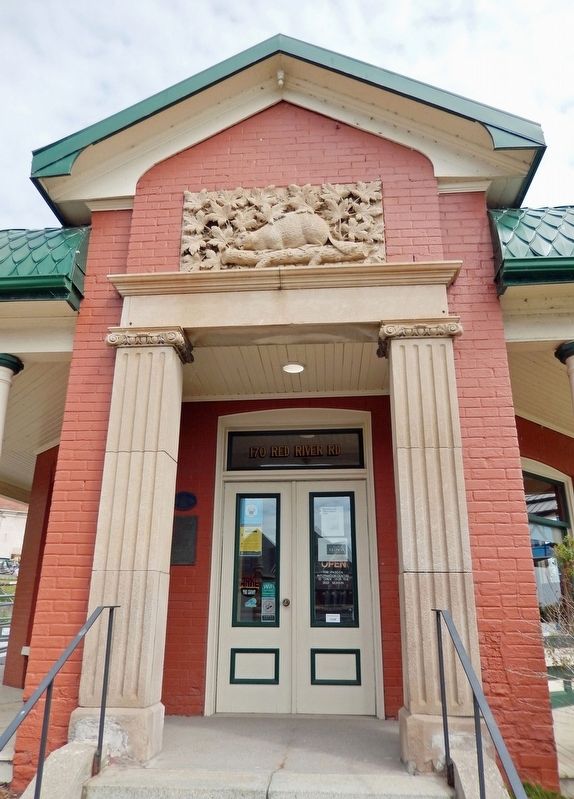
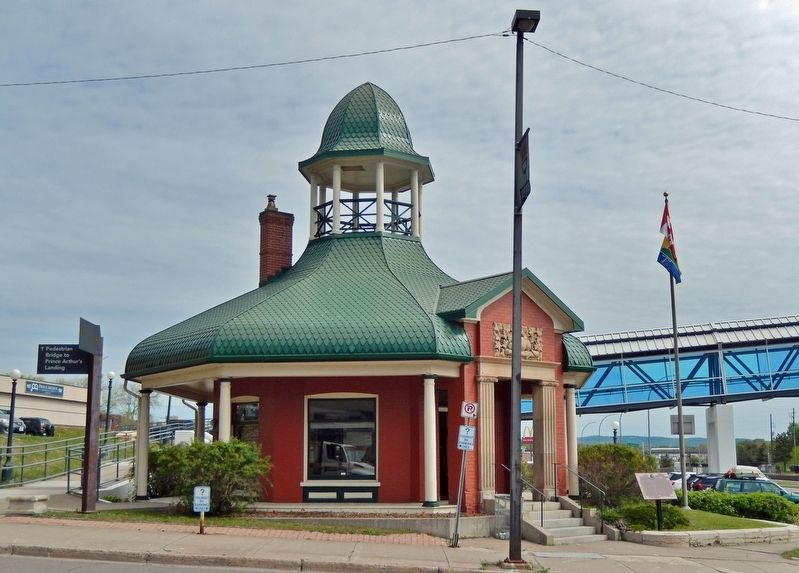
Most likely influenced by Indian architecture, the Pagoda is an octagonal, mushroom-shaped structure with a distinctive ogee or double-curved roof. Composed of metal shingles, the roof is crowned with an open belvedere, six feet (two meters) in diameter and topped with a bell-shaped dome. The octagonal walls are constructed of "local cement red brick" each with(Submitted on March 31, 2024, by Cosmos Mariner of Cape Canaveral, Florida.)a large plate glass window. The entrance to the pagoda is marked by a projecting gable and is framed by fluted Ionic pilasters. Above the entrance is an Indiana limestone panel with a carved relief, depicting a beaver, by B. Jones of the Stanworth Martin Company. A veranda with a wooden floor and eight wooden columns encircles the Pagoda.Photographed by Cosmos Mariner, June 10, 20223. Heritage Conservation Easement Site MarkerHeritage Conservation Easement Site
The heritage character and integrity of this property are protected by a legal agreement between the owner and the Ontario Heritage Foundation
A not-for-profit agency of the Government of Ontario
—————
Site patrimonial protégé par une servitude
Le caractère historique et l'intégrité de cette propriété sont protégés par un accord juridique entre le propriétaire et la Fondation du patrimoine ontarien
Un organisme à but non lucratif relevant du gouvernement de l'Ontario
In 1979, the City of Thunder Bay designated the pagoda under the Ontario Heritage Act and, in 1986, the building was designated a National Historic Site. The Ontario Heritage Trust secured a heritage easement to conserve the building in 1992.

Photographed by Cosmos Mariner, June 10, 2022
4. The Tourist Pagoda
(southeast corner entrance)
(southeast corner entrance)
Photographed by Cosmos Mariner, June 10, 2022
5. The Tourist Pagoda (south elevation)
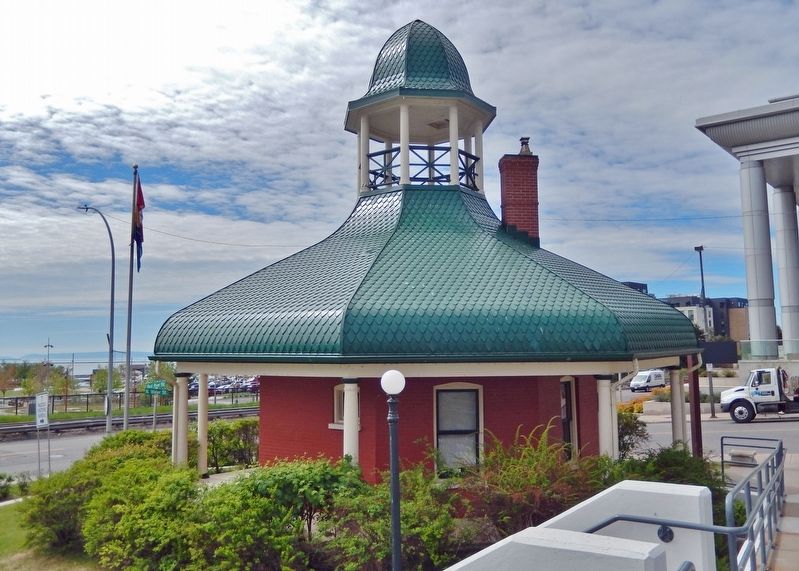
Photographed by Cosmos Mariner, June 10, 2022
6. The Tourist Pagoda (northwest elevation)

Photographed by Cosmos Mariner, June 10, 2022
7. The Tourist Pagoda (southeast elevation)
Credits. This page was last revised on April 1, 2024. It was originally submitted on March 28, 2024, by Cosmos Mariner of Cape Canaveral, Florida. This page has been viewed 240 times since then and 29 times this year. Photos: 1, 2, 3, 4, 5. submitted on March 31, 2024, by Cosmos Mariner of Cape Canaveral, Florida. 6. submitted on April 1, 2024, by Cosmos Mariner of Cape Canaveral, Florida. 7. submitted on March 31, 2024, by Cosmos Mariner of Cape Canaveral, Florida.
