Plaine-Monceau in Paris in Département de Paris, Île-de-France, France — Western Europe
Ernest Chausson
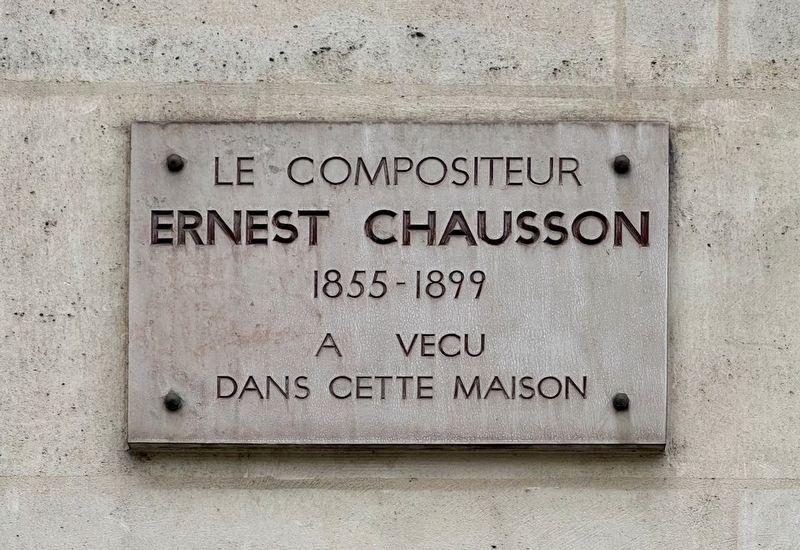
Photographed by Andrew Ruppenstein, March 24, 2024
1. Ernest Chausson Marker

Ernest Chausson
1855-1899
A vecu
dans cette maison
The composer Ernest Chausson (1855-1899) lived in this house.
Topics. This historical marker is listed in this topic list: Arts, Letters, Music.
Location. 48° 52.866′ N, 2° 18.794′ E. Marker is in Paris, Île-de-France, in Département de Paris. It is in Plaine-Monceau. It is on Boulevard de Courcelles, on the right when traveling west. Touch for map. Marker is at or near this postal address: 22 Boulevard de Courcelles, Paris, Île-de-France 75017, France. Touch for directions.

Regionally, it is in the North Atlantic Region, Europe, the European Union, Atlantic Europe, the Schengen Area, Western Europe, a coastal Mediterranean country, and the Western World. Historically, it finds itself in what was once a French colony and also the Roman Empire.
Other nearby markers. At least 8 other markers are within walking distance of this marker: Louis Armand (about 150 meters away, measured in a direct line); Joseph Denais (about 240 meters away); La Première Descente en Parachute / The First Descent by Parachute (approx. 0.3 kilometers away); Fers / Irons (approx. 0.3 kilometers away); Maxime Fabert (approx. 0.3 kilometers away); Elena Theodorini and l’Académie Lyrique Roumaine
this page online
Also see . . .
1. Ernest Chausson (Wikipedia).
Excerpt: Amédée-Ernest Chausson (20 January 1855 – 10 June 1899) was a French Romantic composer.(Submitted on March 30, 2024.)
Chausson's work is individual, but it does reflect some technical influences of both Wagner and his other musical hero, Franck. Stylistic traces not only of Massenet but also of Brahms can be detected sometimes. In general, Chausson's compositional idiom bridges the gap between the ripe Romanticism of Massenet and Franck and the more introverted Impressionism of Debussy.
Several delicate songs came from Chausson's pen. He completed one opera, Le roi Arthus (King Arthur). His orchestral output was small, but significant. It includes the symphonic poem Viviane; the Symphony in B-flat, his sole symphony; Poème for violin and orchestra, an important piece in the violin repertoire; and the dramatic song-cycle Poème de l'amour et de la mer.
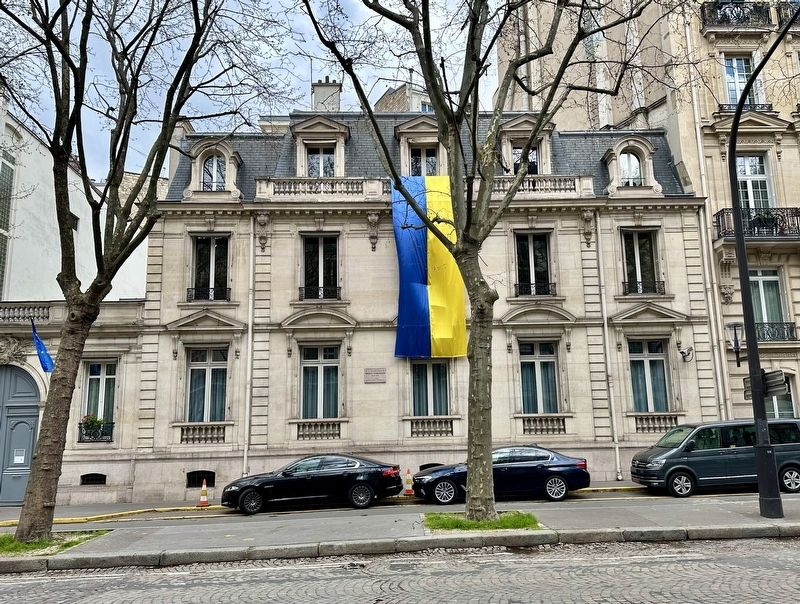
Chausson is believed to be the first composer to use the celesta. He employed that instrument in December 1888 in his incidental music, written for a small orchestra, for La Tempête, a French translationby Maurice Bouchor of Shakespeare's The Tempest.Photographed by Andrew Ruppenstein, March 24, 20242. Ernest Chausson Marker - wide viewThe building currently houses the Lithuanian embassy.
Not at all prolific, Chausson left behind only 39 opus-numbered pieces.
2. Ernest Chausson : Hébé op. 2 n° 6 (YouTube, 2:55). (Submitted on March 30, 2024.)
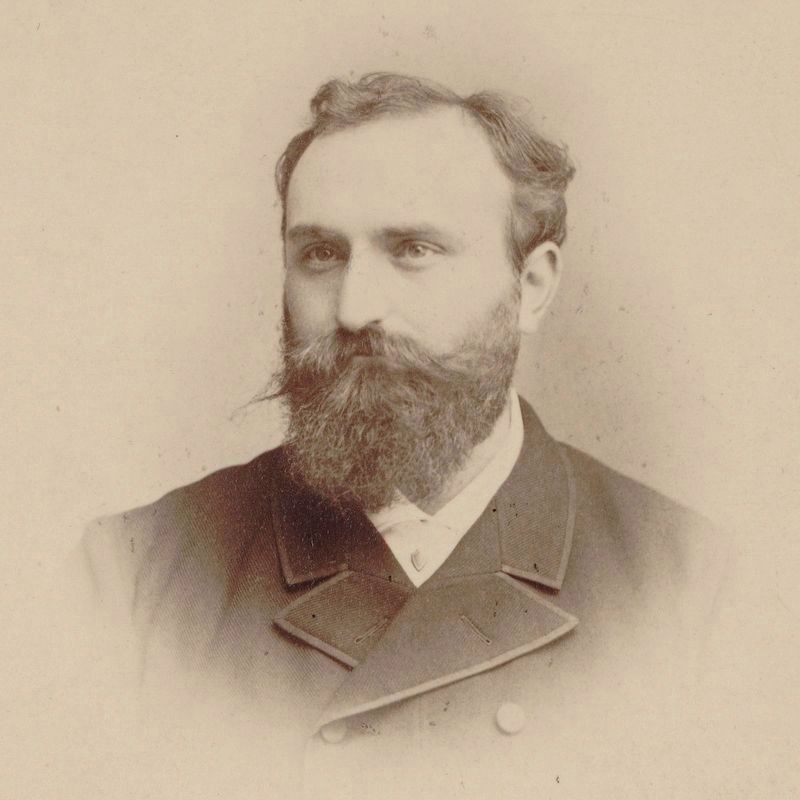
Photographed by P. Frois, Biaritz (via Wikimedia Commons), circa 1885
3. Ernest Chausson
Credits. This page was last revised on March 30, 2024. It was originally submitted on March 30, 2024, by Andrew Ruppenstein of Lamorinda, California. This page has been viewed 131 times since then and 11 times this year. Photos: 1, 2, 3. submitted on March 30, 2024, by Andrew Ruppenstein of Lamorinda, California.
