Columbus in Colorado County, Texas — The American South (West South Central)
Texas and the Struggle for Independence
1823-1848
Photographed by James Hulse, March 27, 2024
1. Texas and the Struggle for Independence Marker
Inscription.
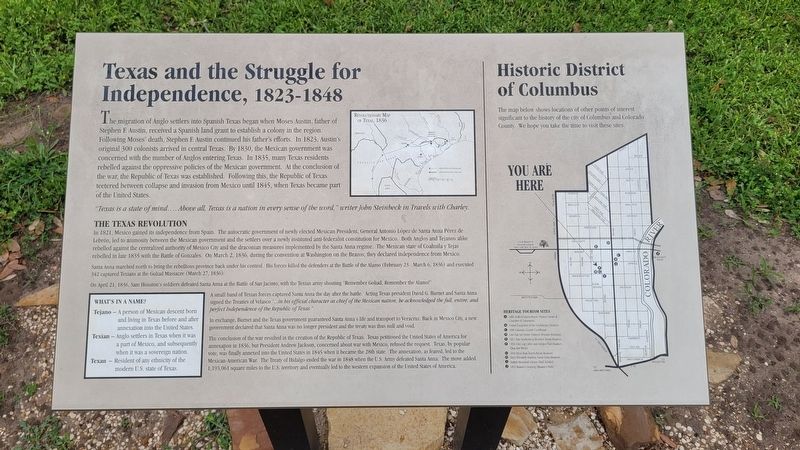
Texas and the Struggle for Independence. The migration of Anglo settlers into Spanish Texas began when Moses Austin, father of Stephen F. Austin, received a Spanish land grant to establish a colony in the region. Following Moses' death, Stephen F. Austin continued his father's efforts. In 1823, Austin's original 300 colonists arrived in central Texas. By 1830, the Mexican government was concerned with the number of Anglos entering Texas. In 1835, many Texas residents rebelled against the oppressive policies of the Mexican government. At the conclusion of the war, the Republic of Texas was established. Following this, the Republic of Texas teetered between collapse and invasion from Mexico until 1845, when Texas became part of the United States., "Texas is a state of mind.... Above all, Texas is a nation in every sense of the word," writer John Steinbeck in Travels with Charley., The Texas Revolution , In 1821, Mexico gained its independence from Spain. The autocratic government of newly elected Mexican President, General Antonio López de Santa Anna Pérez de Lebrón, led to animosity between the Mexican government and the settlers over a newly instituted anti-federalist constitution for Mexico. Both Anglos and Tejanos alike rebelled against the centralized authority of Mexico City and the draconian measures implemented by the Santa Anna regime. The Mexican state of Coahuila y Tejas rebelled in late 1835 with the Battle of Gonzales. On March 2, 1836, during the convention at Washington on the Brazos, they declared independence from Mexico. , Santa Anna marched north to bring the rebellious province back under his control. His forces killed the defenders at the Battle of the Alamo (February 23-March 6, 1836) and executed 342 captured Texians at the Goliad Massacre (March 27, 1836)., On April 21, 1836, Sam Houston's soldiers defeated Santa Anna at the Battle of San Jacinto, with the Texian army shouting "Remember Goliad, Remember the Alamo!", A small band of Texian forces captured Santa Anna the day after the battle. Acting Texas president David G. Burnet and Santa Anna signed the Treaties of Velasco...in his official character as chief of the Mexican nation, be acknowledged the full, entire, and perfect Independence of the Republic of Texas.", In exchange, Burnet and the Texas government guaranteed Santa Anna's life and transport to Veracruz. Back in Mexico City, a new government declared that Santa Anna was no longer president and the treaty was thus null and void., The conclusion of the war resulted in the creation of the Republic of Texas. Texas petitioned the United States of America for annexation in 1836, but President Andrew Jackson, concerned about war with Mexico, refused the request. Texas, by popular vote, was finally annexed into the United States in 1845 when it became the 28th state. The annexation, as feared, led to the Mexican-American War. The Treaty of Hidalgo ended the war in 1848 when the U.S. Army defeated Santa Anna. The move added 1,193,061 square miles to the U.S. territory and eventually led to the western expansion of the United States of America., What's in a Name? , Tejano - A person of Mexican descent born and living in Texas before and after annexation into the United States., Texian - Anglo settlers in Texas when it was a part of Mexico, and subsequently when it was a sovereign nation., Texan - Resident of any ethnicity of the Texan modern U.S. state of Texas., Captions , Revolutionary Map of Texas, 1836
The migration of Anglo settlers into Spanish Texas began when Moses Austin, father of Stephen F. Austin, received a Spanish land grant to establish a colony in the region. Following Moses' death, Stephen F. Austin continued his father's efforts. In 1823, Austin's original 300 colonists arrived in central Texas. By 1830, the Mexican government was concerned with the number of Anglos entering Texas. In 1835, many Texas residents rebelled against the oppressive policies of the Mexican government. At the conclusion of the war, the Republic of Texas was established. Following this, the Republic of Texas teetered between collapse and invasion from Mexico until 1845, when Texas became part of the United States.
"Texas is a state of mind.... Above all, Texas is a nation in every sense of the word," writer John Steinbeck in Travels with Charley.
The Texas Revolution
In 1821, Mexico gained its independence from Spain. The autocratic government of newly elected Mexican President, General Antonio López de Santa Anna Pérez de Lebrón, led to animosity between the Mexican government and the settlers over a newly instituted anti-federalist
Click or scan to see this page online
constitution for Mexico. Both Anglos and Tejanos alike rebelled against the centralized authority of Mexico City and the draconian measures implemented by the Santa Anna regime. The Mexican state of Coahuila y Tejas rebelled in late 1835 with the Battle of Gonzales. On March 2, 1836, during the convention at Washington on the Brazos, they declared independence from Mexico.
Santa Anna marched north to bring the rebellious province back under his control. His forces killed the defenders at the Battle of the Alamo (February 23-March 6, 1836) and executed 342 captured Texians at the Goliad Massacre (March 27, 1836).
On April 21, 1836, Sam Houston's soldiers defeated Santa Anna at the Battle of San Jacinto, with the Texian army shouting "Remember Goliad, Remember the Alamo!"
A small band of Texian forces captured Santa Anna the day after the battle. Acting Texas president David G. Burnet and Santa Anna signed the Treaties of Velasco...in his official character as chief of the Mexican nation, be acknowledged the full, entire, and perfect Independence of the Republic of Texas."
In exchange, Burnet and the Texas government guaranteed
Photographed by James Hulse, March 27, 2024
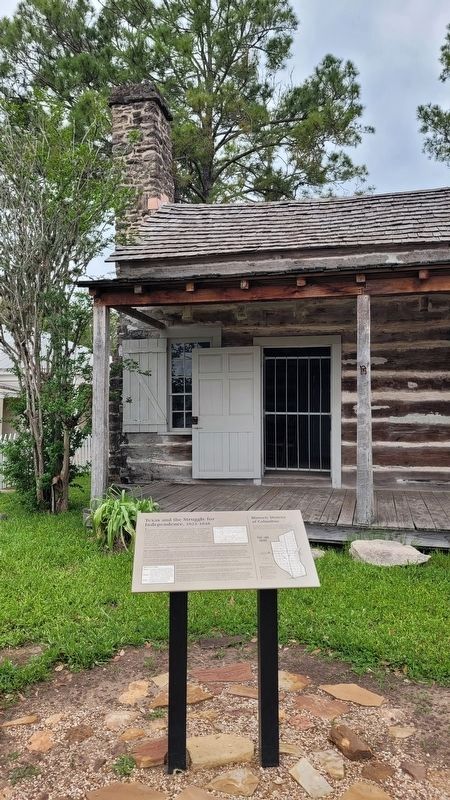
2. The Texas and the Struggle for Independence Marker in front of the Abram Alley Log Cabin
Santa Anna's life and transport to Veracruz. Back in Mexico City, a new government declared that Santa Anna was no longer president and the treaty was thus null and void.
The conclusion of the war resulted in the creation of the Republic of Texas. Texas petitioned the United States of America for annexation in 1836, but President Andrew Jackson, concerned about war with Mexico, refused the request. Texas, by popular vote, was finally annexed into the United States in 1845 when it became the 28th state. The annexation, as feared, led to the Mexican-American War. The Treaty of Hidalgo ended the war in 1848 when the U.S. Army defeated Santa Anna. The move added 1,193,061 square miles to the U.S. territory and eventually led to the western expansion of the United States of America.
What's in a Name? Tejano - A person of Mexican descent born and living in Texas before and after annexation into the United States.
Texian - Anglo settlers in Texas when it was a part of Mexico, and subsequently when it was a sovereign nation.
Texan - Resident of any ethnicity of the Texan modern U.S. state of Texas.
Captions
Revolutionary Map
Photographed by James Hulse, March 27, 2024
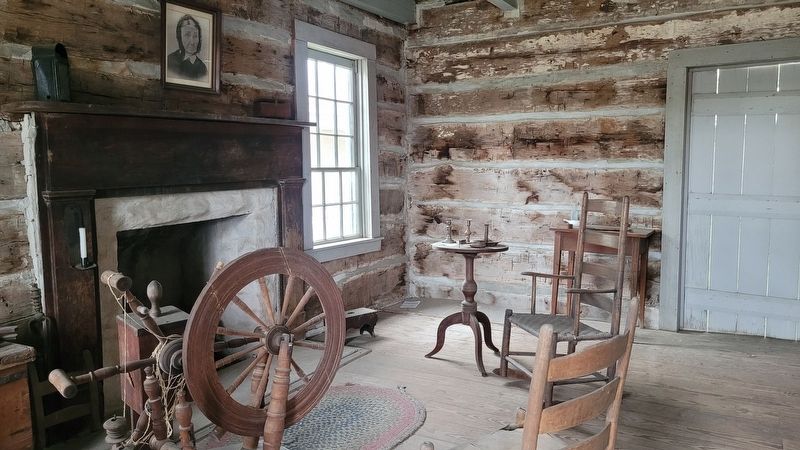
3. The living room of the Abram Alley Log Cabin
of Texas, 1836
Topics. This historical marker is listed in this topic list: War, Texas Independence. A significant historical date for this entry is March 2, 1836.
Location. 29° 42.275′ N, 96° 32.516′ W. Marker is in Columbus, Texas, in Colorado County. It is on Bowie Street north of Washington Street, on the left when traveling north. The marker is located in front of the Abram Alley Log Cabin. Touch for map. Marker is in this post office area: Columbus TX 78934, United States of America. Touch for directions.
Regionally, this marker is in the American South and on the Gulf Coast. Globally, it is in North America, a Gulf of Mexico state, the Western Hemisphere, the Western World, and the Anglosphere. Historically, it finds itself in what was once New Spain, the Republic of Texas, one of the Confederate States of America, and the Antebellum South.
Credits. This page was last revised on April 2, 2024. It was originally submitted on April 1, 2024, by James Hulse of Medina, Texas. This page has been viewed 245 times since then and 25 times this year. Photos:1, 2, 3, 4. submitted on April 2, 2024, by James Hulse of Medina, Texas.