Newark in New Castle County, Delaware — The American Northeast (Mid-Atlantic)
Newark Passenger Railroad Station
Photographed by Bill Pfingsten, April 24, 2016
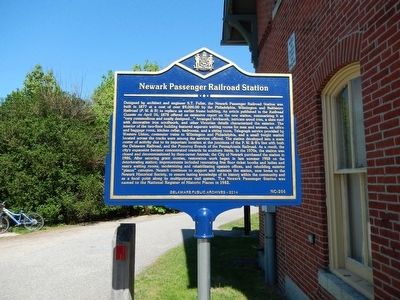
1. Newark Passenger Railroad Station Marker
Designed by architect and engineer S.T. Fuller, the Newark Passenger Railroad Station was built in 1877 at a cost of over $9,000.00 by the Philadelphia, Wilmington and Baltimore Railroad (P. W. & B) to replace an earlier frame building. An article published in the Railroad Gazette on April 26, 1878 offered an extensive report on the new station, summarizing it as "very commodious and neatly designed…" Arranged brickwork, intricate wood trim, a slate roof with decorative iron scrollwork, and other Victorian details characterized the exterior. The interior of the two-floor building featured separate waiting rooms for men and women, an office and baggage room, kitchen cellar, bedrooms and a sitting room. Telegraph service provided by Western Union, commuter trains to Wilmington and Philadelphia, and a small freight station located across the tracks were among the services offered. The station developed into a main center of activity due to its important location at the junctions of the P.W. & B's line with both the Delaware Railroad, and the Pomeroy Branch of the Pennsylvania Railroad. As a result, the city's expansion became
this page online
Erected 2014 by Delaware Public Archives. (Marker Number NC-206.)
Topics and series. This historical marker is listed in these topic lists: Architecture • Railroads & Streetcars. In addition, it is included in the Delaware Public Archives, and the National Register of Historic Places (NRHP) series lists. A significant historical year for this entry is 1877.
Location. 39° 40.222′ N, 75° 45.17′ W.

Photographed by Bill Pfingsten, April 24, 2016
2. Newark Passenger Railroad Station

Regionally, this marker is in Greater Wilmington and in Greater Philadelphia. It is also in the American Mid-Atlantic, on the Delmarva Peninsula, and on the Eastern Seaboard. Globally, it is in the North Atlantic Region, North America, the Western Hemisphere, the Western World, and the Anglosphere. Historically, it finds itself in what was once New Netherland and also one of the original Thirteen Colonies.
Other nearby markers. At least 8 other markers are within walking distance of this marker: Beatrice Hartshorn (1897-1972) (approx. 0.3 miles away); Emily B. Clark Garden (approx. 0.3 miles away); Laurel Hall (approx. 0.4 miles away); Charles Dunham Garden (approx. 0.4 miles away); Emalea Pusey Warner (1853-1948) (approx. 0.4 miles away); Squire Hall (approx. 0.4 miles away); Herbaceous Garden (approx. 0.4 miles away); Charles W. Dunham Entranceway to the University of Delaware Botanic Gardens (approx. 0.4 miles away). Touch for a list and map of all markers in Newark.
More about this marker. It is on the ground next to bridge carrying S. College Avenue over Amtrak, thus probably would be overlooked if you are traveling on S. College Avenue.
Also see . . . Newark Passenger Station - National Register of Historic Places Nomination Form.
The Newark Passenger Station is an excellent survival of high Victorian railroad station architecture which has suffered few substantial modifications since its initial date of construction. The choice of materials lavished in its construction indicate strong corporate opinions about commercial architecture. In addition, the subsequent orientation of buildings and streets near the station give testimony to the importance of this railroad facility in the lives and commerce of Newark citizens.(Submitted on April 23, 2025, by Pete Skillman of Wilmington, Delaware.)
Credits. This page was last revised on April 23, 2025. It was originally submitted on April 28, 2016, by Bill Pfingsten of Bel Air, Maryland. This page has been viewed 630 times since then and 35 times this year. Last updated on April 2, 2024, by Pete Skillman of Wilmington, Delaware. Photos: 1, 2. submitted on April 28, 2016, by Bill Pfingsten of Bel Air, Maryland. • Devry Becker Jones was the editor who published this page.
