Locust Point Industrial Area in Baltimore, Maryland — The American Northeast (Mid-Atlantic)
Dawn's Early Light
9:00 a.m., September 14, 1814
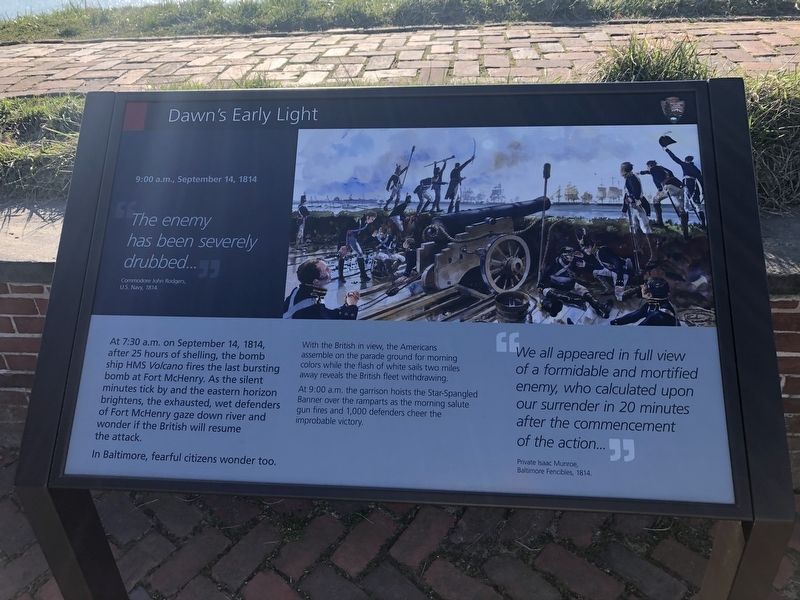
"The enemy has been severely drubbed…"
Commodore John Rodgers, U.S. Navy 1814
At 7:30 a.m. on September 14, 1814, after 25 hours of shelling, the bomb ship HMS Volcano fires the last bursting bomb at Fort McHenry. As the silent minutes tick by and the eastern horizon brightens, the exhausted, wet defenders of Fort McHenry gaze down river and wonder if the British will resume the attack.
In Baltimore, fearful citizens wonder too.
With the British in view, the Americans assemble on the parade ground for morning colors while the flash of white sails two miles away reveals the British fleet withdrawing.
At 9:00 a.m. the garrison hoists the Star-Spangled Banner over the ramparts as the morning salute gun fires and 1,000 defenders cheer the improbable victory.
"We all appeared in full view of a formidable and mortified enemy, who calculated upon our surrender in 20 minutes after the commencement of the action…"
Private Isaac Munroe, Baltimore Fencibles, 1814.
Erected by National Park Service, U.S. Department of the Interior.
Topics and series. This historical marker is listed in these topic lists:
this page online
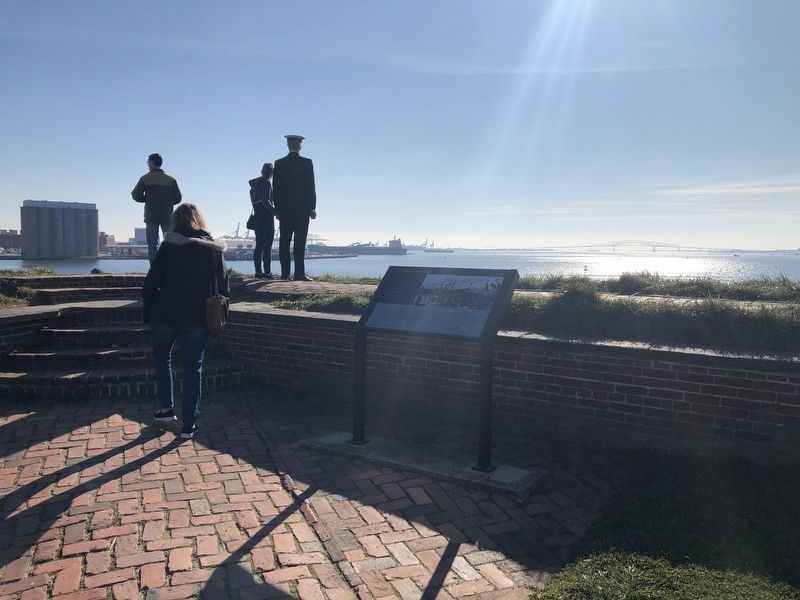
Location. 39° 15.791′ N, 76° 34.755′ W. Marker is in Baltimore, Maryland. It is in the Locust Point Industrial Area. It can be reached from Constellation Plaza 0.3 miles east of Wallace Street, on the right when traveling east. Touch for map. Marker is at or near this postal address: 2400 East Fort Avenue, Baltimore MD 21230, United States of America. Touch for directions.

Regionally, this marker is in Central Maryland. It is also in the American Mid-Atlantic, in the Chesapeake Bay Region, and on the Eastern Seaboard. Globally, it is in the North Atlantic Region, North America, the Western Hemisphere, the Western World, and the Anglosphere. Historically, it finds itself in what was once one of the original Thirteen Colonies and also the Antebellum South.
Other nearby markers. At least 8 other markers are within walking distance of this marker: The Great Guns of the Fort… The Rodman Cannons (a few steps from this marker); Experimental Carriages
Other markers no longer nearby. O Say, Can You See? (was here, next to this marker but has been permanently removed); Outer Battery (was a few steps from this marker but has been permanently removed); Civil War Guardhouse (was within shouting distance of this marker but has been permanently removed); The Ravelin (was within shouting distance of this marker but has been permanently removed).
Credits. This page was last revised on April 6, 2024. It was originally submitted on February 17, 2020, by Devry Becker Jones of Washington, District of Columbia. This page has been viewed 336 times since then and 13 times this year. Last updated on April 6, 2024, by Carl Gordon Moore Jr. of North East, Maryland. Photos: 1, 2. submitted on February 17, 2020, by Devry Becker Jones of Washington, District of Columbia.
