Ein Hakeshatot, Northern District, Israel — West Asia (the Levant in the Middle East)
Lion's Trail
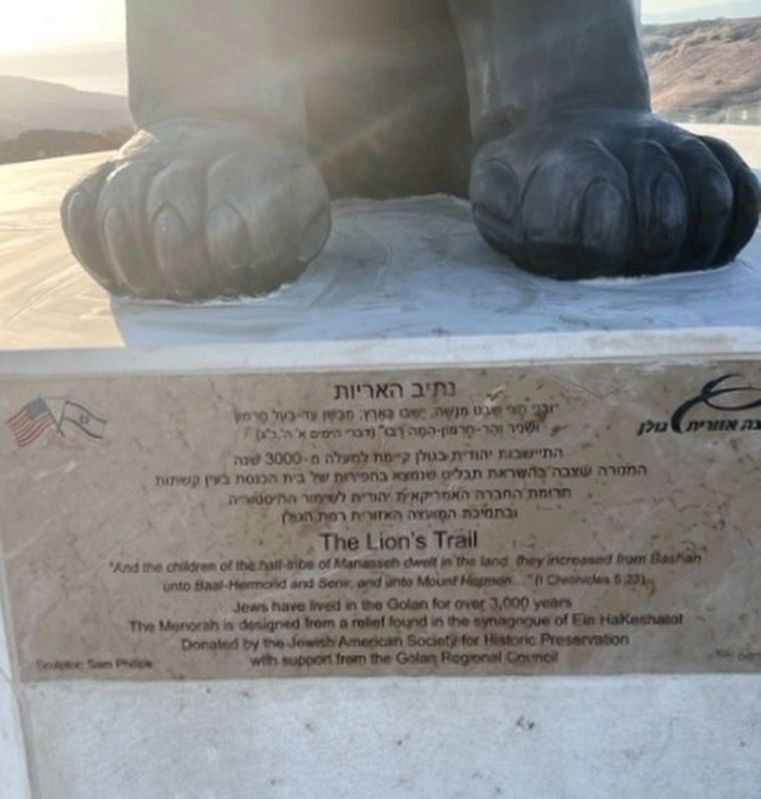
Photographed by Jerry Klinger, November 21, 2023
1. Lion's Trail - Golan Marker
נתיב האריות
כג וּבְנֵי, חֲצִי שֵׁבֶט מְנַשֶּׁה, יָשְׁבוּ, בָּאָרֶץ; מִבָּשָׁן עַד-בַּעַל חֶרְמוֹן, וּשְׂנִיר וְהַר-חֶרְמוֹן--הֵמָּה רָבוּ.
(remainder of Hebrew marker text not transcribed)
Lion’s Trail
"And the children of the half-tribe of Manasseh dwelt in the land: they increased from Bashan unto Baal-Hermond and Senir, and unto Mount Hermon." I Chronicles 5:23
Jews have lived in the Golan for over 3,000 years.
Donated by the Jewish American Society for Historic Preservation with support from the Golan Regional Council
Sam Philipe - Sculptor
Erected 2023
this page online
Topics and series. This historical marker is listed in this topic list: Settlements & Settlers. In addition, it is included in the Former U.S. Presidents: #45 Donald J. Trump series list. A significant historical year for this entry is 749 CE.
Location. 32° 50.976′ N, 35° 44.394′ E. Marker is in Ein Hakeshatot, Northern District. It can be reached from no nearby street. The Lion is located adjacent to the visitor center in the Ein Hakeshatot National Park, Golan Heights. Touch for map. Touch for directions.

Regionally, it is in Asia, specifically in West Asia, in the Middle East, in The Levant, on the Red Sea, in a coastal Mediterranean country, and in the Western World. Historically, it finds itself in what was once the Byzantine Empire, the Ottoman Empire, a British Mandate, and the Roman Empire.
Other nearby markers. At least 8 other markers are within 13 kilometers of this marker, measured as the crow flies: Baptistery (approx. 8.8 kilometers away); Kursi (approx. 8.8 kilometers away); Outer City Gate (approx. 12.2 kilometers away); The Courtyard (approx. 12.2 kilometers away); Inner City Gate (approx. 12.2 kilometers away); Sacrificial High Place (approx. 12.2 kilometers away); Ancient Road
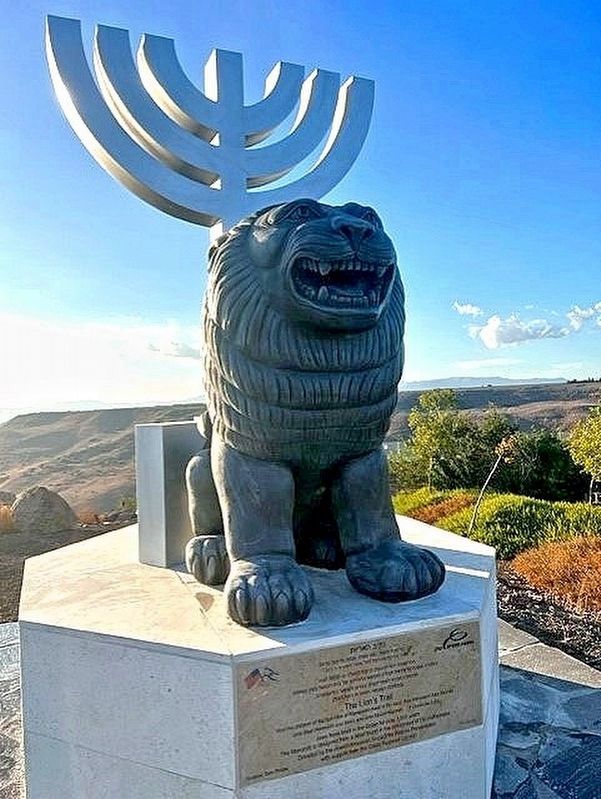
Photographed by Jerry Klinger
2. Lion's Trail Marker in Golan
More about this marker. The Menorah is modeled on the Menorah carved in the ancient Ein HaKeshatot Synagogue.
Also see . . .
1. Ein Keshatot.
Ein Keshatot (Um el-Kanatir) is an archaeological site that has been recognized as a National Heritage Site, and is located in the southern Golan, near Moshav Natur. At the site, remnants of a Jewish village were discovered, along with an impressive synagogue from the Talmudic Period.(Submitted on April 20, 2024, by Jerry Klinger of Boynton Beach, Florida.)
This is one of about 30 Jewish villages that existed in the Golan during the Talmudic Period, which was period of great growth in the area. The synagogue building was constructed in the 6th century CE (approximately 500 years after the destruction of the Second Temple), and was the center of local communal life. It served as a place for prayer, reading of the Torah, and various public activities. A powerful earthquake in 749 CE destroyed the building, as well as the entire village, which was never rebuilt until recent times.
2. Ein Keshatot - the Golan Heights Gem.
The Byzantine-era synagogue and adjoining spring at Ein Keshatot, known in Arabic as Umm el-Kanatir (the(Submitted on April 20, 2024, by Jerry Klinger of Boynton Beach, Florida.)Mother of Arches) – one of the most important Jewish historic sites in the Golan Heights – was rededicated Monday by Prime Minister Benjamin Netanyahu following a 15-year reconstruction.Photographed by Jerry Klinger3. Lion's Trail Marker textThe text below to be added to the plinth at a later time.
March 25, 2019
"The United States recognizes that the Golan Heights are part of the State of Israel."
President Donald J. Trump
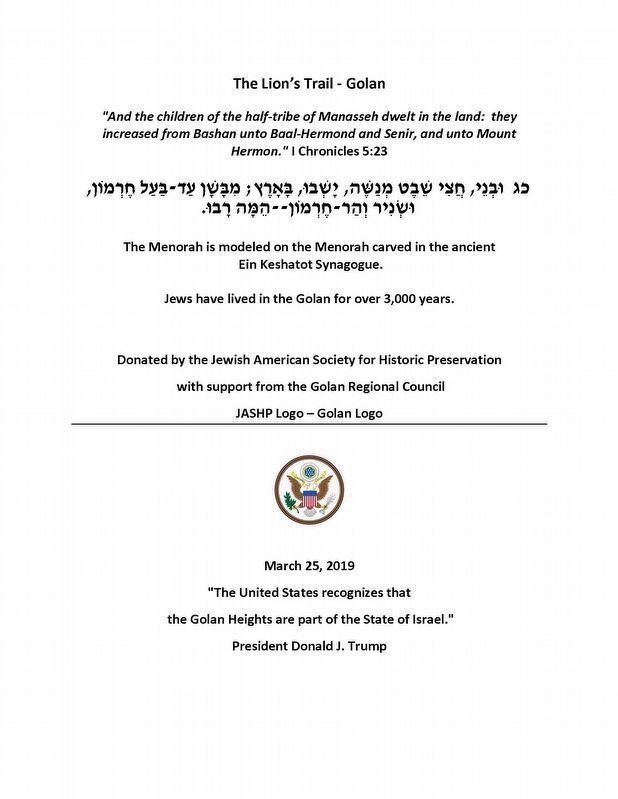
3. Umm-el-Kanatir. (Submitted on April 20, 2024, by Jerry Klinger of Boynton Beach, Florida.)
4. How Um-El-Kanatir became Ein Keshatot.
Most of the names of the ancient Jewish communities in the Golan have been preserved, thanks to the local Arab inhabitants who heard the village names from their parents and elders, and continued using them. This is true throughout Israel, too. For example, the village once known in Arabic as Beisan preserved the name of the ancient city known in Hebrew as Bet Shean; the Arab village of Ein Shams kept the name of the Biblical city of Bet Shemesh.(Submitted on April 20, 2024, by Jerry Klinger of Boynton Beach, Florida.)
5. Lion’s Trail in Golan Recalls 749 Earthquake-Destroyed Synagogue.
EIN KESHATOT, Golan Heights, Israel — “The Lion’s Trail – Golan” sculpture is located adjacent to the Israeli National Historical site of Ein Keshatot, “Spring of the Arches.” It is a “hidden” Jewish archeological treasure, a huge, reconstructed synagogue from the sixth century, high up in the Golan Heights. The dedication plates on the nine-foot tall sculpture are unfinished because of evacuations ordered in parts of northern Israel susceptible to Hezbollah missiles from Lebanon and mortars from Syria.(Submitted on May 1, 2024, by Jerry Klinger of Boynton Beach, Florida.)
Credits. This page was last revised on May 24, 2026. It was originally submitted on April 20, 2024, by Jerry Klinger of Boynton Beach, Florida. This page has been viewed 187 times since then and 33 times this year. Photos: 1, 2, 3. submitted on April 20, 2024, by Jerry Klinger of Boynton Beach, Florida. • Andrew Ruppenstein was the editor who published this page.
