Juno Beach in Palm Beach County, Florida — The American South (South Atlantic)
Celestial Railroad
| — | Juno Beach Landmarks Trail | — |

Photographed by Jim Ferguson
1. Celestial Railroad Marker
• The 7½-mile Celestial Railroad, officially named the Jupiter and Lake Worth Railway (J.& L.W.), operated from 1889 to 1895.
• In those days, ocean-going ships had no navigable access to Lake Worth and its towns, such as West Palm Beach. The Celestial Railroad provided the essential link between Jupiter Inlet and the northern end of the lake, where people and goods could then transfer to lake steamers.
• So essential was this connection that passengers paid a whopping 75 cents (equivalent to more than $20 today) for the half-hour trip.
• The route of this three-foot, narrow-gauge line ran through what is now Ocean Drive in present-day Juno Beach.
• The train had two passenger coaches and three freight cars, which always pointed south. In order to head north, the train had to travel in reverse.
• Though the train only had two stations, Jupiter and Juno, its builders had planned two additional stations called Venus and Mars. Many Juno Beach street names carry out that celestial theme today.
• The Celestial Railroad did not survive the completion of Henry Flagler's Florida East Coast Railway, which bypassed
this page online
Erected 2019 by Town of Juno Beach and Juno Beach Historical Society.
Topics. This historical marker is listed in these topic lists: Railroads & Streetcars • Settlements & Settlers. A significant historical year for this entry is 1889.
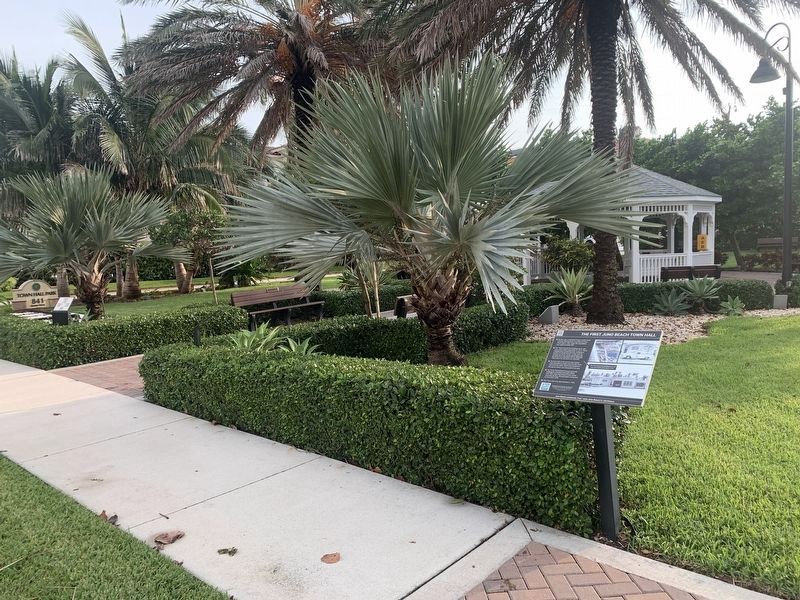
Location. 26° 52.747′ N, 80° 3.196′ W. Marker is in Juno Beach, Florida, in Palm Beach County. It is on Ocean Drive (Florida Route A1A) near Venus Drive, on the right when traveling south. The marker is located in Town Hall Park. Touch for map. Marker is at or near this postal address: 841 Ocean Drive, North Palm Beach FL 33408, United States of America. Touch for directions.

Regionally, this marker is in South Florida, on the Gold Coast, on the Treasure Coast, and in Greater Miami. It is also in the American South and on the Eastern Seaboard. Globally, it is in the North Atlantic Region, North America, a Gulf of Mexico state, the Western Hemisphere, the Western World, and the Anglosphere. Historically, it finds itself in what was once New Spain, the territory of the Mississippian Culture, one of the Confederate States of America,
Photographed by Tim Fillmon, August 7, 2024
2. Celestial Railroad Marker
Other nearby markers. At least 8 other markers are within 5 miles of this marker, measured as the crow flies: The First Juno Beach Town Hall (a few steps from this marker); a different marker also named Celestial Railroad (approx. 0.4 miles away); Eleanor Fletcher and Loggerhead Marinelife Center (approx. 0.4 miles away); Gold Star Memorial (approx. 0.4 miles away); Old Dade County Court House (approx. 2.3 miles away); United States Life Saving Station (approx. 3.6 miles away); U.S. Jupiter Life Saving Station (approx. 3.6 miles away); W.D. Anderson (approx. 4.4 miles away). Touch for a list and map of all markers in Juno Beach.
More about this marker. A section of tracks from the Celestial Railroad is near the marker.
Regarding Celestial Railroad. Before this short railroad line opened in 1889, the entire region between Jupiter and Miami was very sparsely inhabited. Getting lumber and manufactured goods to the settlers was exceedingly difficult and it was equally difficult for them to sell whatever they grew or caught. There were no natural ports, and no practical roads.
Why was ocean access so difficult? There was no Lake Worth inlet back then, although occasionally there would be a very shallow passage. Although small sailing boats could land near the beaches, strong ocean currents and often-adverse winds made travel times and conditions very unpredictable.
What about overland travel? Steamboats from farther north in Titusville ran for over 100 miles up and down the Indian River Lagoon, just inside Florida’s coastal barrier islands, but that lagoon ended at Jupiter. Between Jupiter and Lake Worth, wagon transportation was very difficult as the terrain was hilly, sandy, and rough.
The solution to this dilemma was to build a 7½ mile long narrow narrow-gauge railway just inside the coastal dune. This connected Jupiter and the new village of Juno, which was on the northern end of Lake Worth near today’s Publix at PGA Boulevard and U.S. 1. This train line created a vital link between the paddlewheel steamboats ending in Jupiter and shallow boats which then began operating on the 30-mile, north-south Lake Worth. The railroad charged the whopping fare of 75 cents for this short trip, equivalent to about $22 now.
At the front of the park is a plaque showing the train’s route and a photograph of one of its engines.
This train ran right past where you are standing and continued south along the route of Ocean Drive and U.S. 1. Between the two stations, one resident said at the time, there was “nothing more than a few shacks and pineapple patches.” Its official name was the Jupiter and Lake Worth Railway, but it earned the nickname “Celestial Railroad”. Why?
Since the northern station was named after the Roman god Jupiter, the southern one was creatively named after Jupiter’s wife, Juno. Between the two stations, the railway had two uninhabited stopping points: What could be better than to name them after two of the gods’ children: Venus and Mars! How fitting, then, that an early visitor dubbed this “the Celestial Railroad.”
During the six years it operated, the railway opened the Lake Worth region to trade, settlement, and tourism. The little village of Juno even became the seat of the then-huge Dade County, which covered today’s counties of Saint Lucie, Martin, Palm Beach, Broward and Miami-Dade.
The heyday of the Celestial Railroad came to an end in 1895 when tycoon Henry Flagler built his Florida East Coast Railway further inland through often-flooded wetlands. His line extended to Palm Beach and he even built a railroad bridge across the Lake Worth Lagoon directly to his Royal Poinciana Hotel. At the time, it was the largest wooden building in the world and could accommodate 2000 guests. Once his railroad was completed, there was no longer any use for the Celestial. Flagler’s line was much faster and efficient, meaning people and goods didn’t have to switch back and forth between boats and trains.
It’s interesting to note that in 1950, the women of the Juno Beach Garden Club took on the job of naming all the town’s new streets. Keeping with the celestial theme, streets were often named after Roman gods, goddesses and places associated with them.
Also see . . . Discover Juno Beach Tour. Link to Juno Beach history: mobile app, maps, brochures and historical interpretive plaques. (Submitted on April 22, 2024.)
Credits. This page was last revised on April 13, 2026. It was originally submitted on April 22, 2024, by Jim Ferguson of Juno Beach, Florida. This page has been viewed 605 times since then and 49 times this year. Photos: 1. submitted on April 22, 2024, by Jim Ferguson of Juno Beach, Florida. 2. submitted on August 25, 2024, by Tim Fillmon of Webster, Florida. • J. Makali Bruton was the editor who published this page.
