St-Jean-sur-Richelieu in Montérégie, Québec — Central Canada (French-Canadian)
Halfway House - Casernes de Blairfindie
⎯⎯⎯
The Blairfindie Barracks
Photographed by Stéphane Kirouac, July 27, 2014
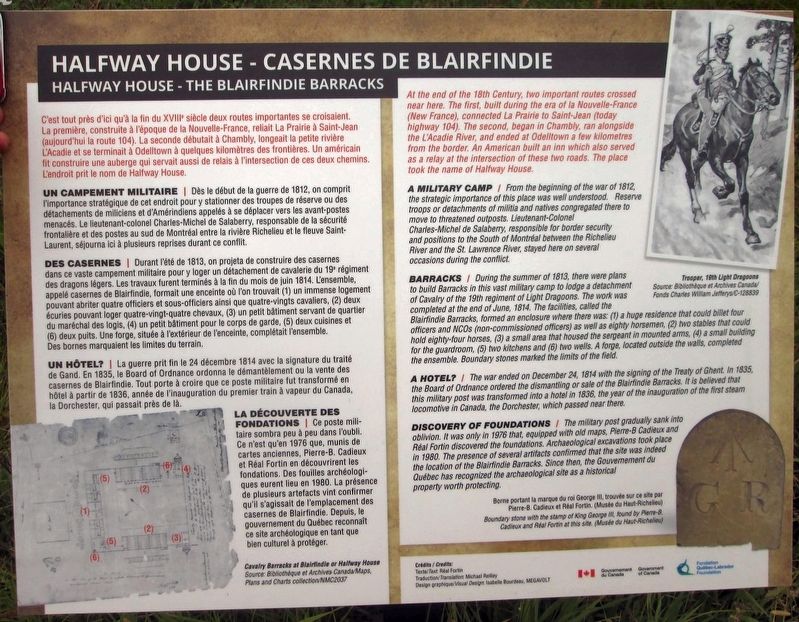
1. Barrack at Blairfindie - Halfway House Marker

Un campement militaries Dès le début de la guerre de 1812, on comprit l’importance stratégique de cet endroit pour y stationner des troupes de réserve ou des détachements de miliciens et d'Amérindiens appelés à se déplacer vers les avant-postes menacés. Le lieutenant-colonel Charles-Michel de Salaberry, responsable de la sécurité frontalière et des postes au sud de Montréal entre la rivière Richelieu et le fleuve Saint-Laurent, séjourna ici à plusieurs reprises durant ce conflit.
Des casernes Durant l'été de 1813, on projeta de construire des casernes dans ce vaste campement militaire pour y loger un détachement de cavalerie
this page online
Un hotel? La guerre prit fin le 24 décembre 1814 avec la signature du traité de Gand. En 1835, le Board of Ordnance ordonna le démantèlement ou la vente des casernes de Blairfindie. Tout porte à croire que ce poste militaire fut transformé en hôtel à partir de 1836, année de l'inauguration du premier train à vapeur du Canada, la Dorchester, qui passait près de là.
La Decouverte des foundations Ce poste militaire sombra peu à peu dans l'oubli. Ce n'est qu'en 1976 que, munis de cartes anciennes, Pierre-B. Cadieux et Réal Fortin en découvrirent les fondations. Des fouilles archéologiques eurent lieu en 1980. La présence de plusieurs artefacts vint confirmer qu'il s'agissait de l'emplacement des casernes de Blairfindie. Depuis, le gouvernement du Québec reconnait ce site archéologique en tant que bien culturel à protéger.
A military camp From the beginning of the war of 1812, the strategic importance of this place was well understood. Reserve troops or detachments of militia and natives congregated there to move to threatened outposts. Lieutenant-Colonel Charles-Michel de Salaberry, responsible for border security and positions to the South of Montréal between the Richelieu River and the St. Lawrence River, stayed here on several occasions during the conflict.
Barracks During the summer of 1813, there were plans to build Barracks in this vast military camp to lodge a detachment of Cavalry of the 19th regiment of Light Dragoons. The work was completed at the end of June, 1814. The facilities, called the Blairfindie Barracks, formed an enclosure where there was: (1) a huge residence that could billet four officers and NCOs (non-commissioned officers) as well as eighty horsemen, (2) two stables that could hold eighty-four horses, (3) a small area that housed the sergeant in mounted arms, (4) a small building for the guardroom, (5) two kitchens and (6) two wells. A forge, located outside the walls, completed the ensemble. Boundary stones marked the limits of the field.
A hotel? The war ended on December 24, 1814 with the signing of the Treaty of Ghent. In 1835 the Board of Ordnance ordered the dismantling or sale of the Blairfindie Barracks. It is believed that this military post was transformed into a hotel in 1836, the year of the inauguration of the first steam locomotive in Canada, the Dorchester, which passed near there.
Discovery of Foundations The military post gradually sank into oblivion. It was only in 1976 that, equipped with old maps, Pierre-B Cadieux and Réal Fortin discovered the foundations. Archaeological excavations took place in 1980. The presence of several artifacts confirmed that the site was indeed the location of the Blairfindie Barracks. Since then, the Gouvernement du Québec has recognized the archaeological site as a historical property worth protecting.
Erected by Government of Canada, Fondation Québec-Labrador.
Topics and series. This historical marker is listed in this topic list: War of 1812. In addition, it is included in the Canada, Historic Sites and Monuments Board series list. A significant historical year for this entry is 1813.
Location. 45° 22.956′ N, 73° 22.19′ W. Marker is in St-Jean-sur-Richelieu, Québec, in Montérégie. It is on Avenue des Pins, on the right when traveling south. Touch for map. Marker is at or near this postal address: 54 Avenue des Pins, St-Jean-sur-Richelieu QC J2W 2Z3, Canada. Touch for directions.

Regionally, this marker is in Greater Montréal. It is also in Central Canada. Globally, it is in North America, the Western Hemisphere, and the Western World. Historically, it finds itself in what was once a British colony, the Viceroyalty of New France, the Haudenosaunee (Iroquois) Confederacy, and Rupert’s Land.
Other nearby markers. At least 8 other markers are within 11 kilometers of this marker, measured as the crow flies: Second Battle of La Prairie (approx. 2.8 kilometers away); Fort Sainte-Thérèse (approx. 8.7 kilometers away); Fort Ste. Therese (approx. 8.7 kilometers away); Chambly Canal (approx. 9.8 kilometers away); Albani (approx. 10.2 kilometers away); General John Thomas (approx. 10.2 kilometers away); Fort Chambly Cemetery (approx. 10.2 kilometers away); Fort Chambly (approx. 10.4 kilometers away).
Also see . . . Site archéologique des Casernes-de-Blairfindie (HistoricPlaces.ca).
Heritage Value: La valeur patrimoniale du site archéologique des Casernes-de-Blairfindie repose sur son intérêt historique. Ce site est un témoin de la guerre de 1812 et des efforts des Britanniques et des Canadiens pour protéger la frontière séparant les États-Unis et les colonies britanniques. Ce conflit, qui découle des luttes politiques engendrées par les guerres napoléoniennes, débute en 1812 alors que les Américains déclarent la guerre à l'Angleterre et entreprennent la conquête de l'Amérique du Nord britannique. Pour protéger Montréal des attaques américaines, sir George Prevost (1767-1816), gouverneur en chef de l'Amérique du Nord britannique, fait ériger plusieurs camps sur les principales voies de communication de la rive sud. Les casernes de Blairfindie sont ainsi construites, vraisemblablement sur un ancien camp nommé Halfway House, quelques mois seulement avant la fin du conflit en 1814. Ces casernes accueillent le 19e régiment de cavalerie des Dragons légers (19th Light Dragoons). La position stratégique de ce poste au centre d'un réseau de forts (fort de Chambly, fort Saint-Jean, vieux fort de Laprairie et blockhaus de Lacolle), à la croisée des routes reliant La Prairie à Saint-Jean et Chambly à Odelltown, permet à la cavalerie de se déplacer aisément d'un point à l'autre pour barrer la route à une éventuelle attaque américaine…(Submitted on May 5, 2024.)
(In translation): The heritage value of the Casernes-de-Blairfindie archaeological site is based on its historical interest. This site is a witness to the War of 1812 and the efforts of the British and Canadians to protect the border separating the United States and the British colonies. This conflict, which stemmed from the political struggles generated by the Napoleonic Wars, began in 1812 when the Americans declared war on England and undertook the conquest of British North America. To protect Montreal from American attacks, Sir George Prevost (1767-1816), governor-in-chief of British North America, had several camps erected on the main lines of communication on the south shore. The Blairfindie barracks were thus built, probably on a former camp called Halfway House, just a few months before the end of the conflict in 1814. These barracks housed the 19th Light Dragoons cavalry regiment. The strategic position of this post at the center of a network of forts (fort de Chambly, fort Saint-Jean, old fort de Laprairie and blockhouse of Lacolle), at the crossroads of the roads linking La Prairie to Saint-Jean and Chambly to Odelltown , allows the cavalry to move easily from one point to another to block the road to a possible American attack…
Credits. This page was last revised on May 5, 2024. It was originally submitted on April 26, 2024, by Stéphane Kirouac of St-Jean-sur-Richelieu, QCQuebec. This page has been viewed 416 times since then and 68 times this year. Photo 1. submitted on April 26, 2024, by Stéphane Kirouac of St-Jean-sur-Richelieu, QCQuebec. • Andrew Ruppenstein was the editor who published this page.
