Plymouth in Grafton County, New Hampshire — The American Northeast (New England)
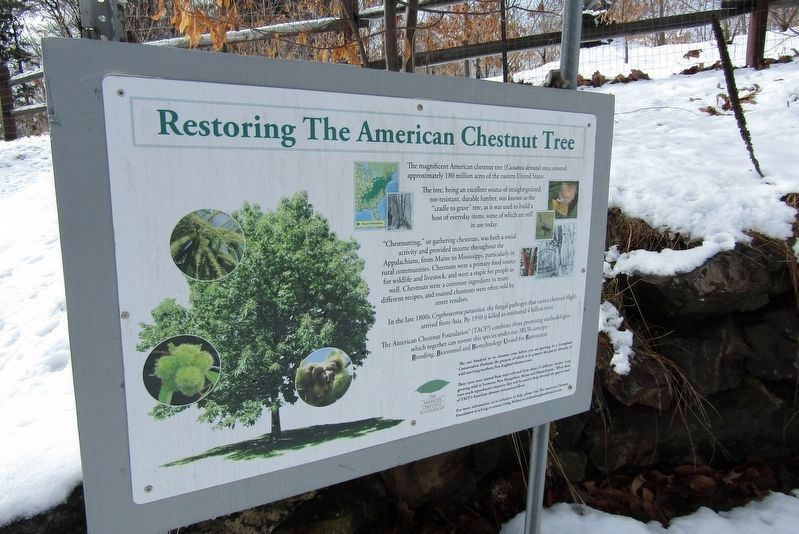
Restoring The American Chestnut Tree
Photographed by Conrad Ward, March 10, 2024
1. Restoring The American Chestnut Tree Marker
The magnificent American chestnut tree (Castanea dentata) once covered approximately 180 million acres of the eastern United States.
The tree, being an excellent source of straight-grained, rot resistant, durable lumber, was known as the "cradle to grave" tree, as it was used to build a host of everyday items, some of which are still in use today.
"Chestnutting," or gathering chestnuts, was both a social activity and provided income throughout the Appalachians, from Maine to Mississippi, particularly in rural communities. Chestnuts were a primary food source for wildlife and livestock, and were a staple for people as well. Chestnuts were a common ingredient in many different recipes, and roasted chestnuts were often sold by street vendors.
In the late 1800s, Cryphonectria parasitica, the fungal pathogen that causes chestnut blight, arrived from Asia. By 1950 it killed an estimated 4 billion trees.
The American Chestnut Foundation (TACF) combines three promising methodologies, which together can restore this species under our 3BUR concept - Breeding, Biocontrol and Biotechnology United for Restoration.
The
this page online
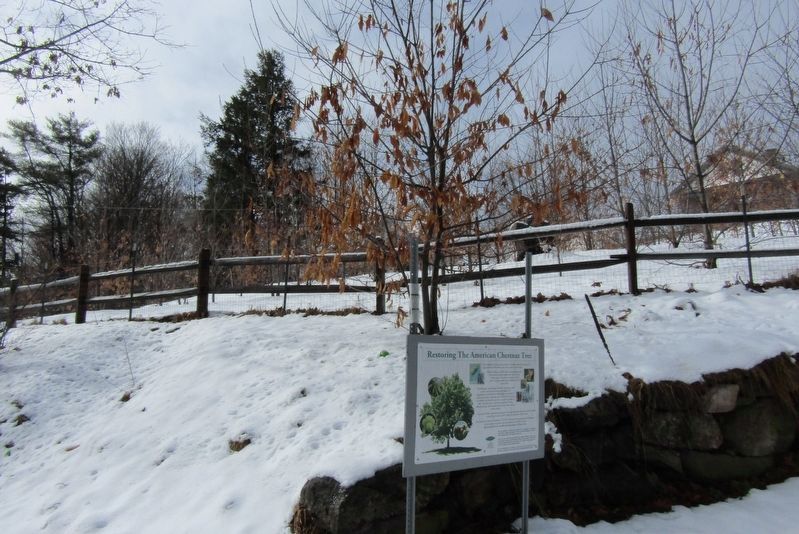
These trees were started from nuts collected from about 25 different 'mother' trees growing wild in Vermont, New Hampshire, Maine, and Massachusetts. When these trees reach reproductive maturity they will be used to help diversify the genetic base of TACF's American chestnut restoration efforts.
For more information, or to volunteer to help, please visit The American Chestnut Foundation at acf.org or contact Doug McLane at [email protected].
Erected by The American Chestnut Foundation.
Topics. This historical marker is listed in this topic list: Horticulture & Forestry.
Location. 43° 45.377′ N, 71° 41.272′ W. Marker is in Plymouth, New Hampshire, in Grafton County. It is at the intersection of Daniel Webster Highway (New Hampshire Route 3) and Railroad Square Road, on the right when traveling south on Daniel Webster Highway. Touch for map. Marker is in this post
Photographed by Conrad Ward, March 10, 2024
2. Restoring The American Chestnut Tree Marker

Regionally, this marker is in the White Mountains. It is also in the American Northeast and in New England. Globally, it is in North America, the Great North Woods, the Western Hemisphere, the Western World, and the Anglosphere. Historically, it finds itself in what was once one of the original Thirteen Colonies.
Other nearby markers. At least 8 other markers are within walking distance of this marker: Rotary Amphitheater (about 400 feet away, measured in a direct line); The Common (about 400 feet away); Plymouth Veterans Monument (about 700 feet away); Revolutionary War Cannon (about 700 feet away); Capt. Harl Pease Jr. (about 700 feet away); Plymouth Town Hall & Bell (about 700 feet away); May 30, 1990 (about 700 feet away); Holmes Academy (approx. 0.2 miles away). Touch for a list and map of all markers in Plymouth.
Also see . . . The American Chestnut Foundation. (Submitted on May 2, 2024, by Michael Herrick of Southbury, Connecticut.)
Credits. This page was last revised on May 2, 2024. It was originally submitted on April 27, 2024, by Conrad Ward of Guilford, Connecticut. This page has been viewed 187 times since then and 25 times this year. Photos: 1, 2. submitted on April 27, 2024, by Conrad Ward of Guilford, Connecticut. • Michael Herrick was the editor who published this page.
