Grand Rapids in Kent County, Michigan — The American Midwest (Great Lakes)
Harriet and Barney Burton
Burton Heights Business District
Photographed by Nathan Bierma
1. Harriet and Barney Burton Marker
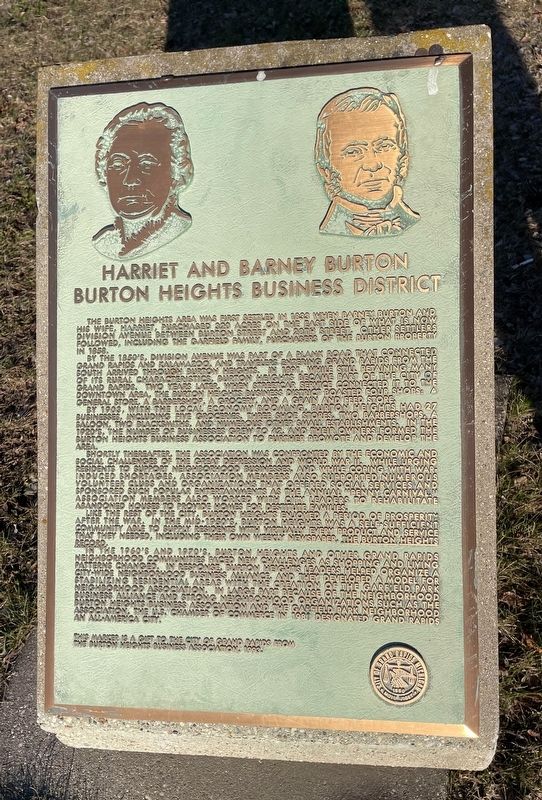
The Burton Heights area was first settled in 1833 when Barney Burton and his wife, Harriet, purchased 320 acres on the east side of what is now Division Avenue between Burton Street and 28th Street. Other settlers followed, including the Garfield family, purchasers of the Burton property in 1858.
By the 1850's, Division Avenue was part of a plank road that connected Grand Rapids and Kalamazoo, and travelers entering Grand Rapids from the south arrived through Burton Heights. In 1891, while still retaining many of its rural characteristics, Burton Heights became part of the City of Grand Rapids. Two years later, when streetcar service connected it to the downtown area, the Burton Heights business district boasted four shops: a general store, a barbershop, a grocery, and a grain and feed store.
By 1903, with the local economy booming, Burton Heights had 27 businesses, including five groceries, three shoe stores, two barbershops, a saloon, two blacksmiths, and numerous other small establishments. In the 1920's, the number of businesses grew to 42, and their owners formed the Burton Heights Business Association to further promote and develop the area.
Shortly thereafter, the association was confronted by the economic and social challenges of the Great Depression and World War II. While urging residents to support neighborhood businesses, and while coping with war-induced shortages, association members also supported numerous volunteer clubs and organizations that offered social services and sponsored such popular entertainments as the annual "penny carnival." Association members also worked with city leaders to rehabilitate abandoned houses to provide homes for destitute families.
Like the rest of the city, Burton Heights enjoyed a period of prosperity after the war. In the mid-1950's, Burton Heights was
this page online
In the 1960's and 1970's, Burton Heights and other Grand Rapids neighborhood communities faced new challenges as shopping and living patterns changed. In response, Burton Heights leaders helped organize a city-wide neighborhood business alliance, and they developed a model for stabilizing residential areas with the creation of the Garfield Park Neighborhood Association. In large part because of the neighborhood business alliance and strong neighborhood organizations such as the Burton Heights Business Association and the Garfield Park Neighborhood Association, the U.S. Chamber of Commerce in 1981 designated Grand Rapids an All-America City.
This marker is a gift to the City of Grand Rapids from the Burton Heights Business Association, 1993.
Erected 1993 by Burton Heights Business Association.
Topics. This historical marker is listed in this topic list: Settlements & Settlers. A significant historical year for this entry is 1833.
Location. 42° 55.051′ N, 85° 39.956′ W.
Photographed by Nathan Bierma, March 6, 2024
2. Harriet and Barney Burton Marker

Regionally, this marker is in West Michigan. It is also in the American Midwest. Globally, it is in North America, the Western Hemisphere, the Western World, and the Anglosphere. Historically, it finds itself in what was once the Northwest Territory.
Other nearby markers. At least 8 other markers are within 3 miles of this marker, measured as the crow flies: Benjamins-Spring House (approx. half a mile away); Cantonment Anderson (approx. 1.6 miles away); Thrifty Acres (approx. 1.9 miles away); St. Andrew's Cemetery (approx. 2 miles away); Gerald R. Ford Boyhood Home / President Gerald R. Ford (approx. 2.4 miles away); May House (approx. 2.6 miles away); Army National Guard Veterans Memorial (approx. 2.7 miles away); 126th Infantry (approx. 2.7 miles away). Touch for a list and map
Photographed by Nathan Bierma, March 6, 2024
3. Harriet and Barney Burton Marker
Photographed by Nathan Bierma, March 6, 2024
4. Harriet and Barney Burton Marker
Credits. This page was last revised on May 1, 2024. It was originally submitted on April 29, 2024, by Nathan Bierma of Grand Rapids, Michigan. This page has been viewed 419 times since then and 51 times this year. Photos: 1, 2, 3, 4. submitted on April 29, 2024, by Nathan Bierma of Grand Rapids, Michigan. • J. Makali Bruton was the editor who published this page.
