Westlake in Los Angeles in Los Angeles County, California — The American West (Pacific Coastal)
Felipe de Neve Branch Library
| — | and First Congregational Church | — |
Photographed by Craig Baker
1. Library Marker
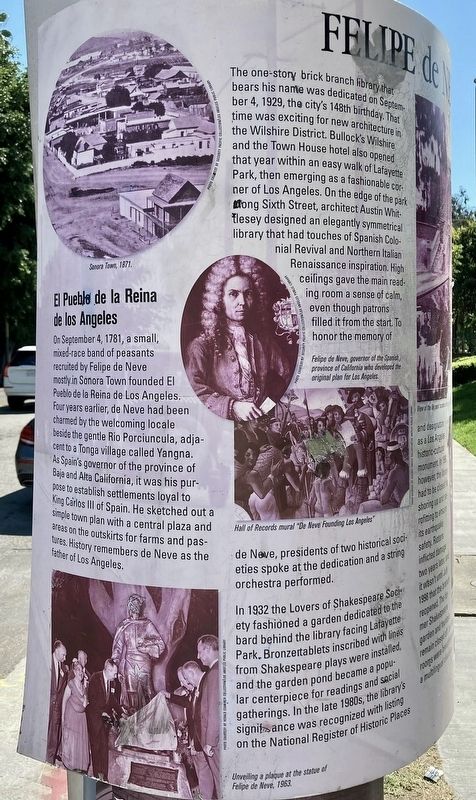
El Pueblo de la Reina de los Angeles
On September 4, 1781, a small, mixed-race band of peasants recruited by Felipe de Neve mostly in Sonora Town founded El Pueblo de la Reina de Los Angeles. Four years earlier, de Neve had been charmed by the welcoming locale beside the gentle Rio Porciuncula, adjacent to a Tonga village called Yangna. As Spain's governor of the province of Baja and Alta California, it was his purpose to establish settlements loyal to King Carlos III of Spain. He sketched out a simple town plan with a central plaza and areas on the outskirts for farms and pastures. History remembers de Neve as the father of Los Angeles.
The one-story, brick branch library that bears his name was dedicated on September 4, 1929, the city's 148th birthday. That time was exciting for new architecture in the Wilshire District. Bullock's Wilshire and the Town House hotel also opened that year within an easy walk of Lafayette Park, then emerging as a fashionable corner of Los Angeles. On the edge of the park ong Sixth Street, architect Austin Whitlesey designed an elegantly symmetrical library that had touches of Spanish Colonial Revival and Northern Italian Renaissance inspiration. High ceilings gave the main reading room a sense of calm, even though patrons filled it from the start. To honor the memory of de Neve, presidents of two historical societies spoke at the dedication and a string orchestra performed.
In 1932 the Lovers of Shakespeare Society fashioned a garden dedicated to the bard behind the library facing Lafayette Park. Bronze tablets inscribed with lines from Shakespeare plays were installed, and the garden pond became a popular centerpiece for readings and social gatherings. In the late 1980s, the library's significance was recognized with
this page online
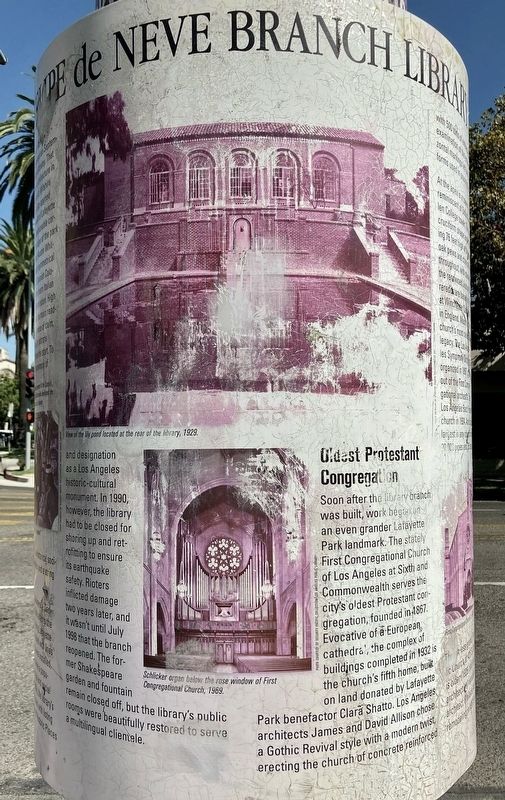
Oldest Protestant Congregation
Soon after the library branch was built, work began on an even grander Lafayette Park landmark. The stately First Congregational Church of Los Angeles at Sixth and Commonwealth serves the city's oldest Protestant congregation, founded in 1867. Evocative of a European cathedral, the complex of buildings completed in 1932 is the church's fifth home, built on land donated by Lafayette Park benefactor Clara Shatto. Los Angeles architects James and David Allison chose a Gothic Revival style with a modern twist, erecting the church of concrete reinforced with 500 tons of embedded steel.
Photographed by Craig Baker
2. Library Marker
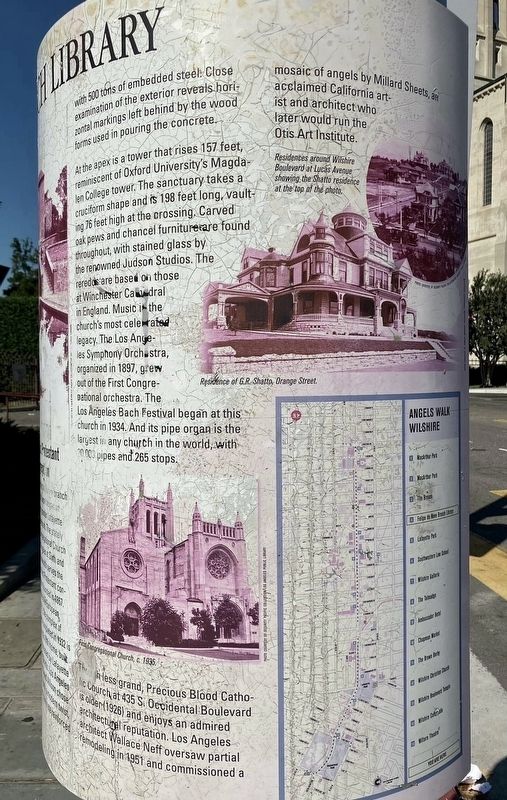
At the apex is a tower that rises 157 feet, reminiscent of Oxford University's Magdalen College tower. The sanctuary takes a cruciform shape and is 198 feet long, vaulting 76 feet high at the crossing. Carved oak pews and chancel furniture are found throughout, with stained glass by the renowned Judson Studios. The reredos are based on those at Winchester Cathedral in England. Music is the church's most celebrated legacy. The Los Angeles Symphony Orchestra, organized in 1897, grew out of the First Congregational orchestra. The Los Angeles Bach Festival began at this church in 1934. And its pipe organ is the largest in any church in the world, with 20,000 pipes and 265 stops.
Though less grand, Precious Blood Catholic Church at 435 S. Occidental Boulevard is older (1926) and enjoys an admired architecture reputation. Los Angeles architect Wallace Neff oversaw partial remodeling in 1951 and commissioned a mosaic of angels by Millard Sheets, an acclaimed California artist and architect who later would run the Otis Art Institute.
Erected 2007 by City of Los Angeles. (Marker Number 452.)
Topics and series. This historical marker is listed in these topic lists: Architecture • Education. In addition, it is included in the Los Angeles Historic-Cultural Monument series list. A significant historical year for this entry is 1781.
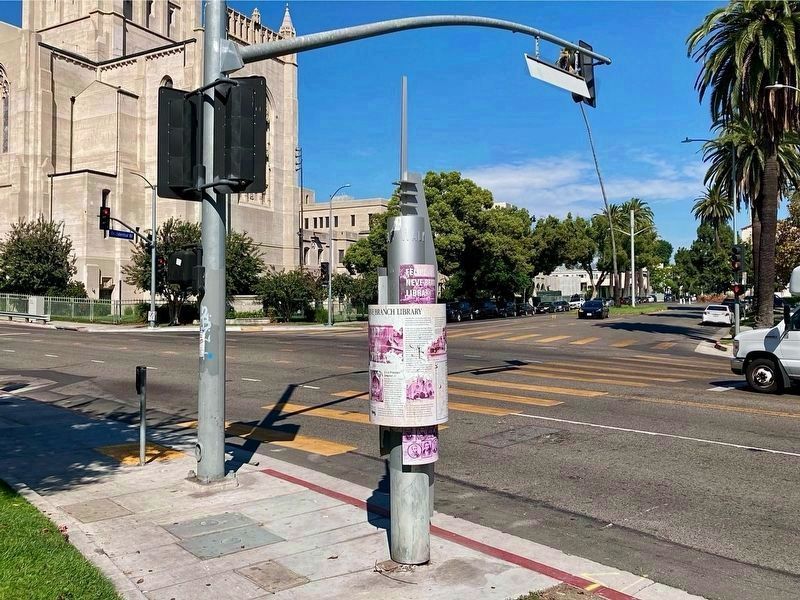
Location. 34° 3.815′ N, 118° 17.051′ W. Marker is in Los Angeles, California, in Los Angeles County. It is in Westlake. It is at the intersection of 6th Street and Occidental Boulevard, on the right when traveling east on 6th Street. Touch for map. Marker is at or near this postal address: 2900 W 6th St, Los Angeles CA 90005, United States
Photographed by Craig Baker
3. Library Marker

Regionally, this marker is in the Transverse Ranges. It is also on the American Pacific Coast. Globally, it is in North America, on the Ring of Fire, on the Pacific Rim, in the Western Hemisphere, in the Western World, and in the Anglosphere. Historically, it finds itself in what was once New Spain and also Mexico’s Alta California.
Other nearby markers. At least 8 other markers are within walking distance of this marker: First Congregational Church (about 400 feet away, measured in a direct line); Bullocks Wilshire (approx. 0.3 miles away); Hungarian Freedom Fight of 1956 (approx. 0.4 miles away); MacArthur Park (approx. 0.4 miles away); Frank C. Hill House (approx. half a mile away); Founder’s Church (approx. 0.6 miles away); Grier-Musser House (approx. 0.8 miles away); Godzilla, King of the Monsters! (approx. 0.8 miles away). Touch for a list and map of all markers in Los Angeles.
Regarding Felipe de Neve Branch Library. Added to the National Register of Historic Places in 1987, and designated Los Angeles Historic-Cultural Monument No. 452 in 1989.
Also see . . . Angels Walk L.A. Self-guided walking tours of historic neighborhoods in Los Angeles. The Felipe de Neve Branch Library marker is part of the Wilshire walk. (Submitted on April 30, 2024.)
Photographed by Craig Baker, October 8, 2023
4. Felipe de Neve Branch Library Marker

Photographed by Craig Baker
5. Library and Marker

Photographed by Craig Baker
6. Felipe de Neve Branch Library
Credits. This page was last revised on September 5, 2026. It was originally submitted on April 30, 2024, by Craig Baker of Sylmar, California. This page has been viewed 432 times since then and 53 times this year. Photos: 1, 2, 3. submitted on April 30, 2024, by Craig Baker of Sylmar, California. 4. submitted on May 5, 2024, by Craig Baker of Sylmar, California. 5. submitted on August 16, 2024, by Craig Baker of Sylmar, California. 6. submitted on April 30, 2024, by Craig Baker of Sylmar, California.
