Lisboa, Portugal — Southwestern Europe (Iberian Peninsula)
Fernando Pessoa
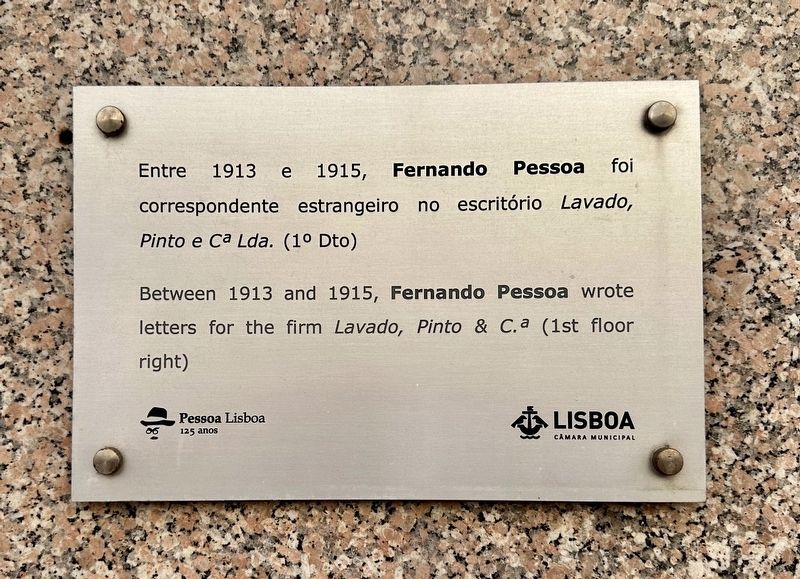
Photographed by Andrew Ruppenstein, April 21, 2024
1. Fernando Pessoa Marker

Entre 1913 e 1915, Fernando Pessoa foi correspondente estrangeiro no escritório Lavado, Pinto e Ca Lda. (1° Dto)
Erected by Pessoa Lisboa, Câmara Municipal Lisboa.
Topics. This historical marker is listed in this topic list: Arts, Letters, Music. A significant historical year for this entry is 1913.
Location. 38° 42.765′ N, 9° 8.263′ W. Marker is in Lisboa. It is on Rua da Prata north of Rua de Santa Justa, on the left when traveling north. Touch for map. Marker is at or near this postal address: Rua da Prata 267, Lisboa 1100-052, Portugal. Touch for directions.

Regionally, it is in the North Atlantic Region, in Europe, in the European Union, in Atlantic Europe, on the Iberian Peninsula, in the Schengen Area, and in the Western World. Historically, it finds itself in what was once Portuguese colonies and also the Roman Empire.
Other nearby markers. At least 8 other markers are within walking distance of this marker: Arco do Bandeira (about 120 meters away, measured in a direct line); A Ginjinha (approx. 0.2 kilometers away); Memorial às Vítimas do Massacre de 1506 / Memorial to the Victims of the 1506 Massacre
this page online
Also see . . .
1. Fernando Pessoa (Wikipedia).
Overview: Fernando António Nogueira Pessoa (13 June 1888 – 30 November 1935) was a Portuguese poet, writer, literary critic, translator, publisher, and philosopher, described as one of the most significant literary figures of the 20th century and one of the greatest poets in the Portuguese language. He also wrote in and translated from English and French.(Submitted on April 30, 2024.)
Pessoa was a prolific writer, and not only under his own name, for he created approximately seventy-five others, of which three stand out: Alberto Caeiro, Álvaro de Campos, and Ricardo Reis. He did not call them pseudonyms because he felt that this did not capture their true independent intellectual life and instead called them heteronyms...
2. Will the real Fernando please stand up? - Ilan Stavans (YouTube, 4:51). “ On November 30th, 1935,

Photographed by Andrew Ruppenstein, April 21, 2024
2. Fernando Pessoa Marker - wide view

Photographed by Andrew Ruppenstein, April 21, 2024
3. Fernando Pessoa Marker - wider view
Credits. This page was last revised on April 30, 2024. It was originally submitted on April 30, 2024, by Andrew Ruppenstein of Lamorinda, California. This page has been viewed 221 times since then and 29 times this year. Photos: 1, 2, 3. submitted on April 30, 2024, by Andrew Ruppenstein of Lamorinda, California.
