Homer in Claiborne Parish, Louisiana — The American South (West South Central)
Homer College (CME) ⎯⎯⎯ African American Education in Louisiana
Photographed by Wesley Harris
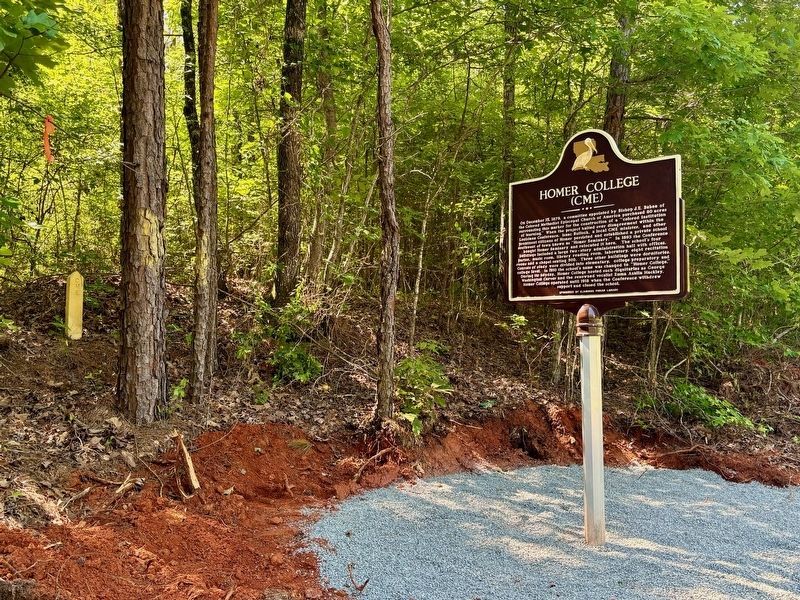
1. Homer College (CME) Marker
Inscription.
Homer College (CME), also, African American Education in Louisiana. .
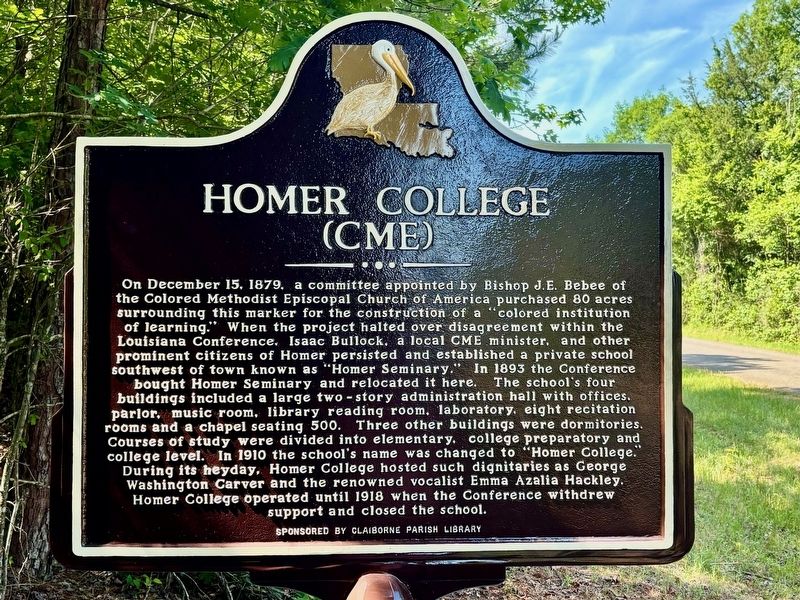
Homer College (CME) . On December 15, 1879, a committee appointed by Bishop J.E. Bebee of the Colored Methodist Episcopal Church of America purchased 80 acres surrounding this marker for the construction of a "colored institution of learning." When the project halted over disagreement within the Louisiana Conference, Isaac Bullock, a local CME minister, and other prominent citizens of Homer persisted and established a private school southwest of town known as "Homer Seminary." In 1893 the Conference bought Homer Seminary and relocated it here. The school's four buildings included a large two-story administration hall with offices, parlor, music room, library reading room, laboratory, eight recitation rooms and a chapel seating 500. Three other buildings were dormitories. Courses of study were divided into elementary, college preparatory and college level. In 1910 the school's name was changed to "Homer College." During its heyday, Homer College hosted such dignitaries as George Washington Carver and the renowned vocalist Emma Azalia Hackley. Homer College operated until 1918 when the Conference withdrew support and closed the school., Reverse Side
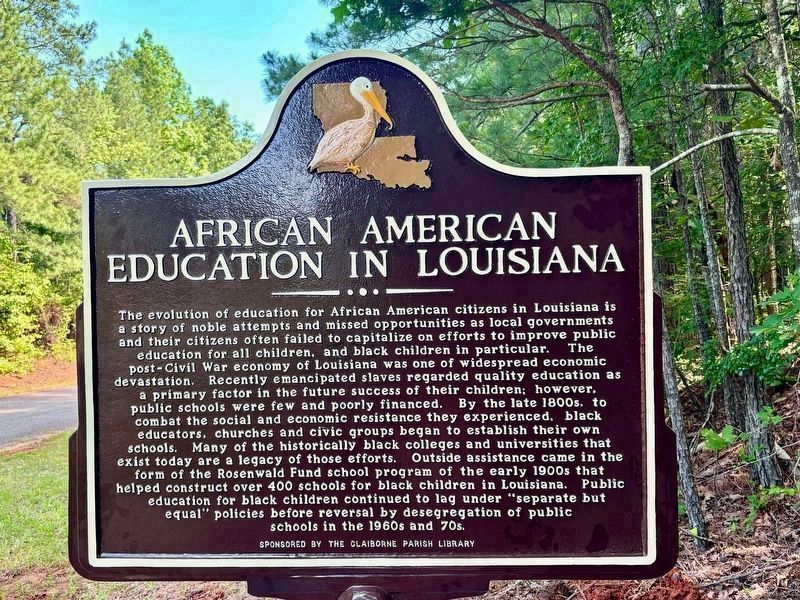
African American Education in Louisiana. The evolution of education for African American citizens in Louisiana is a story of noble attempts and missed opportunities as local governments and their citizens often failed to capitalize on efforts to improve public education for all children, and black children in particular. The post-Civil War economy of Louisiana was one of widespread economic devastation. Recently emancipated slaves regarded quality education as a primary factor in the future success of their children; however, public schools were few and poorly financed to combat the social and economic resistance they experienced. By the late 1800s black educators, churches and civic groups began to establish their own schools. Many of the historically black colleges and universities that exist today are a legacy of those efforts. Outside assistance came in the form of the Rosenwald Fund school program of the early 1900s that helped construct over 400 schools for black children in Louisiana. Public education for black children continued to lag under "separate but equal policies before reversal by desegregation of public schools in the 1960s and 70s.
Homer College (CME)
On December 15, 1879, a committee appointed by Bishop J.E. Bebee of the Colored Methodist Episcopal Church of America purchased 80 acres surrounding this marker for the construction of a "colored institution of learning." When the project halted over disagreement within the Louisiana Conference, Isaac Bullock, a local CME minister, and other prominent citizens of Homer persisted and established a private school southwest of town known as "Homer Seminary." In 1893 the Conference bought Homer Seminary and relocated it here. The school's four buildings included a large two-story administration hall with offices, parlor, music room, library reading room, laboratory, eight recitation rooms and a chapel seating 500. Three other buildings were dormitories. Courses of study were divided into elementary, college preparatory and college level. In 1910 the school's name was changed to "Homer College." During its heyday, Homer College hosted such dignitaries as George Washington Carver and the renowned vocalist Emma Azalia Hackley. Homer College operated until 1918 when the Conference withdrew support and closed the school.
Reverse Side
African American Education in Louisiana
The evolution of education for African American citizens in Louisiana is a story
Click or scan to see this page online
of noble attempts and missed opportunities as local governments and their citizens often failed to capitalize on efforts to improve public education for all children, and black children in particular. The post-Civil War economy of Louisiana was one of widespread economic devastation. Recently emancipated slaves regarded quality education as a primary factor in the future success of their children; however, public schools were few and poorly financed to combat the social and economic resistance they experienced. By the late 1800s black educators, churches and civic groups began to establish their own schools. Many of the historically black colleges and universities that exist today are a legacy of those efforts. Outside assistance came in the form of the Rosenwald Fund school program of the early 1900s that helped construct over 400 schools for black children in Louisiana. Public education for black children continued to lag under "separate but equal policies before reversal by desegregation of public schools in the 1960s and 70s.
Location. 32° 46.103′ N, 93° 3.69′ W. Marker is in Homer, Louisiana, in Claiborne Parish. It is on Lyons Hill Road one mile north of Hill Farm Road, on the right when traveling north. Touch for map. Marker is in this post office area: Homer LA 71040, United States of America. Touch for directions.

Regionally, this marker is in North Louisiana. It is also in the American South, specifically in the Deep South, and in the Piney Woods. Globally, it is in North America, a Gulf of Mexico state, the Western Hemisphere, the Western World, and the Anglosphere. Historically, it finds itself in what was once the territory of the Mississippian Culture, the Louisiana Purchase, one of the Confederate States of America, and the Antebellum South.
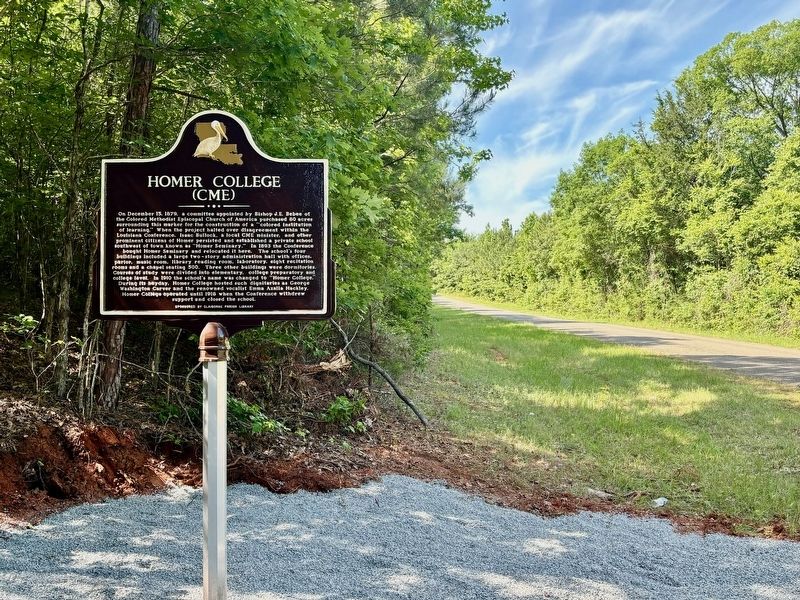
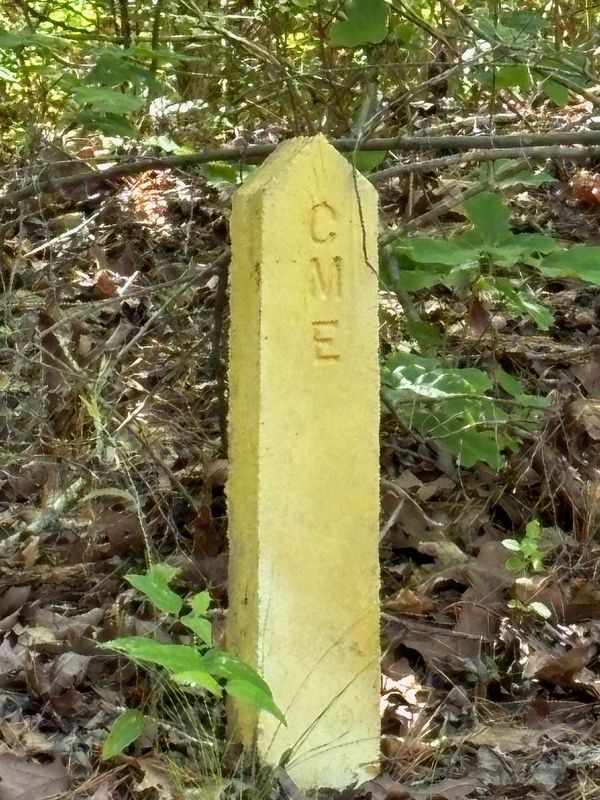
Regarding Homer College (CME) / African American Education in Louisiana. Marker is on the boundary of the school property marked by yellow concrete posts. The property is still owned by the church, now known as the Christian Methodist Episcopal Church. There are no buildings remaining
Photographed by Wesley Harris, May 10, 2024
3. Homer College (CME) Marker
on the property.
Additional commentary. 1. The text of this marker was researched, composed and submitted to the Louisiana State Office of Tourism by Vincent P. Ory and Beverly E. Smith of Claiborne Parish. The Claiborne Parish Library was Sponsor. Special mention goes to Mr. Jules E. Colvin and Rev. Elmer T. Jones, CME for technical assistance.
— Submitted June 1, 2025, by Vincent P. Ory of Lisbon, Louisiana.
Photographed by Wesley Harris, May 10, 2024
4. Homer College property boundary marker
Photographed by Wesley Harris
5. Homer College (CME) / African American Education in Louisiana Marker
Credits. This page was last revised on June 14, 2025. It was originally submitted on May 10, 2024, by Wesley Harris of Ruston, Louisiana. This page has been viewed 883 times since then and 65 times this year. Photos:1, 2, 3, 4, 5. submitted on May 10, 2024, by Wesley Harris of Ruston, Louisiana. • James Hulse was the editor who published this page.