Saint-Denis in Seine-Saint-Denis, Île-de-France, France — Western Europe
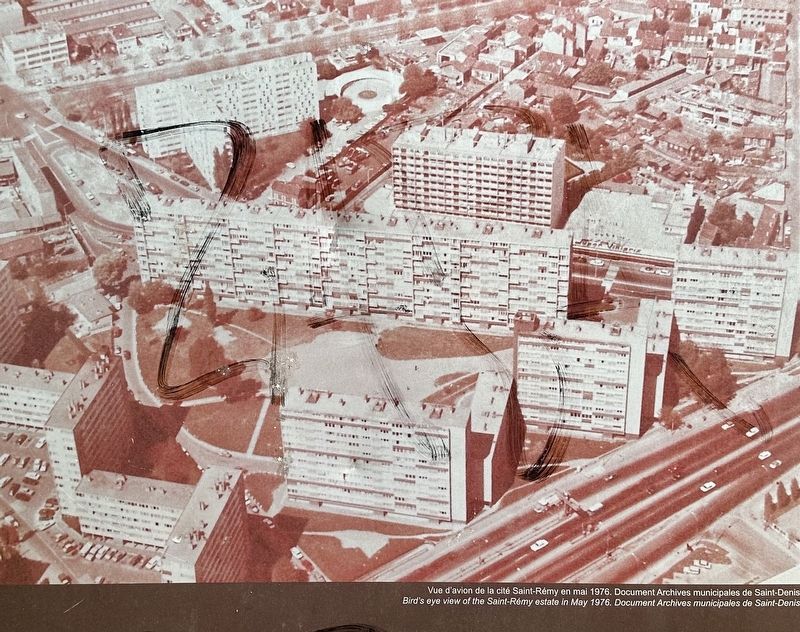
La cité Saint-Rémy ⎯⎯⎯ The estate of Saint-Rémy
Photographed by Andrew Ruppenstein, April 18, 2024
1. La cité Saint-Rémy / The estate of Saint-Rémy Marker
Inscription.
En 1945, afin de répondre à la
demande croissante de logements, est
créé l'Office public d'habitation à bon
marché (OPHBM) qui deviendra l'Office
public d'habitation à loyer modéré
(OPHLM). Dans le cadre de la politique
municipale de logement social,
l'architecte André Lurçat réalise une
série de grands ensembles
comprenant équipements scolaires,
crèches, centres sportifs et
commerciaux, espaces verts. À partir
de 1954, l'État impose l'abaissement
du coût de la construction. En 1956,
l'architecte Fernand Ottin construit le
«Parc Saint-Rémy» qui répond à cette
recherche de rentabilité. Les
immeubles sont édifiés selon la
technique de l'ossature en béton armé
avec des cloisons en briques creuses
et des escaliers préfabriqués. Sept
bâtiments de onze étages et quatre
bâtiments à cinq niveaux offrent le
«confort moderne». Depuis, la cité a
été subdivisée en deux. En 2006 un
financement de l'Agence Nationale
pour la Rénovation Urbaine (ANRU) est
obtenu et, débute en 2010, la
rénovation des 412 logements de
Saint-Rémy Nord.
In 1945, the Public office of affordable
housing was created (OPHBM),
Click or scan to see this page online
which
later became the Public office of
accommodation with moderate rent
(OPHLM). As part of the local policy on
social housing, the architect André
Lurçat conceived a series of large
blocks of housing incorporating
schools, nurseries, sports and
shopping centres as well as green
areas. From 1954, the State imposed a
reduction on building costs. In 1956,
the architect Fernand Ottin builds the
«Saint-Rémy», responding to
this search for affordable
construction costs. These buildings
were erected following the technique
of reinforced concrete for the
structure, and partitions made of
hollow bricks,
well as
pre-fabricated staircases. Seven
buildings of eleven storeys and four
blocks on five levels therefore offered
« modern comfort». Since then, the
estate has been subdivided in two. In
2006, some funding from the Agence
Nationale pour la Rénovation Urbaine
(ANRU) was obtained and enabled the
start of the refurbishment of 412
accommodations in Saint-Rémy Nord.
Topics. This historical marker is listed in this topic list: Architecture. A significant historical year for this entry is 1945.
Location. 48° 56.164′ N, 2° 22.096′ E.
Photographed by Andrew Ruppenstein, April 18, 2024
2. La cité Saint-Rémy / The estate of Saint-Rémy Marker - wide view
The marker is the rightmost of the two stelae visible here.
Marker is in Saint-Denis, Île-de-France, in Seine-Saint-Denis. It is on Rue de Strasbourg, on the right when traveling west. The marker is in the mini-park on the north side of Rue de Strasbourg and is easily visible from the road. Touch for map. Marker is in this post office area: Saint-Denis, Île-de-France 93200, France. Touch for directions.
Regionally, it is in the North Atlantic Region,Europe, the European Union, Atlantic Europe, the Schengen Area, Western Europe, a coastal Mediterranean country, and the Western World. Historically, it finds itself in what was once a French colony and also the Roman Empire.
Credits. This page was last revised on May 10, 2024. It was originally submitted on May 10, 2024, by Andrew Ruppenstein of Lamorinda, California. This page has been viewed 125 times since then and 15 times this year. Photos:1, 2, 3. submitted on May 10, 2024, by Andrew Ruppenstein of Lamorinda, California.