San Marco in Venezia in Città Metropolitana di Venezia, Venetia, Italy — Southern and Western Europe (Mediterranean)
Palazzo Ducale
Piazza San Marco patrimonio dell'umanità
⎯⎯⎯
Doge's Palace
St. Mark's Square a World Heritage site
Photographed by James Hulse, March 6, 2024
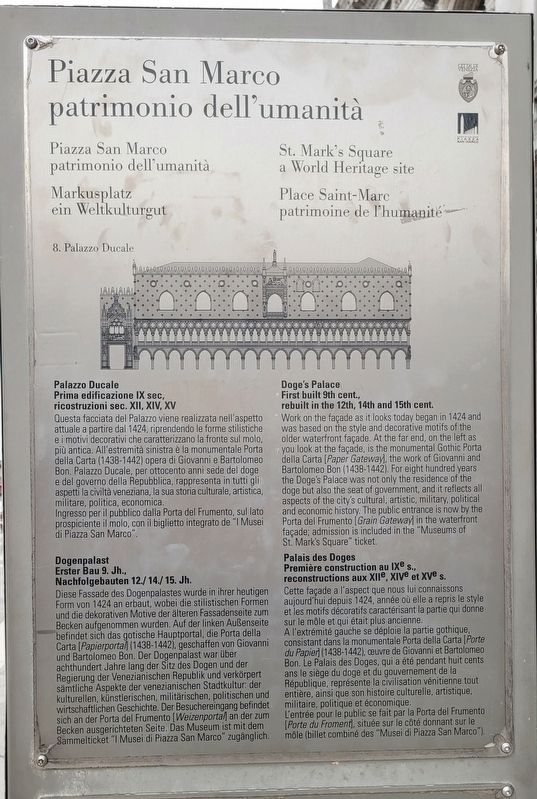
1. Palazzo Ducale / Doge's Palace Marker

Palazzo Ducale
Prima edificazione IX sec,
ricostruzioni sec. XII, XIV, XV
Piazza San Marco patrimonio dell'umanità
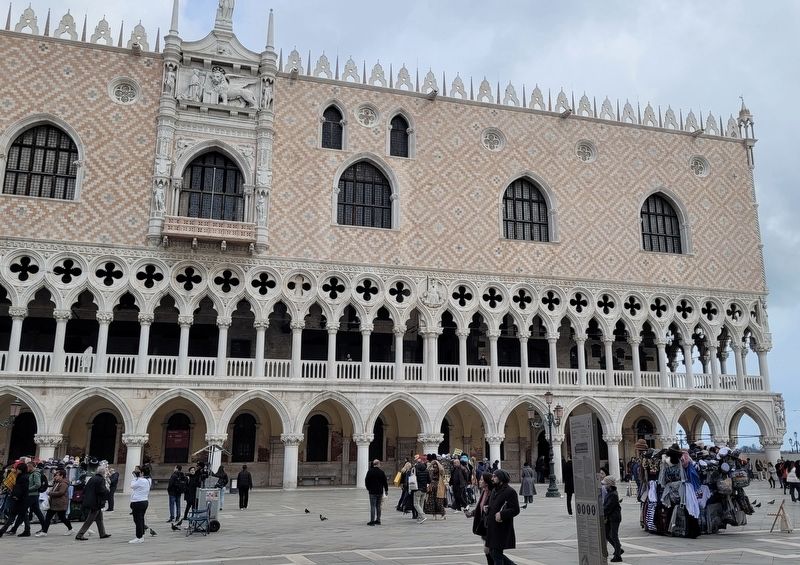
Questa facciata del Palazzo viene realizzata nell'aspetto attuale a partire dal 1424, riprendendo le forme stilistiche e i motivi decorativi che caratterizzano la fronte sul molo, più antica. All'estremità sinistra è la monumentale Porta della Carta (1438-1442) opera di Giovanni e Bartolomeo Bon. Palazzo Ducale, per ottocento anni sede del doge e del governo della Repubblica, rappresenta in tutti gli aspetti la civiltà veneziana, la sua storia culturale, artistica, militare, politica, economica. Ingresso per il pubblico dalla Porta del Frumento, sul lato prospiciente il molo, con il biglietto integrato de "I Musei di Piazza San Marco".
Doge's Palace
First built 9th cent.,
rebuilt in the 12th, 14th and 15th cent.
St. Mark's Square a World Heritage site
Work on the façade as it looks today began in 1424 and was based on the style and decorative motifs of the older waterfront façade. At the far end, on the left as you look at the façade, is the monumental Gothic Porta della Carta [Paper Gateway], the work of Giovanni and Bartolomeo Bon (1438-1442). For eight hundred years the Doge's Palace was not only the residence of the doge but also the seat of government, and it reflects all aspects of the city's cultural, artistic, military, political and economic history. The public entrance is now by the Porta del Frumento [Grain Gateway] in the waterfront façade; admission is included in the "Museums of St. Mark's Square" ticket.
Dogenpalast Erster Bau 9. Jh.
Nachfolgebauten 12./14./15. Jh.
Markusplatz ein Weltkulturgut
Diese Fassade des Dogenpalastes wurde in ihrer heutigen Form von 1424 an erbaut, wobei die stilistischen Formen und die dekorativen Motive der
this page online
Palais des Doges
Première construction au IXe s.,
reconstructions aux XIIe, XIVe et XVe s.
Place Saint-Marc patrimoine de l'humanité
Cette façade a l'aspect que nous lui connaissons aujourd'hui depuis 1424, année où elle a repris le style et les motifs décoratifs caractérisant la partie qui donne sur le môle et qui était plus ancienne. A l'extrémité gauche se déploie la partie gothique, consistant dans la monumentale Porta della Carta [Porte du Papier]
Photographed by James Hulse, March 6, 2024
2. The Doge's Palace and Marker
Erected by Città di Venezia. (Marker Number 8.)
Topics. This historical marker is listed in this topic list: Notable Buildings. A significant historical year for this entry is 1424.
Location. 45° 26.024′ N, 12° 20.364′ E. Marker is in Venezia, Veneto (Venetia), in Città Metropolitana di Venezia. It is in San Marco. It is at the intersection of Piazzetta San Marco and Piazzas San Marco, on the right when traveling south on Piazzetta San Marco. The marker is located in the Piazzetta San Marco. Touch for map. Marker is in this post office area: Venezia, Veneto 30124, Italy. Touch for directions.

Regionally, it is in Europe, the European Union, the Schengen Area, a coastal Mediterranean
Photographed by James Hulse, March 6, 2024
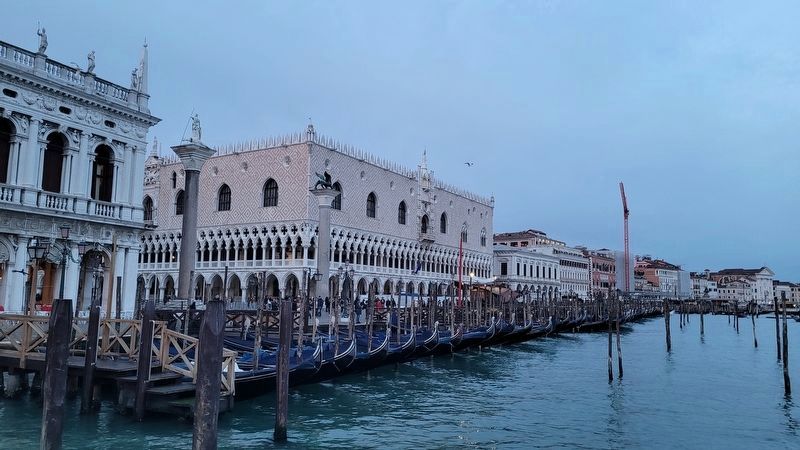
3. The view of the Doge's Palace from the Grand Canal
Other nearby markers. At least 8 other markers are within walking distance of this marker: Libreria Sansoviniana / Sansovino's Library (a few steps from this marker); Loggetta e Campanile / Loggetta and Bell-Tower (within shouting distance of this marker); Basilica San Marco / St. Mark's Basilica (within shouting distance of this marker); Zecca / The Mint (within shouting distance of this marker); Procuratie Nuove (within shouting distance of this marker); Piazzetta dei Leoncini (about 90 meters away, measured in a direct line); Torre dell'Orologio / Clock Tower (about 120 meters away); Ala Napoleonica / Napoleonic Wing (about 120 meters away). Touch for a list and map of all markers in Venezia.
Also see . . . Doge's Palace. Wikipedia
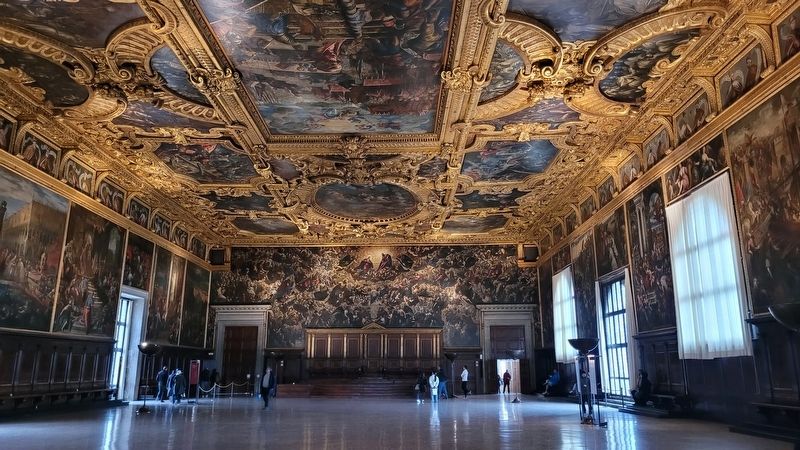
The Doge's Palace (Italian: Palazzo Ducale; Venetian: Pałaso Dogal) is a palace built in Venetian Gothic style, and one of the main landmarks of the city of Venice in northern Italy. The palace was the residence of the Doge of Venice, the supreme(Submitted on May 13, 2024, by James Hulse of Medina, Texas.)authority of the former Republic of Venice. It was built in 1340 and extended and modified in the following centuries. It became a museum in 1923 and is one of the 11 museums run by the Fondazione Musei Civici di Venezia.Photographed by James Hulse, March 7, 20244. The Chamber of the Great Council in the Doge's Palace
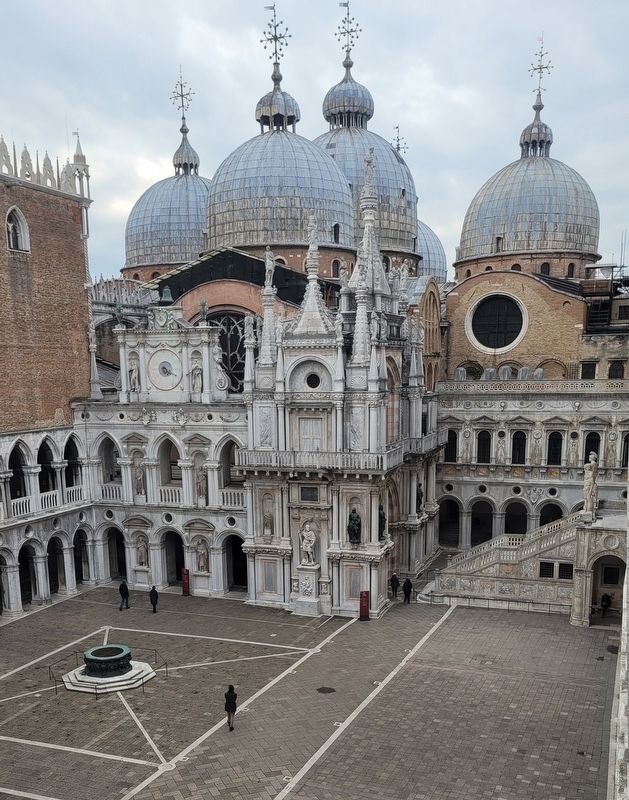
Photographed by James Hulse, March 7, 2024
5. The Courtyard of the Doge's Palace
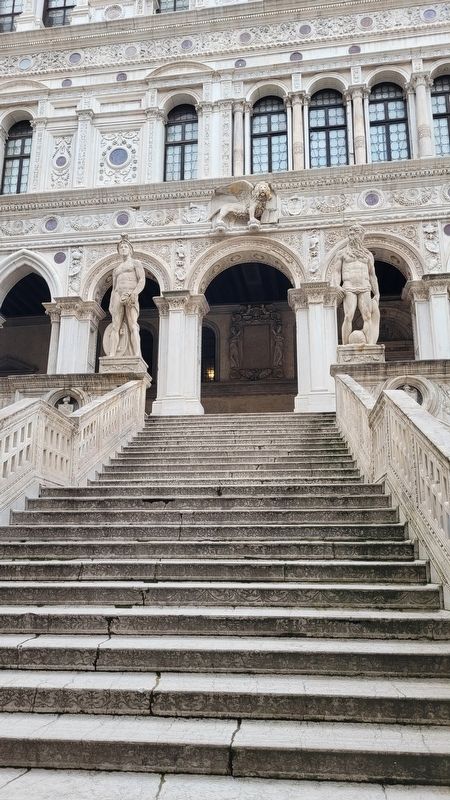
Photographed by James Hulse, March 7, 2024
6. The Scala dei Giganti of the inner courtyard of the Doge’s Palace
Two statues, Mars and Neptune, stand at the top of the Scala dei Giganti (Giants’ Staircase) and they represents the power of Venice over land and sea.
Credits. This page was last revised on May 14, 2024. It was originally submitted on May 13, 2024, by James Hulse of Medina, Texas. This page has been viewed 146 times since then and 18 times this year. Photos: 1, 2, 3, 4, 5, 6. submitted on May 13, 2024, by James Hulse of Medina, Texas.
